


Crypto traders often ask which companies are the best free RPC providers. The answer is that there is no universally fastest RPC provider. To compare the best low-latency RPC node providers for automated trading bots on blockchains such as Solana, Ethereum, Hyperliquid, Base, web3, blockchain apps, NFT, and DeFi data in 2026, you should consider a few criteria.
In this article, we have compared Chainstack, Alchemy, and QuickNode as the three pioneering RPC providers for crypto trading based on blockchain, geographic location, RPC method, and workload. We used publicly available performance data from Chainstack Compare as our primary dataset.
How RPC Providers Work and Why They Matter
RPC stands for Remote Procedure Call. In blockchain, RPC is essentially the method an application, such as a trading bot, wallet, or trading platform, uses to communicate with a blockchain node.
Technically, you can run and maintain your own node, but doing so typically requires significant infrastructure, maintenance, monitoring, and scaling. Instead, you can use an RPC provider, which manages the underlying infrastructure and provides RPC endpoints that allow your application to communicate with the blockchain without directly managing nodes.
In other words, RPC acts as the communication layer between trading infrastructure and blockchain nodes.
How to Choose The Best RPC Providers for Trading
For a typical wallet, a slightly slower RPC response may not matter much. In a latency-sensitive trading system, however, RPC performance can directly affect execution. For example, suppose you are running a Hyperliquid funding rate arbitrage strategy, and your bot identifies a profitable opportunity. If the RPC endpoint is slow, rate-limited, or temporarily unavailable, the arbitrage opportunity may disappear before the transaction reaches the network.
That is why, for trading, RPC access is not enough. Factors such as latency, throughput/RPS, uptime, geographic coverage, rate limits, WebSocket performance, transaction propagation, failover, and overall reliability also matter.
How We Evaluated RPC Providers for Trading
RPC performance for trading heavily depends on the blockchain, geographic location, RPC method, and workload being tested. A provider that delivers low latency in one environment may perform differently under another. For this reason, we at Finestel avoid treating a single network or global latency figure as representative of a provider’s overall performance, particularly when evaluating latency and reliability.
For our performance comparison, we use publicly available data from Chainstack Compare to examine P50, P95, and P99 latency alongside availability across multiple networks and three geographic regions. Rather than selecting a single blockchain as representative of all trading workloads, we look for performance patterns that remain consistent across networks and regions.
Chainstack Compare collects RPC performance data through serverless functions deployed across multiple geographic regions. The service sends API calls to each provider every 1–3 minutes and measures response time and request success. It tests commonly used RPC methods, including balance checks, transaction simulations, and block queries, with the exact method set varying by blockchain.
This methodology is not intended to identify a universally fastest RPC provider. Instead, it helps us evaluate how consistently each provider performs across different network and geographic conditions relevant to trading infrastructure.
Chainstack Compare Data
The table below compares the 7-day performance of Alchemy, QuickNode, and Chainstack across Ethereum, Solana, Base, and Hyperliquid on August 28, 2026:
| Network | Provider | Availability | P50 | P95 | P99 | DE P95 | US P95 | Asia P95 |
| Ethereum | Alchemy | 99.97% | 35 ms | 83 ms | 150 ms | 74 ms | 104 ms | 71 ms |
| QuickNode | 99.97% | 98 ms | 158 ms | 188 ms | 104 ms | 174 ms | 196 ms | |
| Chainstack | 99.97% | 52 ms | 161 ms | 359 ms | 167 ms | 259 ms | 57 ms | |
| Solana | QuickNode | 99.99% | 25 ms | 56 ms | 98 ms | 23 ms | 52 ms | 93 ms |
| Alchemy | 99.99% | 46 ms | 722 ms | 981 ms | 1.95 s | 119 ms | 103 ms | |
| Chainstack | 99.18% | 51 ms | 729 ms | 888 ms | 1.96 s | 96 ms | 137 ms | |
| Base | QuickNode | 99.99% | 33 ms | 76 ms | 129 ms | 61 ms | 90 ms | 77 ms |
| Chainstack | 99.82% | 44 ms | 540 ms | 1.15 s | 1.27 s | 188 ms | 165 ms | |
| Alchemy | 99.98% | 123 ms | 850 ms | 1.90 s | 147 ms | 2.28 s | 124 ms | |
| Hyperliquid | Chainstack | 99.88% | 11 ms | 48 ms | 120 ms | 24 ms | 53 ms | 68 ms |
| QuickNode | 99.97% | 54 ms | 82 ms | 115 ms | 22 ms | 87 ms | 138 ms | |
| Alchemy | 99.99% | 56 ms | 102 ms | 179 ms | 50 ms | 165 ms | 92 ms |
As we can see from the table above, Chainstack delivered the lowest P50 latency on Hyperliquid (11 ms), while results were more mixed on Ethereum, Solana, and Base — reinforcing that RPC selection should be evaluated per network. Chainstack’s Hyperliquid nodes also expose the /nanoreth endpoint by default, giving indexers and analytics pipelines access to system transactions that the standard /evm path strips out.
Top 3 Best RPC Providers for Trading in 2026 Compared
Chainstack, Alchemy, and QuickNode are the three established RPC providers with infrastructure suitable for latency-sensitive and automated trading workloads. Below, we cover what each provider offers, supported chains, and who it is best for.
The table below shows a quick comparison between these top three RPC providers:
| Feature | Chainstack | Alchemy | QuickNode |
| Free Tier | Yes;
– 3M requests – Extra usage, per 1M request units costs $20 – Global Node – Node analytics – 1 included project – Unlimited Included users And more |
Yes;
– 15 requests per second – 5 apps & 5 webhooks – Free 30M CU per month – Full developer platform – All mainnets & testnets – Standard support – Node API – Smart WebSockets And more |
1-month free trial:
– 10M API credits – 15 requests per second – Community support |
| Pricing Plans (Monthly) | – Growth: $49/mo
– Pro: $199/mo |
– Pay as You Go: Pay for what you use.
– Enterprise: Contact sales |
– Build: $49/mo
– Accelerate: $249/mo – Scale: $499/mo |
| Supported Networks | 70+ chains | 100+ chains | 67+ chains |
| gRPC / Streaming | Yes; Yellowstone gRPC (Solana) | Yes; Yellowstone-compatible gRPC (Solana) | Yes; Yellowstone gRPC (Solana) + HyperCore gRPC (Hyperliquid) |
| Best For | DeFi applications and Hyperliquid trading | Ethereum-focused trading & developer tooling | Latency-sensitive multi-chain trading |
Chainstack
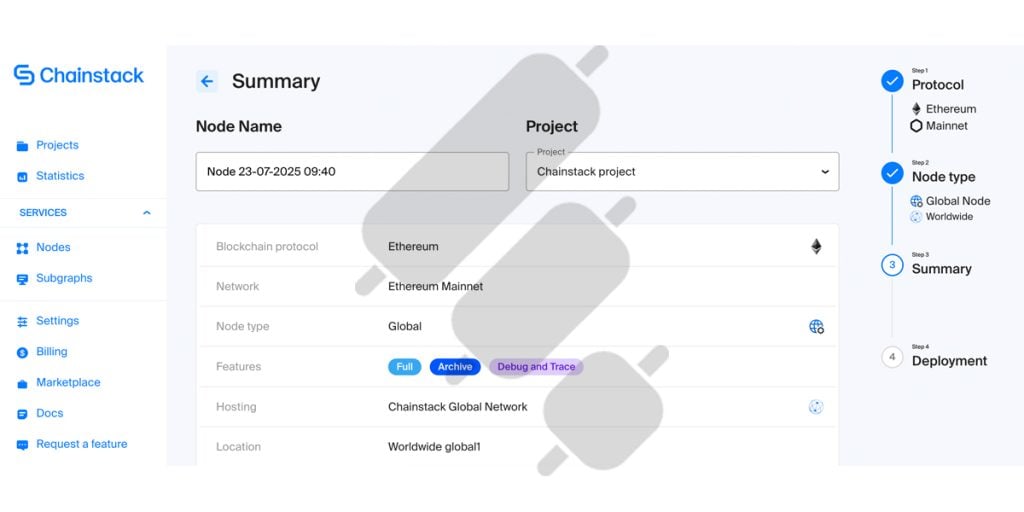
Chainstack operates at the infrastructure layer; the part that most trading platforms quietly depend on but rarely talk about. Chainstack provides managed blockchain node infrastructure and RPC endpoints across 70+ chains, including Ethereum, Solana, BNB Smart Chain, Arbitrum, Hyperliquid, and Robinhood Chain. Instead of running self-hosted nodes, traders connect through Chainstack’s globally distributed network and get reliable, low-latency RPC access from day one.
For automated trading platforms, this matters directly. Trading bots and AI agents need to read on-chain state, watch mempool activity, submit transactions, and interact with smart contracts, not just price feeds. Common use cases include:
- monitoring pending transactions and mempool activity,
- interacting with smart contracts across multiple chains,
- reading DeFi protocol state (liquidity pools, oracle prices),
- and executing multi-chain operations reliably at scale.
The Yellowstone gRPC endpoint for Solana is specifically relevant for high-frequency trading bots and MEV operations requiring sub-second data streams.
Strengths
- Managed node infrastructure across 70+ blockchain networks
- Dedicated nodes and gRPC streaming for latency-sensitive workloads
- Elastic scaling without infrastructure overhead
- MCP server for AI agent and LLM integration
- SOC 2 Type II and ISO 27001 certified — relevant for compliance-sensitive trading infrastructure
Tradeoffs
- Focused on infrastructure, not market data or order execution
- Best results require familiarity with RPC APIs and blockchain primitives
Best for
Chainstack is a strong fit for DeFi applications, on-chain trading bots, AI agents, and multi-chain trading systems that need managed blockchain infrastructure without the operational overhead of running their own nodes.
Our benchmark also shows why performance should be evaluated on a network-by-network basis, and Chainstack delivered particularly strong latency on Hyperliquid, while results varied across Ethereum, Solana, and Base.
Read more about the best Hyperliquid bots in 2026.
Alchemy
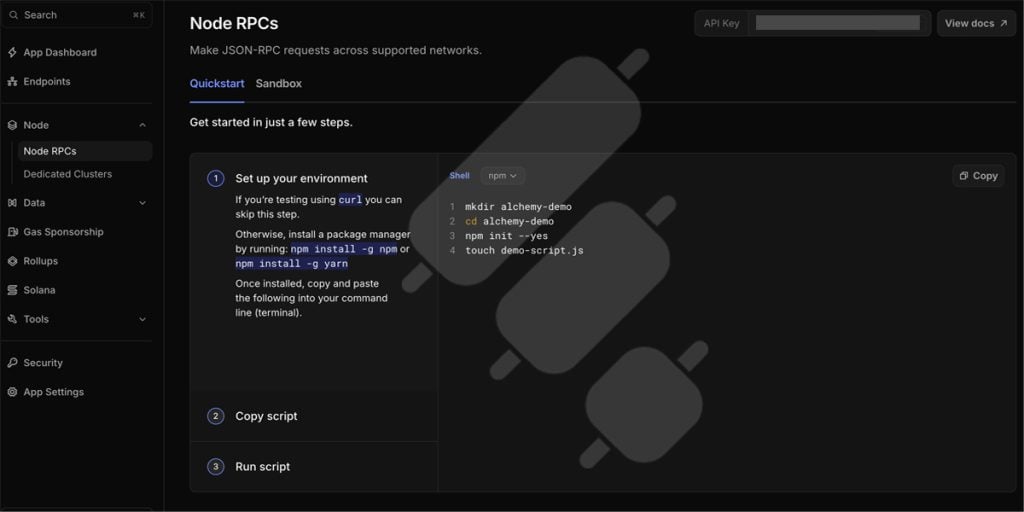
Alchemy is a managed blockchain infrastructure platform providing RPC access and developer APIs across major EVM and non-EVM networks, including Ethereum, Base, Arbitrum, Solana, and Hyperliquid.
For trading applications, Alchemy offers infrastructure for monitoring on-chain activity, interacting with smart contracts, submitting transactions, and consuming real-time blockchain data.
Strengths
- WebSocket support for real-time blockchain events and transaction monitoring
- Yellowstone-compatible gRPC for latency-sensitive Solana data streaming
- Extensive developer APIs and tooling beyond standard RPC access
Tradeoffs
- Regional performance can vary substantially
- Some advanced capabilities are network-specific rather than uniformly available across every supported blockchain
Best for
Alchemy is a strong fit for trading platforms and on-chain applications that prioritize high availability, strong Ethereum performance, broad developer tooling, and access to both standard RPC and real-time data infrastructure.
Based on our benchmark, it stands out particularly for Ethereum workloads, while latency-sensitive teams operating across Solana, Base, or Hyperliquid should evaluate regional and network-specific performance before choosing it as their primary RPC provider.
Quicknode
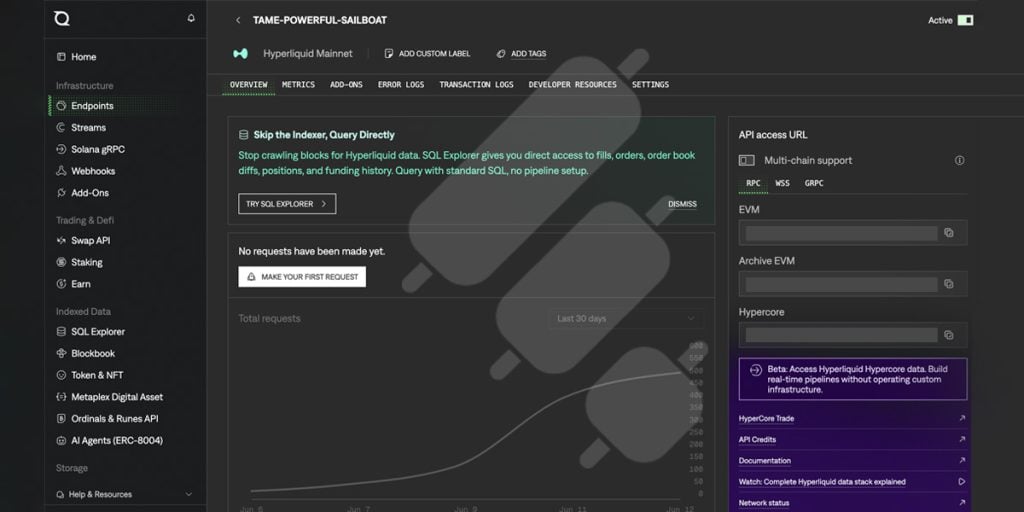
QuickNode provides managed blockchain infrastructure and RPC access across major networks, with dedicated solutions for trading and other latency-sensitive applications.
Trading bots and execution systems can use its infrastructure to stream real-time on-chain data, monitor transactions and market activity, interact with DEXs and smart contracts, and submit transactions with low latency.
It also offers trading-focused tools for high-frequency data streaming and transaction execution, reducing the need for teams to build and maintain their own node infrastructure.
Strength
- Dedicated trading infrastructure combining RPC, real-time data streaming, transaction broadcasting, and execution APIs.
- Solana gRPC (Yellowstone-compatible) for low-latency account and transaction streams.
- Multi-Region Broadcast for submitting transactions across multiple regions.
Tradeoffs
- Some of the specialized trading capabilities are chain-specific; for example, Metis and Yellowstone gRPC target Solana, while HyperCore gRPC and the Exchange API target Hyperliquid.
- Advanced infrastructure such as Solana gRPC may depend on the selected plan or add-on.
Best for
Based on our test results, QuickNode is best suited for latency-sensitive, multi-chain trading systems that prioritize consistently low response times. It delivered the lowest P95 latency on Solana (56 ms) and Base (76 ms), while maintaining 99.97% or higher availability across all four tested networks.
Final Thoughts
Choosing the best RPC providers for trading is less about finding a universally fastest service and more about finding the infrastructure that performs well for your specific network, region, and workload.
Our seven-day comparison reflects this clearly. Alchemy recorded the lowest P95 latency on Ethereum, QuickNode led on Solana and Base, and Chainstack delivered the lowest P95 latency on a Hyperliquid trading bot. QuickNode showed the strongest cross-network latency consistency overall, while Alchemy maintained particularly high availability and Chainstack stood out on Hyperliquid.
FAQs
Can I use multiple RPC providers for one trading bot?
Yes. Production trading systems can use multiple RPC providers for redundancy, failover, or routing requests based on network and regional performance.
Are free RPC endpoints suitable for trading bots?
They can work for development and low-volume strategies, but their rate limits, shared resources, and reliability constraints can make them unsuitable for latency-sensitive or high-volume trading.
Is WebSocket better than HTTP RPC for crypto trading?
Neither is universally better. HTTP RPC is commonly used for individual requests and transaction submission, while WebSockets are useful for continuously receiving real-time events and blockchain updates.
Should I use a dedicated RPC node for a trading bot?
It depends on the workload. High-frequency or high-volume systems may benefit from dedicated infrastructure because resources are not shared with other customers, while smaller bots may perform adequately on shared RPC infrastructure.



Leave a Reply