
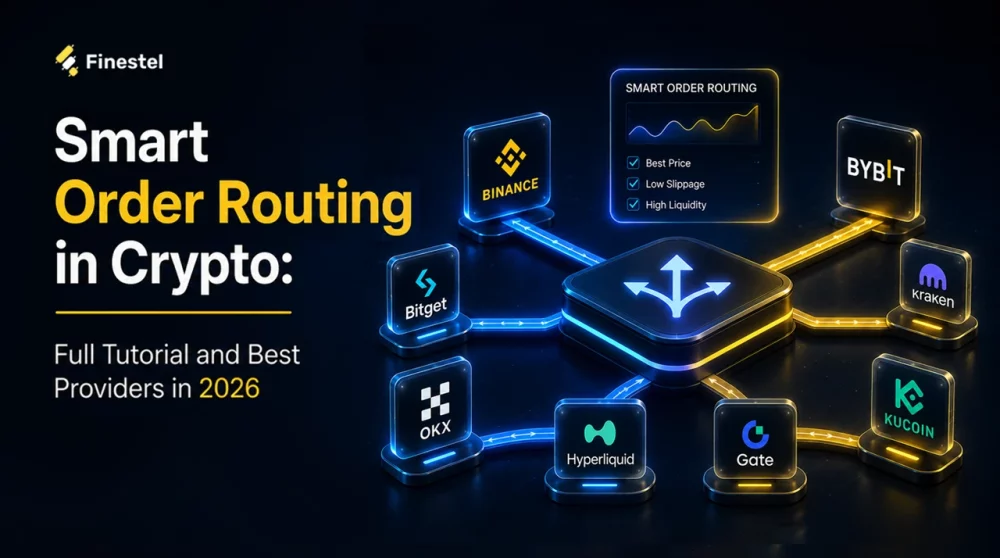

Smart Order Routing (SOR) algorithm is a crypto trading tool that automatically routes your orders to the exchanges that provide the most favorable price, liquidity, and execution speed. SOR splits huge orders across different exchanges to secure top deals, which ensures traders receive ideal outcomes without needing to manage orders manually.
However, SOR cannot guarantee the best price or eliminate slippage, and its effectiveness depends heavily on venue connectivity, available balances, market-data quality, latency, and routing rules.
When we analyze execution workflows for professional traders and asset managers, SOR delivers the most value when handling large orders in fragmented or fast-moving markets, but only when it is paired with real-time monitoring, sensible risk limits, and post-trade execution analysis.
What is Smart Order Routing (SOR) and How Does it Work?
Picture this: you’re shopping for a flight. You have the choice of booking the first flight option shown or employing a search tool that reviews all airlines to discover the lowest-priced ticket. SOR is that tool for crypto trading.
A smart order router seeks the best available execution outcome across its connected venues, considering executable price, fees, liquidity, latency, fill probability, settlement, and market impact. It does not guarantee the best price or eliminate slippage.
The origins of SOR trace back to traditional stock markets from decades ago. Traders who seek every advantage now depend on crypto market lifelines because of its fragmented markets and dominant volatility.
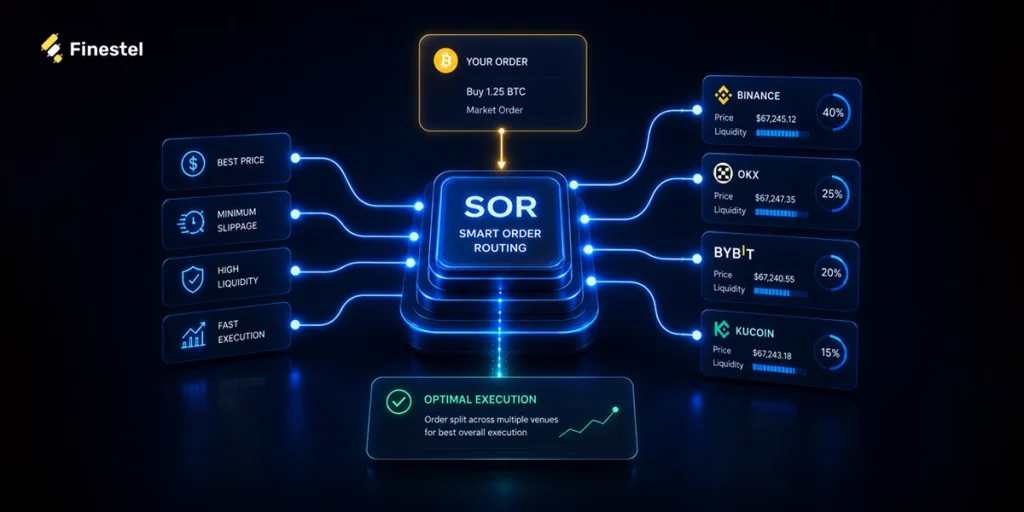
Smart Order Routing workflow includes the steps below:
- Order Splitting: Got a big trade? SOR divides your large order into smaller parts and distributes them across different trading venues to prevent price spikes.
- Real-Time Price Discovery: The system constantly searches for the optimal price deal by monitoring platforms such as Binance and Coinbase and decentralized exchanges in real time.
- Liquidity Aggregation: SOR integrates liquidity from both centralized (CEX) and decentralized (DEX) exchanges to eliminate delays caused by a lack of buyers or sellers. Read more about liquidity challenges and solutions in 2026.
Smart Routing vs. Direct Routing: What’s the Difference?
If you are uncertain about how Smart Order Routing compares to direct routing, Here’s a quick breakdown:
| Feature | Direct Routing | Smart Routing (SOR) |
| Execution Venue | Sends your order to one exchange you pick. | Routes to the best exchange(s) automatically. |
| Liquidity | Limited to that exchange; slippage risk is high. | Pulls liquidity from many sources for stability. |
| Price Optimization | You might miss cheaper options elsewhere. | Helps find the best price. |
| Best For | Small, fast trades on a trusted platform. | Big trades, arbitrage, or volatile markets. |
When to Use Each: Direct routing is the optimal choice for small trades where speed takes precedence over cost savings. SOR represents the optimal choice for executing larger transactions or when seeking arbitrage opportunities.
SOR vs Other Execution Algorithms and Trading Methods
Smart Order Routing is often confused with other execution and trading methods because these systems may work together within the same platform. However, each serves a distinct purpose:
- SOR determines where an order should be executed.
- Execution algorithms determine how and when it should be placed.
- Arbitrage engines identify trading opportunities.
- Order management systems coordinate the broader trading workflow.
The table below shows a quick recap of how these methods are different:
| Methods | Primary Function |
| Smart Order Routing (SOR) | Selects, splits, and reroutes orders across connected venues based on factors such as executable price, liquidity, fees, latency, and fill probability. |
| TWAP, VWAP, and POV Algorithms | Determine the timing, size, and pace of child orders to reduce market impact when executing a larger parent order. |
| DEX Aggregator | Searches on-chain liquidity sources and identifies an efficient swap route across decentralized exchanges, pools, and intermediary tokens. |
| Arbitrage Engine | Detects price discrepancies and coordinates multiple trades to capture potential profit across venues, assets, or trading pairs. |
| OMS/OEMS | Manages the broader order lifecycle, including order entry, execution, positions, risk controls, allocations, and reporting. |
These methods are complementary rather than interchangeable. For example, an institutional trading platform may use an OEMS (Order and Execution Management System) to manage the complete order lifecycle, a TWAP order to schedule a large trade, and an SOR to decide where each child order should be sent.
Similarly, a DEX aggregator performs routing within on-chain markets but does not necessarily provide the same custody, settlement, risk management, or multi-venue functionality as an institutional SOR.
Understanding these distinctions helps traders evaluate platforms based on their actual execution needs rather than treating every order-splitting or liquidity-aggregation tool as a complete Smart Order Routing system.
Read more about which TWAP settings work best for your trades.
How SOR Achieves ‘Best Execution’
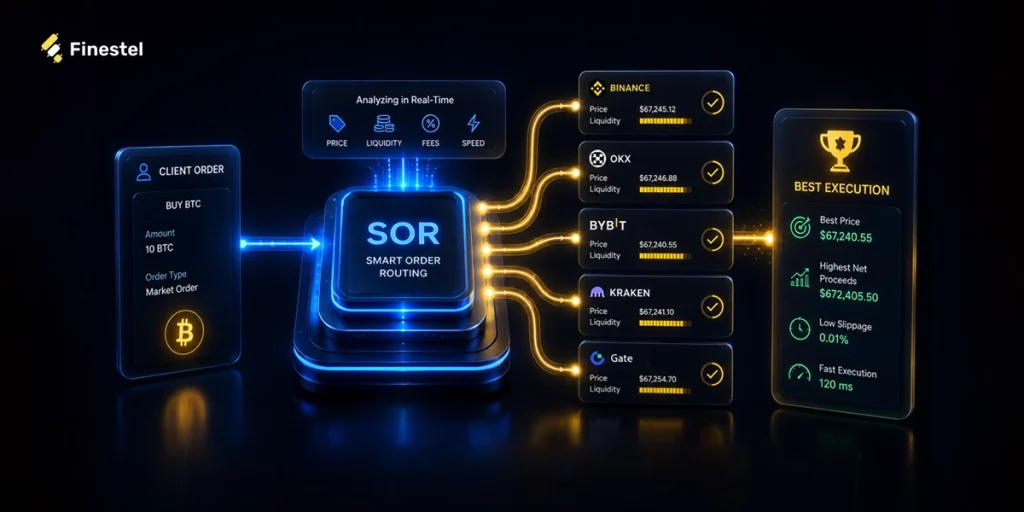
Best execution means achieving optimal results through top price performance combined with minimal slippage, all while delivering fast delivery. SOR delivers it like this:
- Dynamic Order Splitting: Say you’re buying 10 ETH. SOR could allocate 4 ETH to Kraken while sending 3 ETH to Binance and another 3 ETH to a DEX to achieve optimal pricing.
- Fee Awareness: SOR evaluates both trading fees and network expenses while searching for price opportunities to maximize your savings.
- Slippage Protection: SOR distributes your order through various platforms to maintain market stability and prevent your trade from causing a price surge.
Illustrative Example
Imagine Bitcoin is crashing. You want to buy 5 BTC. Your trade will become expensive if you place the entire order on a single exchange because it will increase the price mid-transaction without SOR. It divides your order across multiple platforms to secure the lower price without affecting market stability.
Myth Busting: Best execution means getting the best overall value from a trade by considering speed, fees, and market impact instead of just looking for the lowest price.
Note that Smart Order Routing may improve execution efficiency but cannot guarantee the best price, complete fills, or reduced slippage. Provider features, fees, supported venues, and regional availability may change over time. Always conduct independent research and assess the technical, market, custody, and regulatory risks before trading.
Common Mistakes Traders Make with SOR (and How to Avoid Them)

SOR is powerful, but it is not foolproof. Here are pitfalls to dodge:
Overlooking Fees
- Mistake: Obsessing over price and ignoring hidden costs.
- Fix: Choose SOR tools that focus on minimizing costs and always review the detailed terms.
Set-and-Forget Syndrome
- Mistake: Allowing SOR to operate without supervision during market turbulence leads to potential risks.
- Fix: Keep an eye on it. While SOR demonstrates intelligence in its algorithms, it fails to foresee black swan events.
Bad Asset Setup
- Mistake: The absence of funds on appropriate exchanges prevents effective strategy execution.
- Fix: Distribute your financial resources across essential trading platforms or employ SOR tools that support multiple exchanges.
Slow Connections
- Mistake: Running SOR on laggy internet, missing opportunities.
- Fix: Upgrade your setup; speed is everything in crypto.
Leading Crypto SOR and Routing Platforms in 2026
Crypto routing platforms are not directly interchangeable. Some provide institutional Smart Order Routing across centralized exchanges, OTC desks, and liquidity providers, while others specialize in decentralized swaps, embedded trading APIs, custom algorithm development, or large-order execution.
Therefore, the best platform depends on the trader’s market, order size, custody model, technical requirements, and regulatory jurisdiction.
The comparison below groups providers by their primary function instead of treating every liquidity aggregation or order-splitting product as a complete multi-venue SOR system:
| Provider | Category | Best For | Key Capabilities |
| CoinRoutes | Institutional multi-venue SOR and OEMS | Hedge funds, asset managers, market makers, and professional trading firms | Smart Order Router, multiple execution algorithms, consolidated market data, portfolio and risk tools, and Transaction Cost Analysis |
| Talos | Institutional trading platform and OEMS | Banks, brokers, hedge funds, asset managers, and OTC desks | Liquidity aggregation, Smart Order Routing, algorithmic execution, RFQ workflows, TCA, settlement, and portfolio management across centralized and decentralized venues |
| Coinbase Prime | Institutional prime brokerage and trading API | Institutions requiring execution, custody, and settlement in one environment | Multi-venue Smart Order Router, institutional custody, REST, FIX, and WebSocket APIs, market data, and post-trade workflows |
| 1inch | Non-custodial DEX aggregator | DeFi users and developers seeking efficient on-chain swaps | Pathfinder routing, transaction splitting across decentralized liquidity sources, gas-aware route optimization, and wallet-based execution |
| Finestel | Large-order execution and multi-account, multi-venue automation | Asset managers, professional traders, and businesses managing multiple exchange accounts | Large Order Advanced Execution, TWAP, DCA, bulk order execution, trading automation, multi-account management, and portfolio monitoring |
| Cybrid | Embedded crypto and stablecoin infrastructure | Fintechs building fiat, stablecoin, payment, custody, and trading products | API-based quotes and trades, access to multiple liquidity providers, fiat and crypto accounts, settlement, custody, and compliance workflows |
| Empirica | Custom algorithmic trading software | Hedge funds and institutions requiring configurable execution logic | Customizable SOR, pre-built execution algorithms, exchange connectivity, deployment support, and proprietary strategy development |
| LCX | Crypto trading platform with previously documented SOR functionality | Users seeking an integrated crypto trading environment, subject to availability | LCX has historically offered Smart Order functionality and multi-source price aggregation |
Institutional firms that need multi-venue execution, consolidated risk management, FIX connectivity, and post-trade analysis may find platforms such as CoinRoutes, Talos, and Coinbase Prime more suitable.
DeFi users primarily seeking the best available on-chain swap route may prefer 1inch, while fintech companies embedding crypto or stablecoin functionality into their own products may consider Cybrid.
Empirica is better suited to firms that need customized routing logic, whereas Finestel focuses on large-order execution, automation, and multi-account, multi-venue trading workflows.
Finestel: Turbocharge Your SOR with Large Order Smart Execution
Professional asset managers and traders seeking premier SOR services find that their large transactions depend heavily on available liquidity. Finestel’s adaptive large-order advanced execution algorithms, including DCA bot, TWAP, and Grid, provide an essential solution that effortlessly processes high-volume trading operations into successful outcomes.
The system breaks down trades to fit available liquidity, which avoids price slippage and maintains stable pricing during both active and inactive market periods. Trades execute smoothly with optimal pricing while avoiding market disruptions.
The precision of this process makes the extended duration acceptable when working with low-liquidity market pools. Finestel stands out for those who handle significant AUM since it provides the dependable SOR you need.
Through Finestel’s White Label solution, businesses can offer the full suite of Finestel services to their own clients under their company name, logo, colors, domain, and brand identity. This includes a branded trading terminal, automation bots, execution strategies, dashboards, reporting tools, and web and mobile applications, allowing clients to access the entire trading experience without seeing the Finestel brand. Contact us for more information.

How to Use SOR for Trading: The Playbook
This section details how you can optimize SOR for your needs.
- Choose the Right Platform: Select an institutional SOR for multi-exchange trading or a DEX aggregator for on-chain swaps. Compare venue coverage, fees, supported assets, execution tools, and geographic availability.
- Connect Your Accounts or Wallet: For centralized venues, complete KYC/KYB and connect approved exchanges using trade-only API or FIX credentials. For DEX routing, connect a compatible wallet, verify the network, and review token approvals carefully.
- Prepare Your Funds: CEX-based routers may require balances or credit on each connected venue. DEX users need the correct tokens and enough native currency to cover network fees.
- Set Your Rules: Configure priorities such as net price, speed, fees, slippage, liquidity, venue limits, and partial-fill handling. DEX users should also review price impact, minimum received, gas costs, and available MEV protection.
- Test and Monitor: Start with a sandbox or small order, then monitor fills, fees, rejected orders, and execution quality. Institutional setup may take several days or longer, while a self-service DEX route can usually be prepared much faster.
How Traders Use SOR for Arbitrage Trading
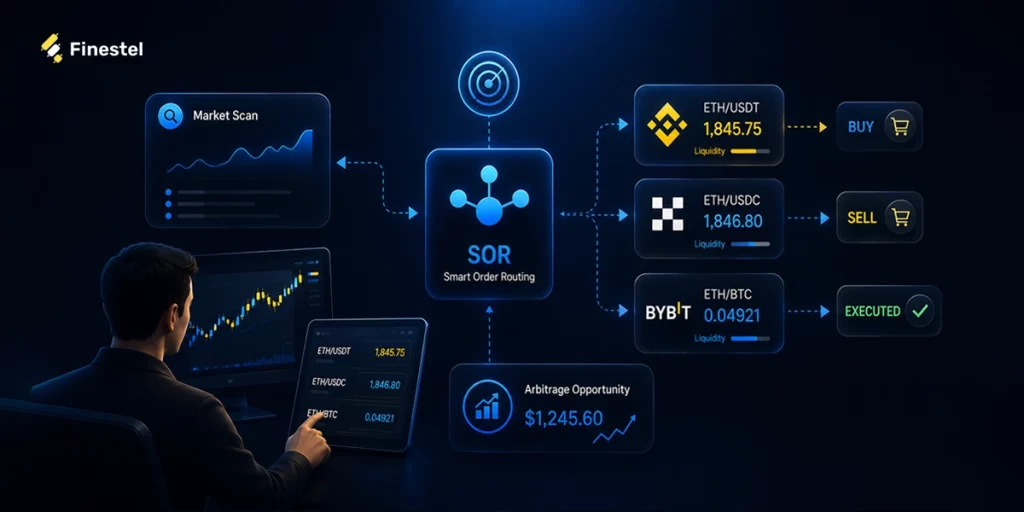
Traders use crypto arbitrage bots to exploit price discrepancies between exchanges for rapid profits, while Smart Order Routing (SOR) serves as their essential tool for achieving this.
Smart Order Routing acts as a fast, intelligent sidekick that transforms market chaos into consistent profit with minimal stress. The following steps demonstrate real traders’ practical application of SOR.
Read more about how Hyperliquid funding rate arbitrage works in our blog.
Spotting the Deals
Picture this: The Bitcoin price stands at $60,000 on Kraken while it reaches $60,300 on Binance. You smell money, but checking prices manually? Forget it, that gap’s gone in seconds. SOR functions like a hawk-eye that monitors all exchanges in real-time to catch price differences worth $300 before the screen can refresh. The tool allows traders to identify trading opportunities without having to guess.
Making the Move
The moment SOR identifies the price gap between exchanges, its trading algorithm springs into action. The system performs rapid transactions by purchasing BTC at Kraken’s low rates and selling them at Binance’s higher prices. SOR enables simultaneous trade management across exchanges without additional login or transfer steps.
A trader can focus on earning profits while the system takes care of operational specifics. The rapid speed becomes essential for traders who need to respond quickly during their transactions.
Handling Big Trades
Got 10 BTC to move? Sell 10 BTC on one exchange, and the market reacts with price spikes that reduce your profits. SOR improves trade execution by splitting orders into smaller chunks of 4 BTC and 6 BTC that it distributes across multiple platforms to maintain price stability. Traders appreciate this method because it maintains their competitive advantage regardless of the transaction size.
Dodging the Fee Trap
The combination of trading expenses and gas fees on decentralized exchanges can destroy an arbitrage opportunity. SOR guarantees maximum value by calculating post-fee returns for your transactions. When fees strip half from a $200 gap a trader spots, SOR decides to take an alternate path or skips the trade entirely. Preserving your funds in your wallet proves to be a practical approach.
Going Fancy with Triangles
Certain traders enhance SOR with triangular arbitrage by exchanging BTC for ETH, then ETH for USDT, before converting back to BTC to gain additional profit. The complexity of triangular arbitrage becomes manageable with SOR’s precise timing and mathematical accuracy throughout each step. Experienced traders utilize this approach to maximize market opportunities when standard buying and selling options become limited.
Bridging DEXs and CEXs
You might have seen that Ethereum costs $4,000 on Uniswap and $4,050 on Coinbase. Advanced traders execute SOR strategies to switch between decentralized and centralized exchanges to capture price discrepancies. SOR helps users avoid expensive gas fees by selecting appropriate pools while remaining popular among investors trading across both crypto markets.

Conclusion
Crypto traders find SOR indispensable because it delivers efficient transaction execution while minimizing costs in rapidly shifting markets. This technology enables traders to secure better prices and eliminate slippage while capitalizing on arbitrage chances, which simultaneously reduces the time and effort needed. The potential of trading tools such as SOR continues to expand as the crypto market keeps developing.
The advancement of AI and machine learning technology will make these tools more intelligent and enable real-time predictive analytics and trade optimization in unpredictable market conditions. The maturation of technology enables traders to achieve higher precision and efficiency, which helps them maintain a competitive edge and increase profits despite market changes.
FAQs
Why is Smart Order Routing better than Direct Order Routing?
DOR restricts trades to one exchange, while SOR achieves optimal pricing through order division across multiple exchanges and liquidity aggregation to reduce slippage.
Can Smart Order Routing (SOR) achieve efficient trade execution in the crypto market?
Yes. Smart Order Routing automatically channels orders toward exchanges that provide superior price points along with high liquidity and fast execution speeds. The fragmented and volatile nature of the crypto market requires SOR to divide larger orders across multiple exchanges for optimal execution while reducing slippage and enabling real-time price discovery.
What’s the Difference Between SOR and Algorithmic Trading (Algo)?
Smart Order Routing (SOR) serves as your execution specialist by locating the quickest route to fulfill your orders on exchanges such as Binance or KuCoin and securing the most advantageous price. Algorithmic trading functions as the system’s intelligence, which determines both the moment for trading activity and the strategies to use, such as trend following or profit scalping. Algo sets the play; SOR runs it. Traders often pair them up for max impact: Algorithms create the trading strategy, which SOR executes to deliver results.



Leave a Reply