
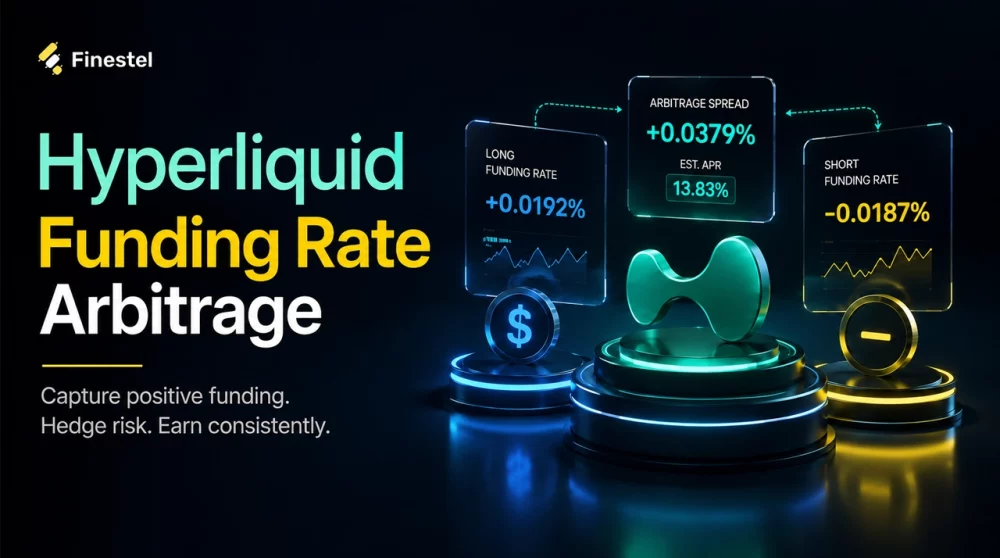

Hyperliquid funding rate arbitrage is a strategy that takes advantage of differences in funding rates paid between traders in Hyperliquid’s perpetual futures markets. Because funding rates can vary across assets and over time, traders can profit from the difference while reducing their exposure to the underlying asset’s price movements. Hyperliquid’s deep liquidity and low transaction costs make it an interesting platform for exploring funding rate arbitrage.
Funding rates on Hyperliquid truly stand out because of two specific things: its hourly payouts and its good funding spikes. Hyperliquid settles and pays funding every single hour on its L1, unlike centralized exchanges like Binance that settle every 8 hours. And because Hyperliquid is a DEX with active perpetual futures trading, its funding rates can offer attractive returns and even be higher than centralized exchanges, although this varies by asset and market conditions.
In this guide, I want to share how I actually run funding rate arbitrage on Hyperliquid. We will break down how the mechanics work, walk through the exact numbers and net yield formulas, address the operational risks that often get ignored, and look at how to automate everything using webhooks and available multi-account tools.
What is Hyperliquid Funding Rate Arbitrage and How It Works
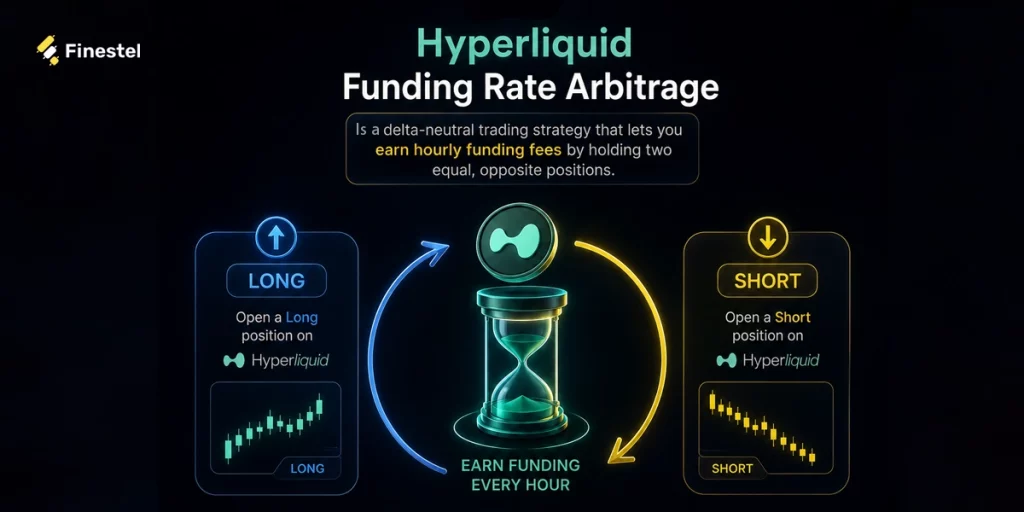
Hyperliquid funding rate arbitrage is a delta-neutral trading strategy that lets you earn hourly funding fees by holding two equal, opposite positions. Because both positions balance each other out, you do not have to guess whether coin prices will go up or down. Your profit comes from collecting the hourly funding payouts that perpetual traders pay to keep their positions open.
To make this work better, you just need to understand how perpetual contract prices stay tied to regular spot prices.
Read more about the best Hyperliquid bots in our blog.
The Mechanics of Hyperliquid Funding Rates
Unlike traditional futures that expire on a set date, perpetual contracts never expire. Because they stay open indefinitely, exchanges need a way to keep perpetual prices from drifting too far away from actual spot prices. They do this using the funding rate mechanism.
The funding rate is simply a periodic fee paid between long and short traders to balance the market:
- When the market is bullish: Perpetual prices rise above spot prices. The funding rate turns positive, meaning long traders pay a continuous fee to short traders.
- When the market is bearish: Perpetual prices fall below spot prices. The funding rate turns negative, meaning short traders pay long traders.
On Hyperliquid, these funding fees are calculated and settled every single hour directly on their L1 blockchain. More frequent settlement can give traders quicker access to received funding payments.
Delta-Neutral Strategy Architecture
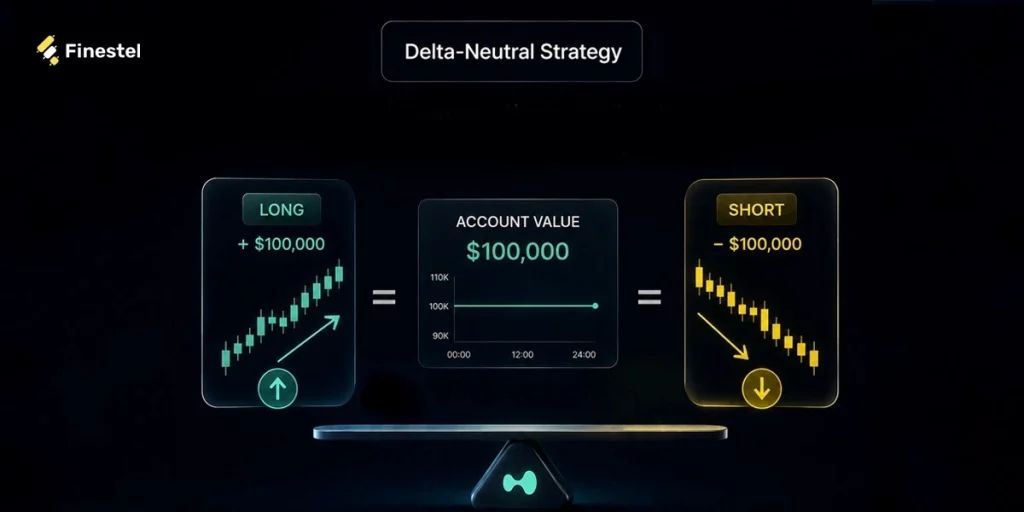
In trading, “delta” is just a technical term for how much your portfolio’s value changes when the price of a coin moves. You can now guess that a delta-neutral strategy aims for zero price risk. This means the overall dollar value of your account can stay nearly flat, whether a coin doubles in price or crashes by half.
You create this balance by opening two opposite trades using the exact matching underlying quantity.
Primary Hyperliquid Funding Arbitrage Structures
When setting up funding arbitrage on Hyperliquid, traders generally pick between two main structures:
1. Spot-Perp Funding Arbitrage
Spot-perp arbitrage refers to buying the actual asset on the spot market with an equal short position on Hyperliquid perpetuals. When Hyperliquid funding rates are positive, the setup works in a way like this:
- Buy $100,000 worth of an asset on the spot market.
- Open an equivalent $100,000 short position on Hyperliquid futures at the same time. (Note that the underlying quantity should match; for example, 1 unit of a certain coin on the spot and 1 unit of the same coin on the futures.)
- If the token price pumps 20%, the $20,000 gain on your spot holding cancels out the $20,000 unrealized loss on your short. Your price exposure remains flat.
- As long as the funding rate stays positive, you continuously collect hourly funding payouts from long traders.
This is usually my favorite, safe setup for major assets like ETH or BTC. Pay attention to the fact that the numbers I have used here are simplified versions of what happens on exchanges. In practice, factors like fees, slippage, and the differences between spot and perpetuals affect the result. Our goal is one thing: to keep your directional price exposure approximately neutral.

2. Cross-Exchange Funding Arbitrage
Cross-exchange arbitrage profits from the gap between funding rates across two different platforms.
During strong market rallies, aggressive demand on DEXs can push Hyperliquid’s annualized funding rate significantly higher than rates on centralized exchanges. For example, suppose Hyperliquid offers a 70% annualized funding rate, while Binance offers 15% for the same token.
To capture that spread, you can:
- Open a $100,000 short perpetual position on Hyperliquid, earning funding while the rate remains positive.
- Open a $100,000 long perpetual position on Binance, paying its funding rate.
- The equal-sized long and short positions largely neutralize your directional exposure to the underlying asset.
- The resulting gross annualized funding spread is 55% (70% − 15%), before trading fees, slippage, and other costs.
How Much Can Funding Arbitrage Earn?

One mistake I see newer traders make is checking a tracker, seeing a 100% annualized funding rate, and assuming that the entire percentage lands straight in their wallet. Your real profit is always what remains after paying exchange fees and slippage.
Mathematical Formulas
To calculate the exact funding payout you receive or pay for a single funding cycle (hourly on Hyperliquid), here is the standard position funding formula:
Funding Payout = Position Value × Hourly Funding Rate, where:
- Position Value (Nominal Size): The total dollar value of your open perpetual position (e.g., $50,000).
- Hourly Funding Rate: The active rate for that specific hour.
For example, if you hold a $50,000 short perpetual position and the hourly funding rate is 0.005%:
$50,000 × 0.00005 = $2.50 per hour
To calculate your total gross funding over a specific timeframe (such as 24 hours or 3 days), multiply the single payout by the number of active payout hours:
Gross Funding Earned = Funding Payout per Hour × Total Hours Held
Finally, to estimate your actual net profit from an arbitrage trade, subtract execution friction from your total gross funding:
Net Arbitrage Profit = Gross Funding Earned − Total Trading Fees − Slippage Costs
Where:
- Total Trading Fees: Combined entry and exit fees for both spot and perpetual legs.
- Slippage Costs: Total price impact across all four execution orders.
A Numerical Example
Below are two practical scenarios showing how execution friction impacts short-term holding windows versus extended holds at a steady 0.005% average hourly rate.
- Capital Allocation: $100,000 Total Strategy Capital ($50,000 Spot Long + $50,000 Perpetual Short).
- Assumed Base Taker Fee: 0.035% average per execution (Note: Actual fees vary depending on your Hyperliquid VIP tier, maker vs. taker orders, and market type).
- Estimated Slippage: 0.015% average per execution leg.
Scenario A: Short-Term Hold (3 Days / 72 Hours)
Because Hyperliquid settles funding hourly, sometimes traders capture moderate rates over short multi-day swings. Here is how the math looks for a 3-day hold on a $100,000 total trade setup at a steady 0.005% average hourly rate: Gross Funding Income:
- 0.005% × 72 = 0.36%
- $100,000 × 0.36% = $360 Gross Income
Transaction Friction (4 Executions = $200,000 Total Volume to Open/Close Both Legs):
- Base Taker Fees (0.035%): $200,000 × 0.00035 = $70
- Slippage (0.015%): $200,000 × 0.00015 = $30
- Total Friction: $70 + $30 = $100
Net Realized Profit:
- $360 (Gross Income) – $100 (Friction) = $260 Net Profit
- Net 3-Day Yield = $260 / $100,000 = 0.26%

Scenario B: Extended Hold (30 Days)
When holding the same $100,000 setup over 30 days at the same 0.005% hourly rate, your fixed trading friction is diluted over 720 hourly payouts (24 hours × 30 days):
Gross Funding Income:
- 0.005% × 24 × 30 = 3.60%
- $100,000 × 3.60% = $3,600 Gross Income
Transaction Friction:
- Total Friction (Same 4 Executions)= $100
Net Realized Profit:
- $3,600 – $100 = $3,500 Net Profit
- Net 30-Day Yield = $3,500 / $100,000 = 3.50%
Holding over longer windows allows your accumulated hourly payouts to steadily grow your overall return above the fixed entry and exit costs.
How to Find Profitable Hyperliquid Funding Opportunities
Finding good yield is about finding steady funding gaps, not chasing brief five-minute spikes.
1. Direct Hyperliquid Order Book Analysis
Checking the Hyperliquid trade interface directly and sorting contracts by funding rate is a good starting point. However, the funding rate should be considered alongside other market metrics like open interest rate, order book depth, bid-ask spread, and trading volume.
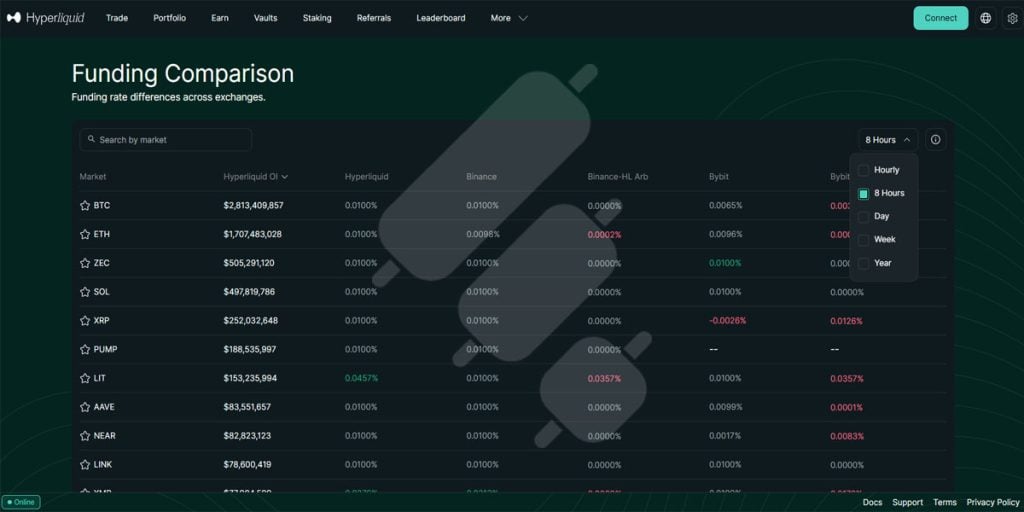
Open interest can indicate the level of market participation and help identify crowded positioning, but it doesn’t work as a measure of liquidity. To assess execution liquidity, look at order book depth, bid-ask spread, and trading volume, and impact price. These metrics can give you a better sense of whether the market can absorb your trade without significant price impact or slippage.
2. Using Cross-Venue Aggregators
I use Hyperliquid arbitrage finder platforms like Coinglass and DefiLlama to track rates across different exchanges. Filtering for Hyperliquid lets me compare its real-time rates against centralized platforms like Binance or OKX.
3. Automated API Monitoring
If you want to trade actively, manual checking might be too slow. Running simple Python scripts that pull data from the official Hyperliquid API documentation can be a more efficient solution for those traders who can do this.
Advantages and Operational Risks of Hyperliquid Funding Arbitrage
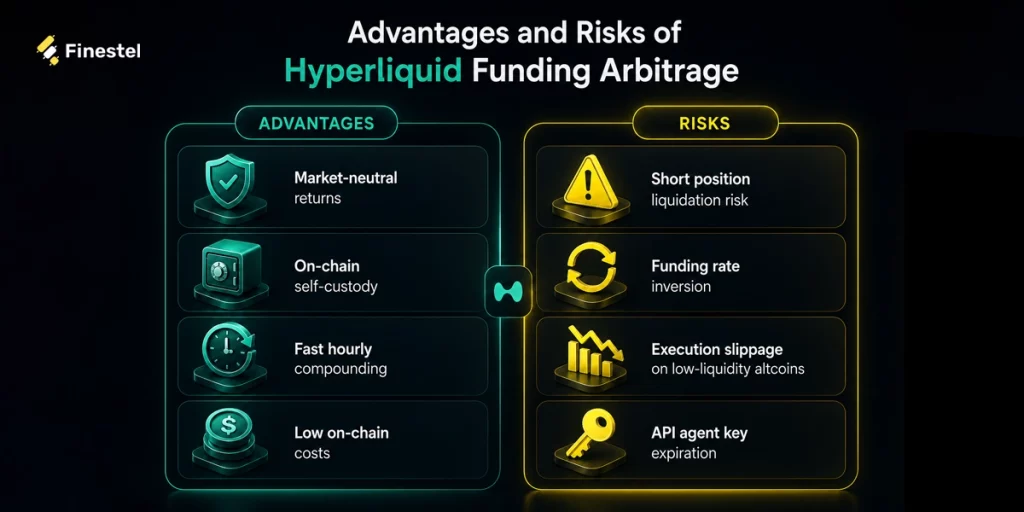
Delta-neutral strategies are much safer than directional trading, but managing the operational risks is what keeps your account alive.
Advantages
- Reduced directional exposure: A properly hedged position can earn funding with substantially lower sensitivity to directional price moves.
- On-chain self-custody: Your capital stays in your wallet and on transparent Hyperliquid smart contracts rather than on a CEX balance sheet.
- Hourly settlement: Hourly payouts make it easy to reinvest or move yield quickly.
- Low on-chain costs: Minimal L1 execution fees mean small transactions do not eat up your profits.
Hyperliquid also supports vaults, which let users allocate capital to a trader or strategy while keeping the activity on-chain. For a closer look at how they work, their risk model, and the difference between depositing into a vault and trading from your own account, read our guide to Hyperliquid vaults.
Critical Risks and How to Manage Them
Despite all the benefits, there are still some risks involved. Let’s check them and see how you can manage them.
Short Position Liquidation Risk
When the market pumps hard, your short perpetual position on Hyperliquid will show unrealized losses. If you use high leverage, a fast move up can liquidate your short before you have time to rebalance.
To avoid this, I usually keep my leverage low (1x to 2x max) and set up automated margin alerts so I can top up collateral before liquidation gets close.
Funding Rate Inversion
Funding rates move with market sentiment. A token paying +50% of the annualized funding rate today can easily flip negative tomorrow if buying interest cools down.
You can set automated triggers to close the trade if the net yield drops below your target minimum (for example, below 5%).
Execution Slippage on Low-Liquidity Altcoins
Some small altcoins show attractive three-digit funding rates, but their order books are thin. Trying to enter with a large order will cause heavy slippage and instantly destroy your expected yield.
I suggest that you always cap your position size based on order book depth, or split your entries using TWAP orders.
API Agent Key Expiration
Hyperliquid uses temporary L1 API agent keys for automated execution, and these keys carry strict expiration dates. If an API key expires without you noticing, your automated bots will stop working mid-trade.
You’d better use dashboards that monitor API key validity and alert you before keys expire.

How to Automate Hyperliquid Funding Arbitrage Execution
Generally, manual execution of two-legged trades like this is slow and leaves room for execution lag. Setting up an automated workflow keeps your entries faster and more precise. In this section, we will explore the automation of Hyperliquid funding rate arbitrage execution using the advanced tools and dashboards that Finestel provides.
If you are new to connecting Hyperliquid with Finestel, follow our step-by-step Finestel Hyperliquid trading tutorial to set up your account, connect your API agent key, and place or automate your first trades.
Automated Signals, Webhooks, and Execution via Finestel
Finestel supports Hyperliquid trading automation for users who want to deploy their own trading strategies. You simply need to sign up or log in to access the tools we explain further on. It provides a free trial for new users.
Adding Account
Now, you need to add your Hyperliquid accounts to your Finestel interface. Head over to My Exchanges in the left sidebar menu and click the “Add Account” button. Select Hyperliquid and link your wallet using its L1 API agent key.
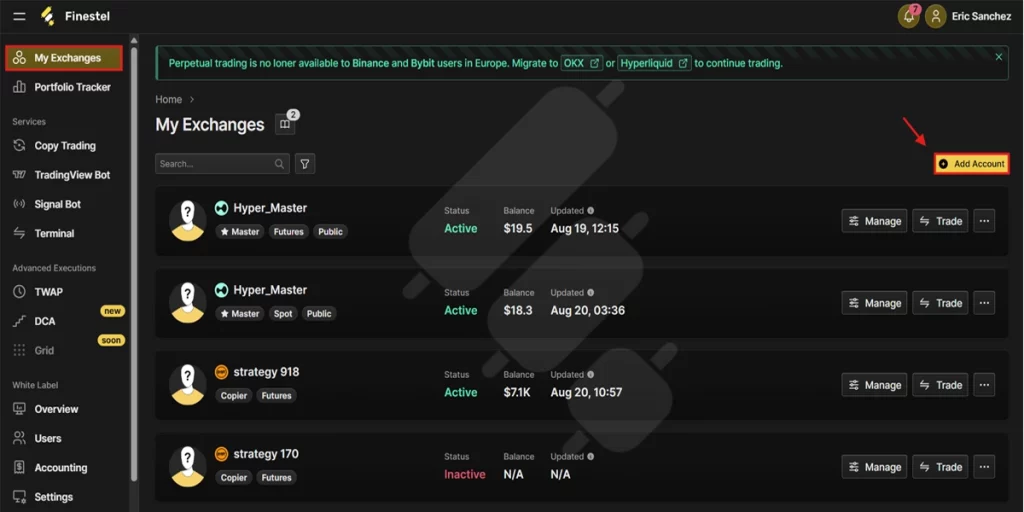
For delta-neutral arbitrage, it helps to create two separate account profiles inside Finestel: set up one as Master Futures (like Hyper_Master Futures) to manage your short perpetual positions, and another as Master Spot (like Hyper_Master Spot) to handle your spot long holdings.
Setting Up Strategy Signals
Every automated trade starts with a trigger. Depending on how you like to analyze the market, you can generate signals in two practical ways:
- Custom Python Scripts: Build a simple script that monitors funding rate gaps across venues. Whenever a profitable spread opens up, your script generates a JSON payload containing the token symbol, order size, and trade direction.
- TradingView Indicators: If you rely on charts, set up Pine Script indicators or funding rate overlays directly on TradingView and create alert conditions whenever yields hit your target threshold.
Routing Webhook Signals
Once a signal triggers, you need to send it to Finestel instantly without any human delay. For this, you can use both Finestel’s signal bot and TradingView bot.
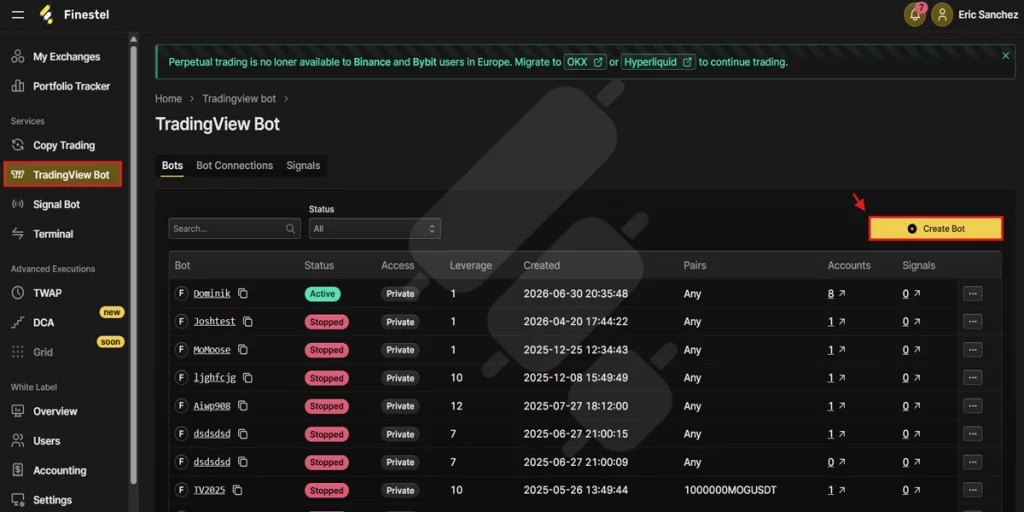
If you are trading off TradingView indicators and charts, click TradingView Bot in the sidebar and select Create Bot. Copy the provided webhook URL and paste it into the Notifications tab of your TradingView alert settings.
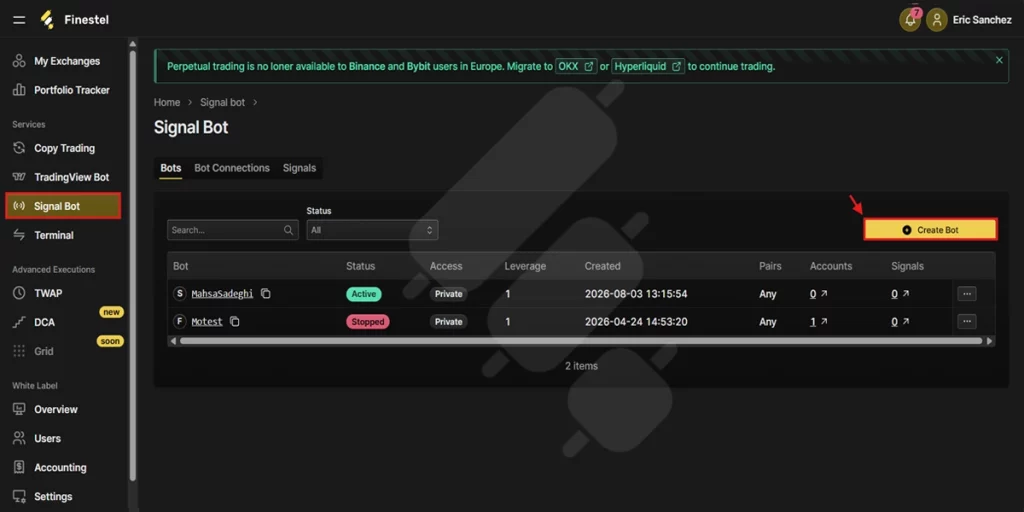
Otherwise, pick Signal Bot and click Create Bot to generate a webhook endpoint. Copy this URL and paste it into your custom script so it streams JSON payloads directly into Finestel.
Direct Manual and Terminal Execution
If you prefer to review market depth and place trades manually while keeping an eye on real-time order books, Finestel’s trading terminal is a useful choice for you. Navigate to Terminal in the sidebar menu and from there, pick your connected Hyperliquid account.
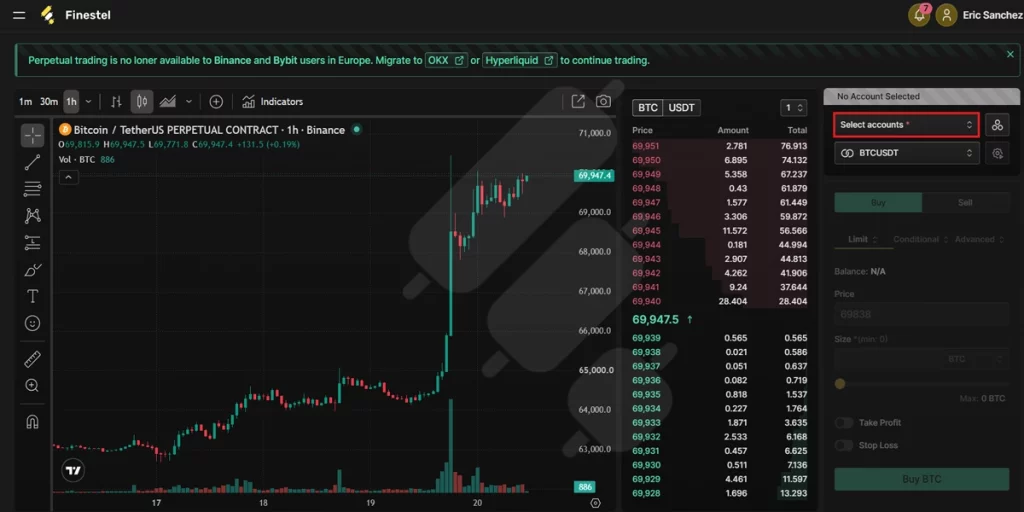
You can place market or limit orders directly onto Hyperliquid order books with real-time price charts and order book depth right in front of you.
Read more about “what is a trading terminal” in our article.
Algorithmic Execution via TWAP and DCA
Firing off a single, massive market order on thinner altcoin books can lead to heavy slippage and eat into your profits. To handle this smoothly, you can use the TWAP option. We have covered the best TWAP order strategies in our blog.
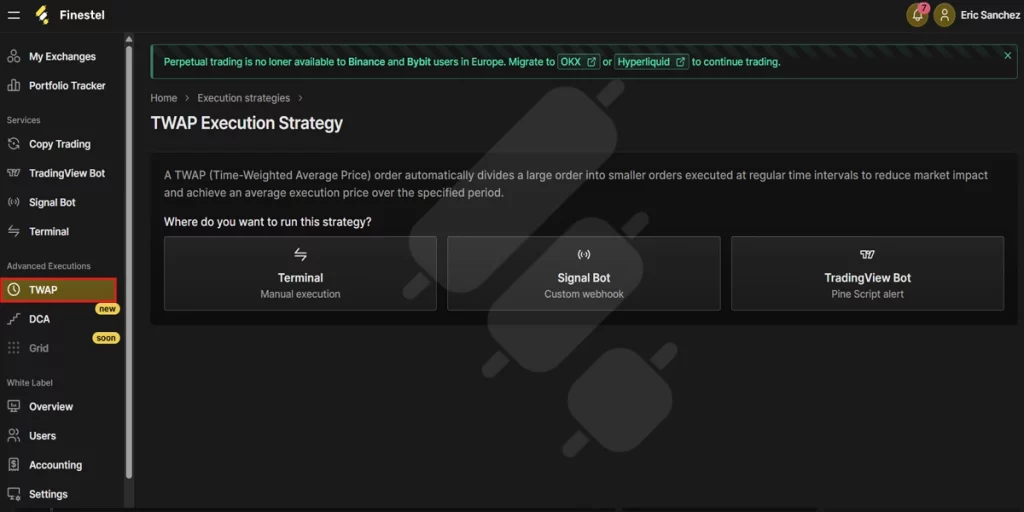
Pick your preferred execution channel, whether that is Terminal for manual algorithmic entries, Signal Bot for custom webhooks, or TradingView Bot for Pine Script alerts. The TWAP algorithm automatically breaks your total parent order into smaller child orders and executes them at regular intervals over time.
While TWAP spreads your trade over time, the Finestel DCA bot buys or sells based on price changes. Instead of placing your whole trade at once, it scales into your long spot and short perpetual positions step-by-step as prices move, based on the parameters you set. This helps you average a much better entry price during market swings.
Multi-Account Management
If you are an asset manager or run multiple sub-accounts, executing trades manually for each account is almost impossible during fast market shifts. The multi-account setup inside the Finestel Trading Terminal handles this cleanly through a master-copier layout.
Master-Copier Setup
Inside Finestel, you connect your main master accounts to Hyperliquid API endpoints:
- Hyper_Master (MasterFuturesPublic): Handles short perpetual entries.
- Hyper_Master (MasterSpotPublic): Handles spot long entries.
Client accounts or sub-accounts are linked underneath as copier accounts. 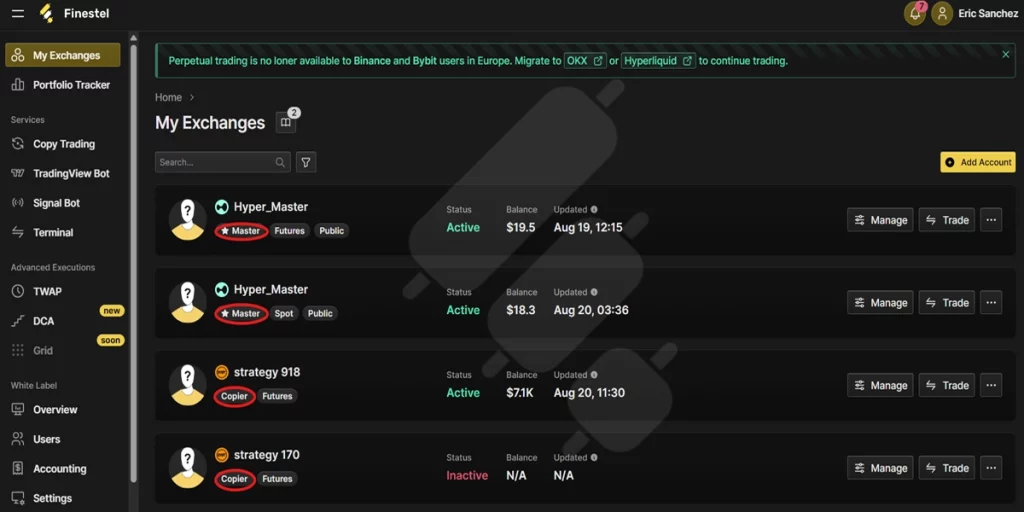
Proportional Replication
When a trade triggers on the Hyper_Master account, Finestel automatically mirrors the position across all linked copier accounts using its Trade Copier Software. Every account takes spot and perpetual positions sized proportionally to its available capital.
Easier API Agent Management
Since Hyperliquid temporary API agent keys eventually expire, Finestel tracks key validity inside the interface. You get alerts before any key expires, allowing you to extend API agent wallets with a single click without taking trading bots offline.
When Funding Arbitrage Is Not Worth It
Any experienced trader has learnt that knowing when to stay out of a trade is just as important as finding good entries:
Follow the Minimum Profitability Threshold
I usually don’t open an arbitrage trade unless my projected net yield over 7 days covers at least three times my total round-trip costs (trading fees plus estimated slippage). If your margin is thinner than that, even a slight drop in funding rates will lead to a loss.
Watch Open Interest Drops
Unusually high funding rates paired with falling open interest usually mean over-leveraged traders are about to get liquidated. Once those liquidations clear out, funding rates collapse fast. It is better to close your short perpetual positions before those liquidation waves come and sweep the order book.
Maintain Heavy Collateral Buffers
When prices pump hard, your spot value goes up, but your short position loses margin fast. I usually keep a conservative margin buffer (200% to 300% coverage) on Hyperliquid, and I periodically rebalance funds to keep my short position safe during big market pumps.
Conclusion
Hyperliquid funding rate arbitrage strategy is one of the most practical ways to capture steady, market-neutral yields in crypto. Like any other trading strategy, success comes down to execution and discipline. When you pair this strategy with automated execution tools, like the ones covered in this article, you can significantly improve your results. Don’t forget to start small and keep your leverage conservative.
FAQs
What is the best leverage for Hyperliquid funding rate arbitrage 2026?
Keep your leverage low, ideally between 1x and 2x on your short perpetual leg. Higher leverage increases your liquidation risk during sudden price spikes without giving you a meaningful yield.
How often are funding rates paid on Hyperliquid?
Hyperliquid pays funding rates every hour. This frequent payout cycle lets you receive yields faster,
What happens if the funding rate turns negative?
If the funding rate turns negative, your short position will pay the long position, which cuts into your profits. You can set automated triggers in your execution system to automatically close the trade if the net annualized funding rate drops below your minimum target.
Do I need to hold the exact same amount of spot and short perps?
Yes, delta neutrality requires a 1:1 balance between your long spot value and short perpetual value.


Leave a Reply