

If you trade crypto derivatives, data fragmentation is pretty much an unavoidable headache. I mean, you should look at funding rates on one tab, implied volatility surface on another, and open interest somewhere else entirely. Laevitas promises to solve that by pulling all of it into one place, and that’s why I’ve done a deep dive into the platform to write this Laevitas review.
I spent time actually using the platform to see if it delivers on that. The positioning is clear. They offer institutional-grade derivatives data and analytics, without having to stitch together five different tools to get a coherent read on the market.
So, in this Laevitas review, I cover what Laevitas does, who it’s genuinely built for, where it falls short, and whether any of the paid plans are worth it. I’ll also flag one gap the platform doesn’t cover, and what to pair it with if you need more than just data.

What Is Laevitas?
Laevitas is a crypto derivatives data and analytics platform that was founded in 2020. It’s registered in Singapore under Laevitas Pte. Ltd. They have a solid list of institutional partners, which includes Bybit, Deribit, OKX, Paradigm, and Greeks.live among them.
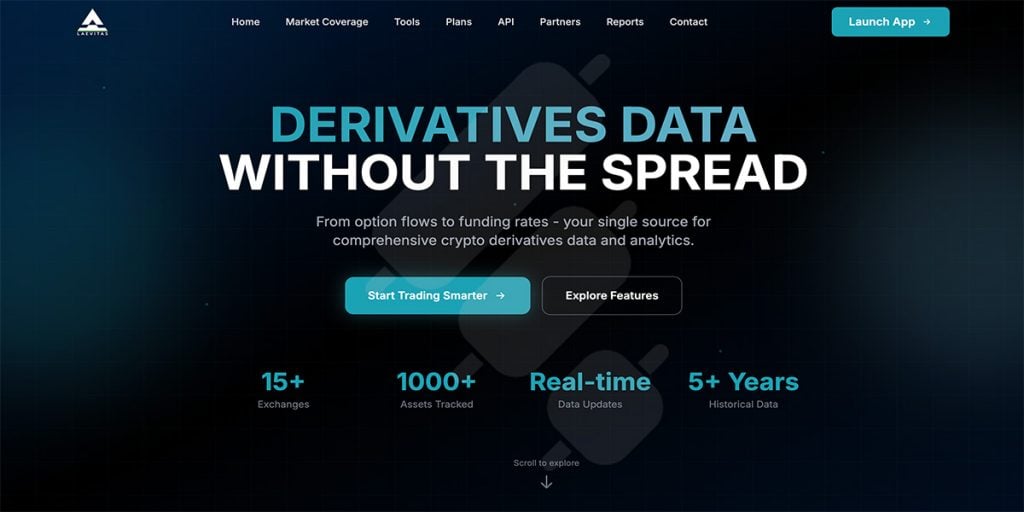
Now, what Laevitas actually does is aggregate real-time and historical derivatives data across all major exchanges into one place, then layer professional-grade analytics tools on top. In terms of coverage, it covers 15+ exchanges, tracks 1,000+ assets, and goes back 5+ years on historical data. This is actually meaningful if you’re backtesting strategies or studying how the market behaved across different cycles.
But we should also be clear about what Laevitas is and isn’t. It’s a data and analytics platform, not a trading terminal or an execution and automation tool like Finestel. You come here to read the market, not to place orders. Keep that distinction in mind as you go through the rest of this Laevitas review.
What Does Laevitas Actually Cover?
The Laevitas crypto data platform is built around four market pillars. It’s worth understanding each one in practical terms, so I’ll try to explain what’s included and what matters in each rather than just the marketing description.
Options markets are where Laevitas is strongest. You can see full option chains, detailed trade flows including blocks and strategies, implied volatility metrics, Greeks, and deep historical data. Specifically, if you trade options on BTC or ETH, this is the layer that gives you a proper read on where the market is positioned and what institutional flow looks like. The Laevitas crypto options data is actually among the most well-known in the space.
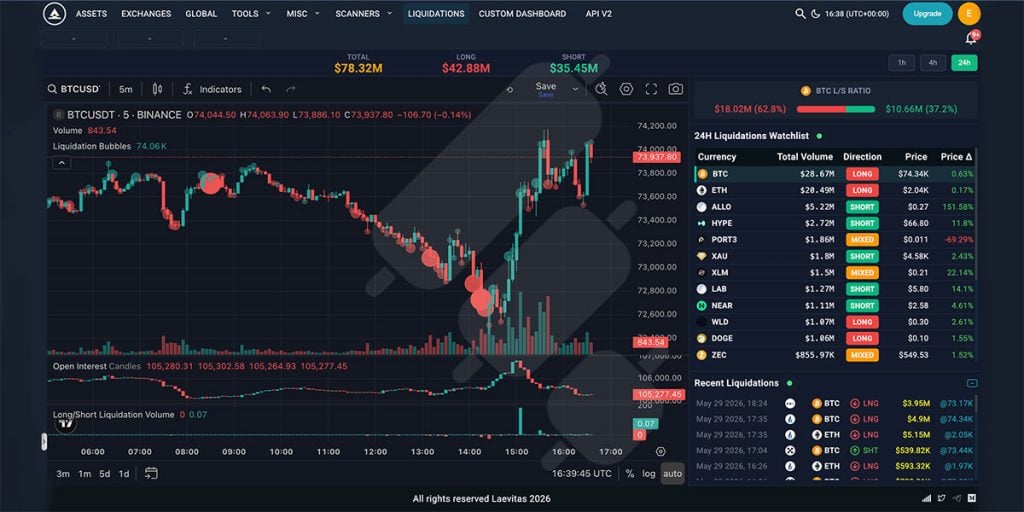
The perpetual futures market is the next area Laevitas covers. Real-time prices, volume, funding rates, liquidations, basis levels, and open interest are measured and displayed across venues. Clearly, this is useful for anyone running perp strategies. It’s also beneficial if you just want to understand the broader market structure before entering a position.
Laevitas also covers Dated Futures. It gives you term structure analysis and volume metrics across expirations. This is quite handy for spotting contango/backwardation dynamics and understanding where the market is pricing future delivery. Lots of professional traders factor this in, and I suggest you do so as well.
Laevitas Asset Overview for BTC and ETH
BTC and ETH naturally have the deepest coverage. The reason is, of course, that there is much more data available for these two compared to other altcoins. On Laevitas, you can see full volatility surfaces, skew data, options chains, and flow. But I should also mention that SOL coverage is expanding, too.
Another thing worth noting is that through a partnership with Gate, Laevitas now also carries WTI crude oil and gold options data, which is unusual for a crypto-native analytics tool and reflects where the platform is pushing its market coverage.
Laevitas Tools Overview
Beyond the data layer, Laevitas also includes four analytical tools built into the platform. Here’s what each one actually does.
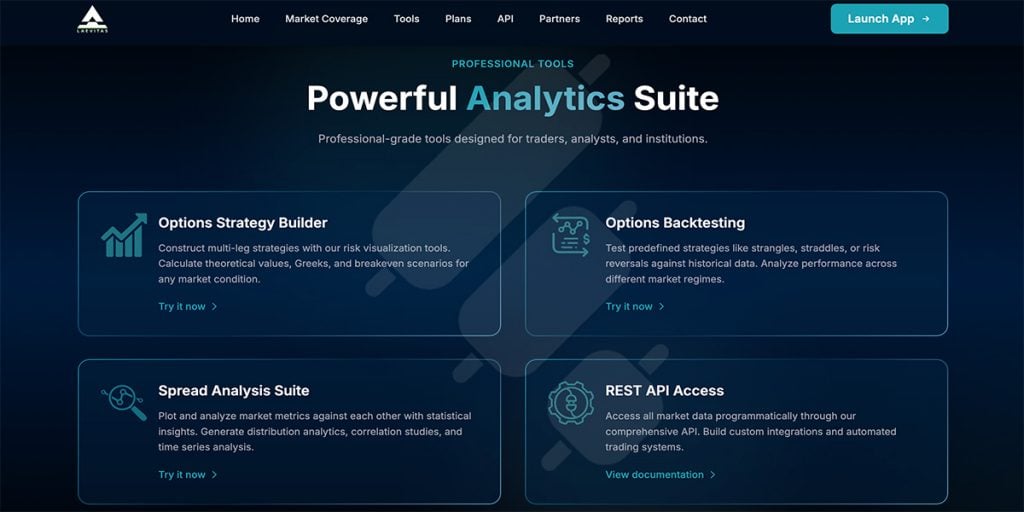
Backtester lets you test predefined options strategies. I mean strangles, straddles, risk reversals, and more, all against historical data. The value here is being able to see how a strategy would have performed across different market regimes. That’s a very useful tool if you’re into options trading.
The next tool is the Laevitas Calculator, which is basically an options strategy builder. You can construct multi-leg strategies and visualize the risk profile. It helps you calculate theoretical values, Greeks, and breakeven scenarios for any market condition. Again, it’s very useful for structuring a trade before you go to your execution platform.
Model IV is the tool I liked the most when trying the platform to write this Laevitas review. This tool gives you access to implied volatility modelling. So instead of just reading the raw IV number, you can work with a fitted volatility surface and understand where the market is pricing risk across strikes and expirations simultaneously.
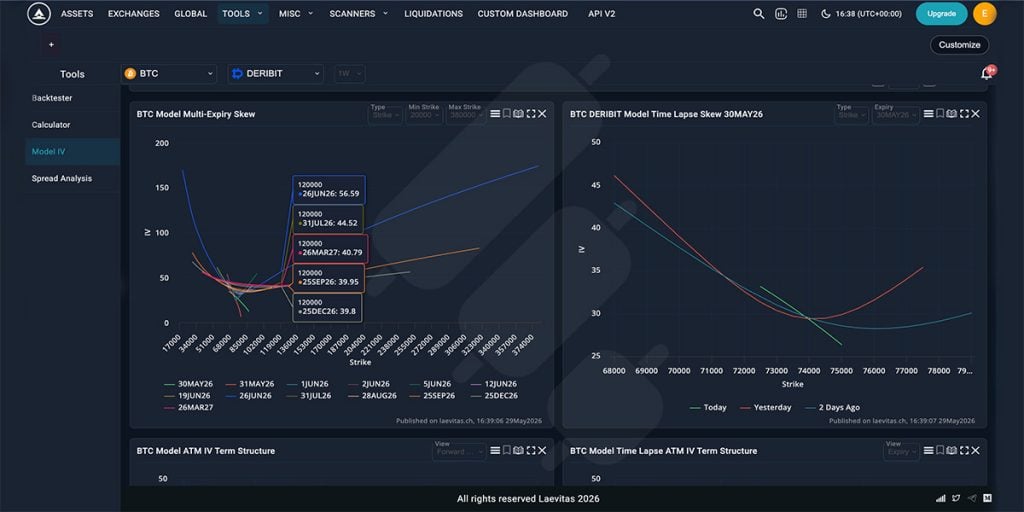
Spread Analysis is the last tool, and it lets you plot market metrics against each other with statistical context. I mean, correlation studies, distribution analytics, and time series comparisons. It’s actually the kind of tool quants and analysts get more out of than discretionary traders. But still, it’s there if you need it.
Now, the API layer sits on top of all of this. There’s REST v2, WebSocket for live streaming, an MCP server with 20+ tools that connect natively to Claude or ChatGPT, and an x402 pay-per-request option via USDC if you don’t want a full subscription. I can confidently say that the last one is a genuinely interesting setup for developers who need occasional data pulls.
Laevitas Pricing
Now, the most important part of this Laevitas review for many traders is analyzing the pricing plans. There are four tiers, and the jump between them is significant enough to think about carefully.
| Plan | Price | Historical Data | Key Features |
| Free | $0/mo | 1 week | Basic charting, 8 charts/page |
| Premium | $50/mo/seat | 1 year | 3 dashboards, full toolkit, CSV exports, advanced filtering |
| Enterprise | $500/mo/seat | Full API access | Unlimited dashboards, priority support |
| Custom Enterprise | Contact | Tailored | High-throughput API, dedicated manager |
The Free tier is useful for getting a feel for the platform before committing. You can access core features and poke around the data. So, it’s not a crippled demo.
Premium at $50/month gives you a full year of historical data, the complete toolkit, and CSV exports. Enterprise at $500/month is a different conversation entirely. That’s institutional territory, as it provides API access, unlimited dashboards, and priority support.
But there’s one thing I’d like to flag up front, and it’s that Laevitas payments are non-refundable. There are no credits for unused periods and no exceptions outside of applicable law. So I’d suggest that if you’re considering Premium or above, you make sure you’ve spent real time on the free tier first.
Laevitas Reviews on Trustpilot and Reddit
When looking for online Laevitas reviews, I’ve found the fact that there’s no Laevitas Trustpilot page a bit concerning. Reddit discussion around the platform is also minimal. So, if you go looking for a thread full of user experiences, you’re not going to find much.
Yet, that’s not very odd for a platform operating at this level. Laevitas isn’t targeting retail traders who leave app store reviews. It’s a derivatives data tool used by institutions, quants, and professional traders. That audience doesn’t typically post on Trustpilot.
What you do find, however, is industry credibility. Laevitas data is regularly cited on CoinTelegraph and major crypto media. Partnerships with Bybit, Deribit, OKX, Paradigm, and Greeks.live also speak for themselves, as those names don’t attach to unreliable data providers. The validation here comes from who’s using it, not from a star rating on a consumer review site. So, I still consider Laevitas legit and potentially worth it for the right trader.
Who Is Laevitas For?
Speaking of the right trader, Laevitas is a good fit if you trade options seriously. If you do, you would need proper IV surfaces, flow data, and Greeks, and Laevitas provides that. Moreover, if you’re a quant building strategies that require clean, granular derivatives data across multiple exchanges, it’s also a very useful platform. Algo traders integrating market data via API will also find the setup capable, especially with the MCP server and pay-per-request options.

So, what you should’ve picked up by now from this Laevitas review is that it is not the right tool if you’re a retail spot trader or a beginner still learning how derivatives work. Even someone who mainly runs perpetual futures on a single exchange might not find it useful. The analytics depth that makes Laevitas valuable for professionals is the same thing that makes it overkill for traders who don’t need that layer.
The other gap worth flagging is that if you manage funds for others, run a copy trading operation, or need any kind of execution and portfolio management layer, Laevitas doesn’t cover that. It tells you what’s happening in the market.
Finestel as the Execution Layer
Laevitas solves the data and analytics problem well. But if you’re also managing trades for others, running a copy trading operation, or automating strategy execution across multiple exchanges, you’re looking at a completely different toolset.
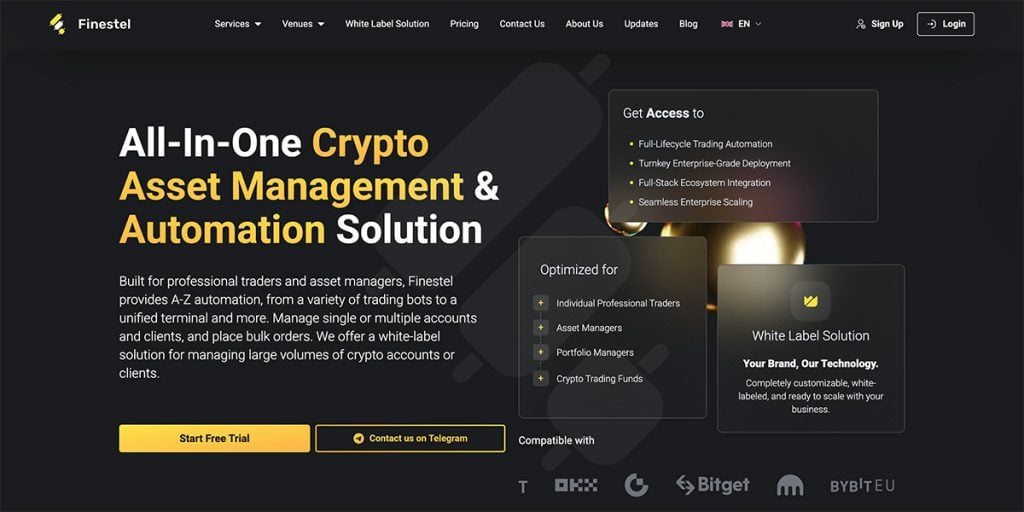
That’s where Finestel comes in. It’s built specifically for the operational side of running trades, which is the layer Laevitas doesn’t touch.
Here’s what it covers:
- Copy trading software across Binance, Bybit, OKX, KuCoin, Bitget, and Gate. So, once Laevitas data informs your directional bias, you can push that trade across multiple follower accounts simultaneously.
- TradingView Bot and Signal Bot for automated execution. Connect your signals directly to live accounts without manual intervention.
- Trading terminal built for asset managers. You can easily execute basic and advanced orders, utilize bulk execution, track AUM, monitor individual account performance, and manage allocations across your entire client base or even your own accounts and portfolios in one place.
- White-label solution is where it gets more professional. It helps you run a copy trading, signals, or portfolio management service under your own brand, with various tools like automated billing, CRM, marketing, and more.
So, I see the practical pairing like this: you use Laevitas to read derivatives market structure and Finestel to execute and manage positions at scale. One handles the intelligence side, the other handles the operations side. For anyone running a structured trading business, having both in your stack makes a lot of sense.

Conclusion
To wrap up this Laevitas review, it’s a genuinely solid derivatives data platform. Options coverage, IV surfaces, flow data, and multi-exchange depth that most crypto-native tools don’t come close to matching. For options traders, quants, and institutions who need a clean, comprehensive read on market structure, the paid plans are worth it. Just test the free tier thoroughly first, as payments are non-refundable.
The gap it leaves is on the execution and operations side. If you also manage funds, run copy trading, or automate strategy execution across exchanges, that’s a separate problem entirely, and one that Finestel is built to solve. Check it out and see if it fits your setup.




Leave a Reply