
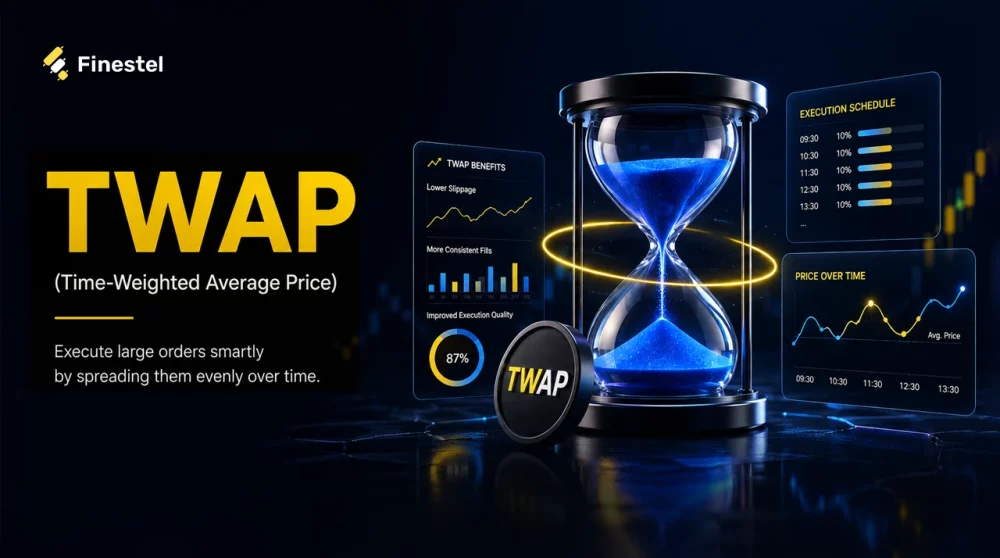

A market order can execute quickly, but a large one can consume several levels of the order book and change the entire average price. A Time-Weighted Average Price, or a TWAP order, solves the problem with an efficient innovation. Instead of sending the entire parent order at once, it divides it into smaller child orders and distributes their execution over time.
TWAP order on Finestel is an execution method. Like other execution strategies, you should know what settings it has and how to make the most of it. TWAP is great for minimizing price impact, but in my view, it works best in liquid, range-bound markets. It may harm you in a trending market in which the price is constantly going up or coming down. Let’s see why.
What is TWAP?
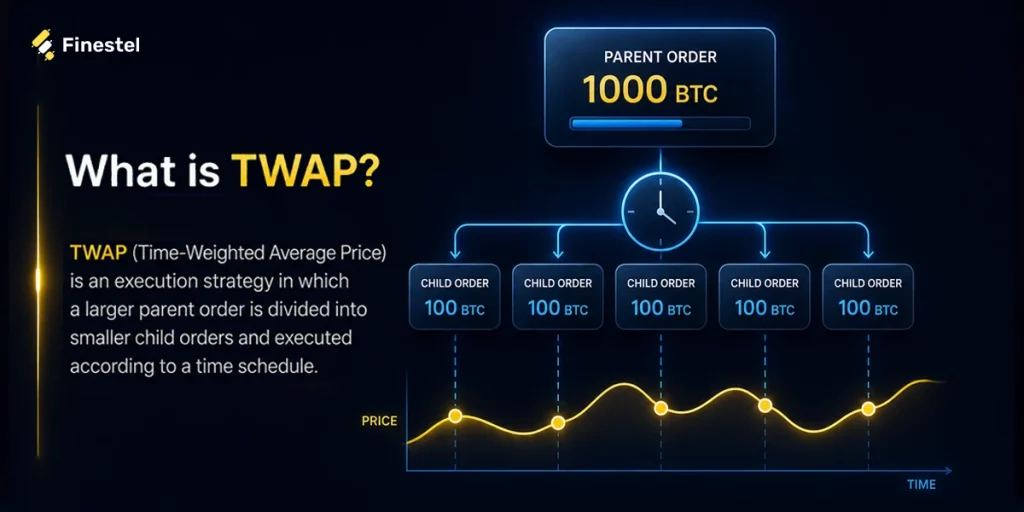
TWAP stands for Time-Weighted Average Price. In execution, a TWAP strategy is primarily a scheduling approach: a larger parent order is divided into smaller child orders and executed according to a time schedule. The objective of TWAP trading is to reduce the market impact of placing the full order immediately and make execution less dependent on one moment’s liquidity.
What Does TWAP Actually Optimize?
TWAP is most useful when you have a sizable order but do not need the entire position immediately. Putting this sizable order at once can affect the price in a way that works against you. In practical and simple terms, I think of it as a scheduling method for executing a larger order.
By the way, I should note that TWAP does NOT guarantee a better price. It doesn’t eliminate slippage or predict where the market will move next. For example, if BTC rises throughout your execution window, spreading a buy order over time can mean paying higher prices. So, the trade-off here is between executing immediately and accepting the market risk that comes with taking more time.
Parent Orders, Child Orders, and Execution Schedules
The concept of a TWAP execution algorithm is based on these three main parts:
- Parent order: The full position you want to buy or sell.
- Child orders: The smaller orders created from the parent order.
- Execution schedule: The timing that determines when those child orders are submitted.
It may sound simple, but the exact configuration matters here. Ten large child orders produce a different result from 60 small ones, even if both eventually execute the same parent quantity. This is why TWAP execution, in practice, is more than simply splitting an order. Let’s get to the TWAP settings and see how they affect the final execution quality.
Main TWAP Settings and Parameters
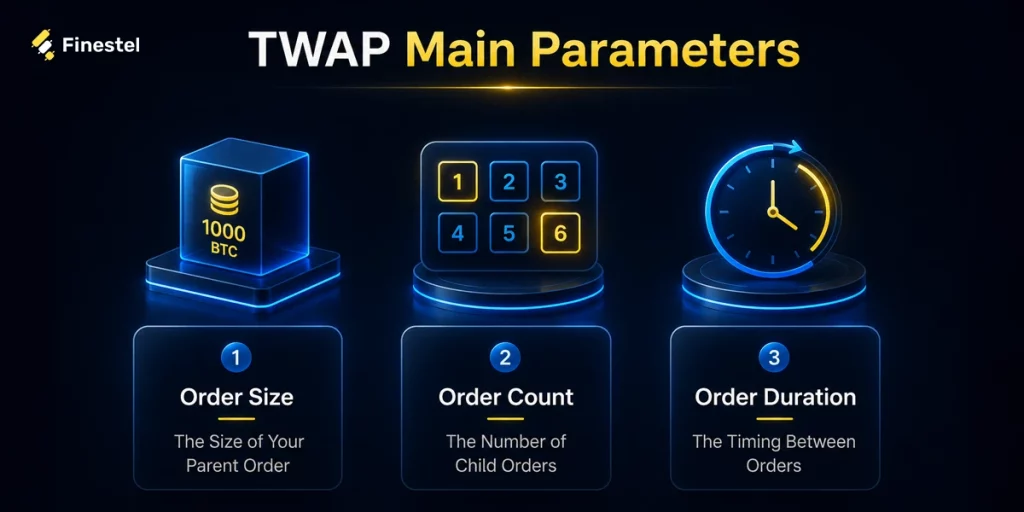
If you prefer to use a TWAP crypto trading strategy, you have to fill out a number of fields that are usually similar in all platforms.
Order Size (Amount)
The order size field determines the size of your parent order. It actually determines how much inventory the TWAP execution needs to complete. Different platforms may have a minimum amount for this setting. For example, Finestel’s trading terminal has a minimum amount of 0.001 BTC for Bitcoin. I will explain these in detail in the following parts.
Order Count (or Number of Orders)
The number of child orders determines how the parent order is divided. If the parent order is 1 BTC and the execution uses 10 equal orders, each scheduled slice would represent approximately 0.1 BTC.
More slices mean less impact, but increasing the number of orders is not automatically better. Extremely small orders may become inefficient because of fees and price slippage. Different platforms also have a minimum and maximum for this setting. Finestel’s trading terminal lets users set between 1 and 60 orders.
Order Duration
Duration controls the timing of the TWAP execution. In Finestel’s trading terminal, the dashboard exposes an order duration from 1 to 600 seconds.
A shorter duration gives the market less time to move away from you, but it also makes the execution more concentrated. A longer duration reduces the impact of each individual slice, but increases timing risk: the market can move substantially before the parent order is completed.

Factors That Determine TWAP Execution Quality
Now, we are familiar with the basics of a TWAP order and the fields we have to fill in. But if we don’t know how to decide on the parameters and how to choose the numbers, the whole strategy is totally useless.
Don’t forget that this guide aims to help you learn the concept. The numbers and scenarios I use are intentionally simplified to break down these execution concepts into plain English. Make sure to do your own research (DYOR) and stick to solid risk management before beginning.
Should You Use a TWAP Order at All?
Before talking about how to set TWAP order parameters, let’s first answer this question: Do you need to use a TWAP order at all? To answer this question, examine the order book and average daily volume of the coin.
I want to give you a general rule of thumb used by execution desks: Try to keep total TWAP order size below five percent of the expected volume during the execution window. If your total order exceeds 5% of the expected volume in that window, you’d better lengthen the duration to let new buyers or sellers arrive.
Setting Duration Based on Market Volatility

A factor that plays a key role in determining your duration is the whole market volatility. In a calm, sideways-ranging market, extending the duration is low risk and gives you maximum liquidity benefits. You can comfortably stretch an order over thirty minutes to an hour without fearing a sudden price runaway.
In a highly volatile or trending market, a long duration works against you. If the market is trending upward while you are trying to buy, every successive child order will execute at a higher price. Conclusion? In fast-moving conditions, reduce the duration to minimize timing risk. Accept a slightly higher market impact per each order for faster completion.
Finding the Right Order Count and Child Order Size
Splitting a parent order into 60 tiny child orders minimizes the impact of each order, but it introduces secondary challenges. First, if your child orders fall below the minimum order size required by the exchange or trading terminal, the bot will fail orders. Second, if you use market orders for each slice, accumulating dozens of fees can quietly destroy your execution edge.
How should we optimize our order count to avoid these challenges? We can do this in three steps:
- First, identify the minimum allowed trade size on the exchange for your trading pair. For instance, if an exchange requires a minimum order size of $10, your child orders must be above $10. In such a case, you typically need at least $20 to account for minor price fluctuations that could temporarily push your order below the limit.
- Next, look at the order book for your asset and inspect the top level (the best bid or ask price). Note how much liquidity sits right at that top price. To avoid pushing the price, cap each child order at no more than 2% to 5% of that top-level liquidity. For example, if there is $1,000 worth of liquidity at the best ask price, keep each child order between $20 and $50.
- And finally, divide your total parent order size by your target child order size to get the total number of orders. Using a $1,000 total parent order and our $50 child orders, we need 20 counts.
TWAP Providers: Top Platforms Comparison
Here is a quick introduction and comparison of some popular TWAP providers:
| Provider | TWAP Approach | Workflow | Multi-Account Focus |
| Finestel | TWAP through the trading terminal, Signal Bot, and TradingView Bot, on 10+ exchanges including Hyperliquid | Manual (trading terminal), webhook, and TradingView-driven execution | Strong; one TWAP order placed on many accounts at once, Trading Groups, non-custodial (funds stay on each exchange) |
| Binance | Native TWAP and POV algorithmic orders | Exchange-native execution | Primarily Binance ecosystem |
| OKX | Native “Slicing Bot” TWAP with custom price variance protection | Dedicated bot dashboard with constant/percentage price caps | Single OKX account execution |
| Pionex | Dedicated TWAP bot | Built-in bot workflow | Exchange-native |
| 3Commas | No dedicated native TWAP bot currently; broader bot and signal-based automation | SmartTrade, Signal Bots, TradingView/webhook automation, and API-connected exchanges | Strong multi-exchange/account management, but not specifically built around TWAP bulk execution |
| WunderTrading | No dedicated native TWAP bot; can complement exchange-native TWAP with external automation | Trading Terminal, Signal Bots, TradingView alerts, API-based automation, and custom workflows | Strong; supports simultaneous execution across multiple API profiles/accounts |
How Finestel’s TWAP Execution Helps Traders
Finestel offers three ways to start a TWAP order: the Trading Terminal, Signal Bot, and TradingView Bot. Whichever you use, the same TWAP can run on one account or on many accounts at once.
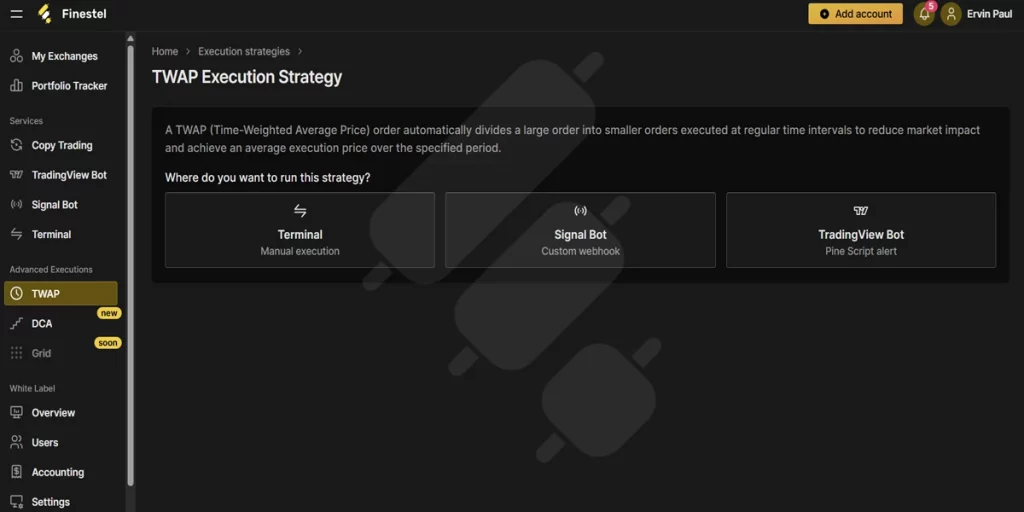
1. Trading Terminal
The Trading Terminal is the most direct option when you already know the order you want to execute. In the TWAP interface, our dashboard exposes:
- Order Count: minimum 1, maximum 60
- Order Duration: 1–600 seconds
- Size: minimum 0.001
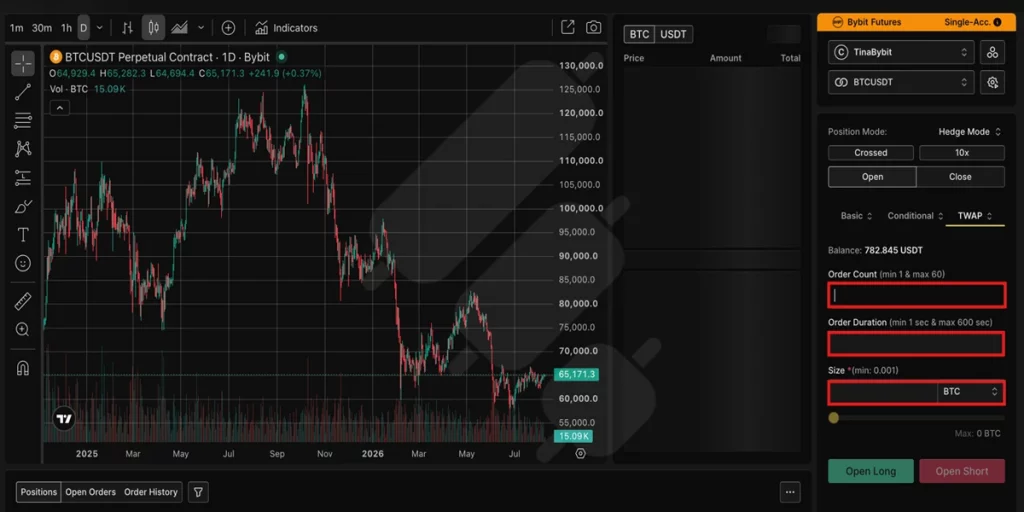
This makes the terminal appropriate when the trader is making the execution decision manually but wants the actual order slicing automated. It is also appropriate for traders operating multiple accounts. In Finestel’s terminal, you select the accounts or a Trading Group and place one TWAP order, and it runs on every selected account simultaneously, each sliced by the same settings.
2. Signal Bot
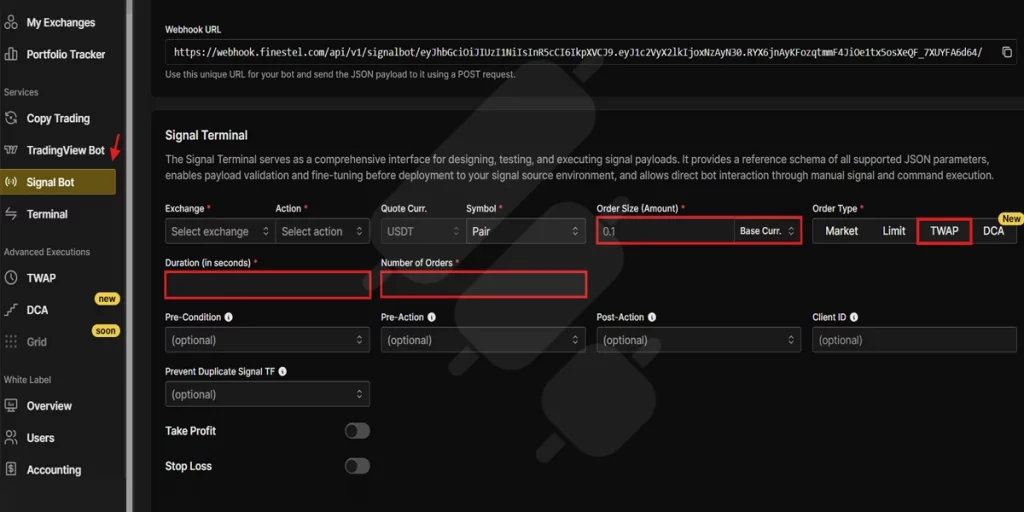
Signal Bot is a better option when the trading decision originates outside the Terminal. Finestel’s Signal Bot accepts webhook alerts and works with sources such as Python or Java scripts, Pine Script, TradingView, n8n, and other systems capable of sending a POST request. In the bot settings, you can configure:
- Default order type, including TWAP
- Order Size (Amount)
- Duration (in seconds)
- Number of Orders
3. TradingView Bot
TradingView Bot is designed for traders whose entry and exit logic already lives in TradingView. A Pine Script strategy can generate an alert, and Finestel’s TradingView Bot turns that alert into a TWAP order on every linked account at once.
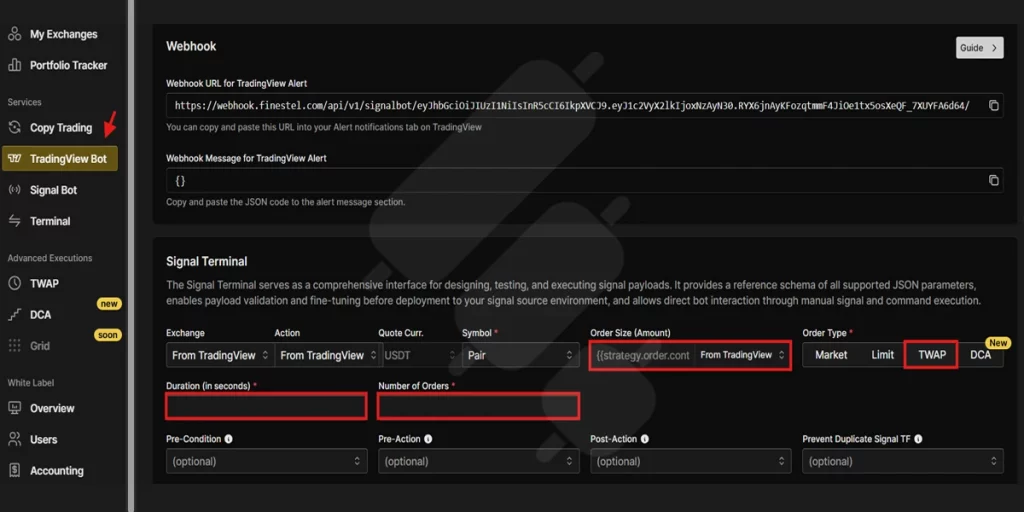
Try TWAP on your own accounts: the trading terminal, Signal Bot, and TradingView Bot are all included in the free Starter plan. Compare plans.
TWAP vs. Other Smart Execution Methods
TWAP is only one way to approach a large order. You can find the other ones in the table below:
| Execution Method | Main Logic | Main Trade-off |
| TWAP | Splits trade equally over time | Ignores market spikes; buys during quiet, illiquid moments |
| VWAP | Splits trade to match historical volume | Misses targets if today’s volume doesn’t match past trends |
| POV | Scales trades to a percentage of live volume | Completion time is unpredictable if trading volume drops |
| DCA | Buys a fixed dollar amount regularly | Not designed for executing a single large trade |
| Iceberg | Hides total size and shows one small order at a time | Doesn’t protect against overall market price movement |
TWAP vs VWAP
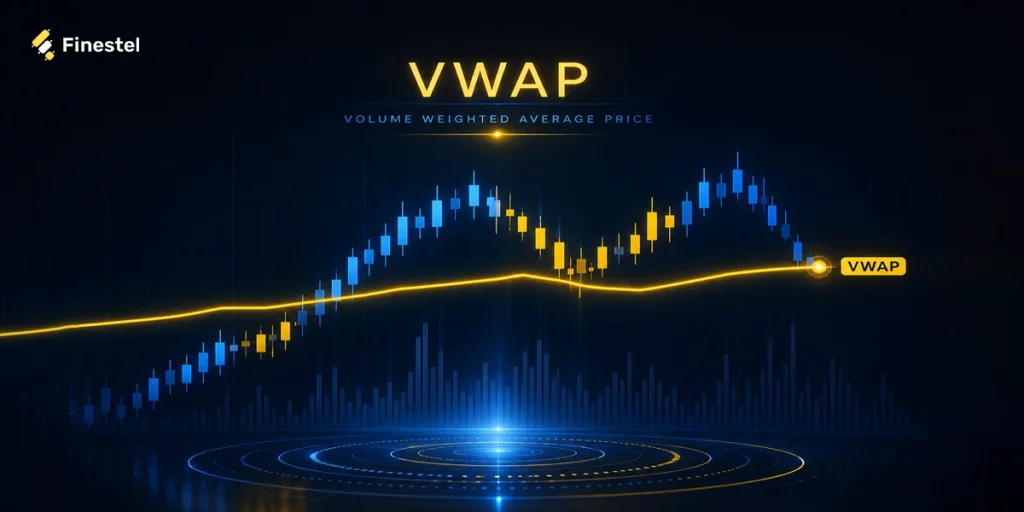
VWAP stands for Volume-Weighted Average Price. The simplest distinction between TWAP and VWAP is that TWAP follows time, but VWAP follows volume.
TWAP generally divides execution according to time. VWAP attempts to align execution with the market’s volume profile. If trading volume is predictable and strongly concentrated at particular periods, VWAP can make more sense. If you want a simpler schedule that does not depend on forecasting volume, TWAP can be easier to implement.
TWAP vs DCA
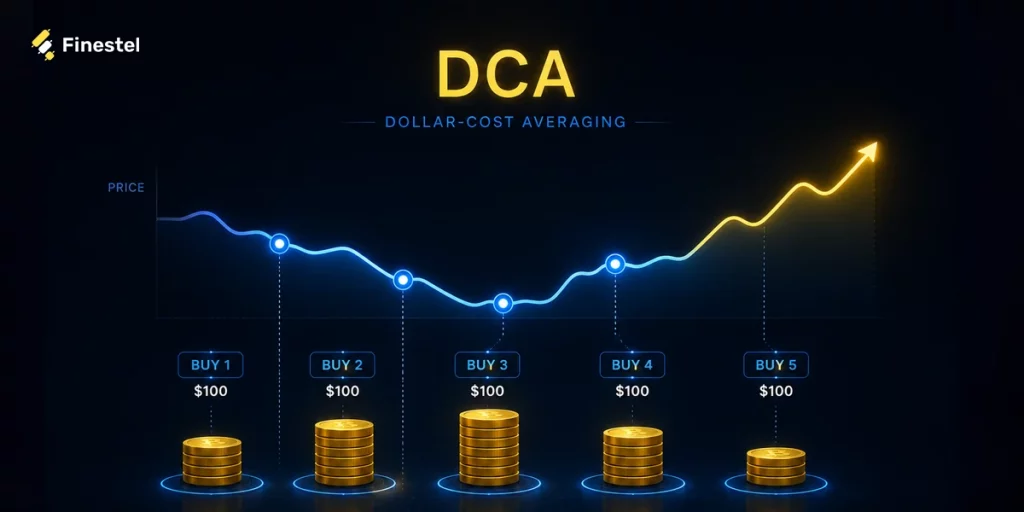
TWAP and DCA settings both execute multiple orders over time, but they serve completely different purposes. Dollar-Cost Averaging (DCA) is a multi-order trading or investment method designed to profit from ongoing price volatility. TWAP is purely an execution method rather than a trading strategy.
I would use TWAP when I want to place a fixed but large order. For example, if I want to buy $50,000 worth of BTC, TWAP lets me spread that order across smaller executions over a defined timeframe. My goal here is to avoid a price impact that works against me.
I would choose a DCA bot from a list of the best DCA bots that we have provided in that article when I want to build a position gradually based on price movements. For example, I make an initial purchase and place additional orders if the price drops by certain percentages. In this case, I am not trying to complete one fixed order within a set timeframe. I am using market movements to decide when to put more money into the position.
TWAP vs POV

POV, or Percentage of Volume, responds to the market’s actual trading activity. If the market becomes more active, a POV algorithm increases its participation. When market volume falls, it slows down. For example, if you set it to 10%, it will try to make up about 10% of the market’s trading volume while your order is being executed. If the market gets busy, it can execute more. If trading slows down, it slows down too.
TWAP does not need that volume participation logic. It follows its time schedule instead. It’s actually a simpler and more straightforward option for spreading an order over a specific period.
TWAP vs Iceberg

An iceberg order primarily addresses visibility. It shows only a portion of a larger order to the market at a time. It’s best suited for traders concerned about displaying full order size. It does not solve timing risk. TWAP primarily addresses timing. The two concepts can therefore solve different execution problems rather than being direct substitutes.
What Are the Advantages of TWAP Execution?
Up to now, we have gone through almost everything you need to know about a TWAP order and its features. If we want to sum up its key advantages, we can refer to:
- Reduced Market Impact: This is the first and most obvious advantage. Splitting a large trade into smaller child orders saves you from heavy price slippage and moving the market against yourself.
- Smoother Entry Prices: This is a secondary, potential advantage. Executing all at once exposes you to bad timing, like buying at an accidental price spike. Spreading your trade over time averages out short-term market noise.
- Hides Your Intentions: Flashing a huge order on the order book alerts other traders and bots, who might trade against you. Slicing your order into smaller pieces keeps your total trade size hidden.
- Hands-Off Execution: Instead of sitting at your screen for hours manually placing dozens of small trades, a TWAP bot handles the entire process automatically and without emotional mistakes.
TWAP Risks and Limitations
Like any other execution tool that assists you in your trades and investments, TWAP comes with its own risks and limitations. The most important limitations include:
- Price Drift: If the market trends strongly while your bot is running, your later orders will fill at much worse prices than your first ones.
- Ignoring Sudden Low Liquidity: TWAP buys on a strict timer. If trading volume suddenly drops, the bot keeps buying anyway, which can cause heavy slippage on thin order books.
- Predictable Patterns: Trading at exact time intervals makes it easy for algorithms to spot your pattern and trade ahead of your next order.
- Accumulated Fees: Slicing one big order into dozens of tiny market trades can generate high trading fees that eat into your profits.
Conclusion
Executing large crypto orders used to mean losing control over your entry prices and watching slippage destroy your profits, but TWAP changes the game. I went through different TWAP features and explained which markets and conditions it is best suited for.
As the concluding point, I want to emphasize one key takeaway. From my perspective, the key to getting the best results while using a TWAP order is to keep these two important rules in mind: cap child orders at 2% to 5% of top-level liquidity, and restrict long durations to quiet or range-bound markets. TWAP is here to reduce the price impact for you. It shouldn’t lead to buying high or selling low.
FAQs
When is the best time to use a TWAP order?
TWAP works best when you need to execute a large order over a fixed timeframe in a steady market. However, you should avoid using TWAP during high-impact news events or sudden market crashes, as its fixed timing will blindly keep buying or selling into sharp price drops.
Can I run a TWAP order using limit orders instead of market orders?
Yes, many platforms allow you to set child orders as limit orders to avoid paying higher taker fees. However, if the market trends away from your limit price, your order won’t fill.
What happens if a child order doesn’t get filled during its time window?
Depending on how your exchange or bot is configured, it will either cancel the unfilled order, retry it at the market price, or add the remaining size onto the next child order to keep your total target on track.
Is TWAP useful for small retail trades?
While TWAP was built for large institutional orders, it is also useful for retail traders in low-liquidity altcoin markets. If you are buying a low-market-cap token with a thin order book, even a $1,000 order can sweep multiple price levels.



Leave a Reply