


PAMM accounts present a unique investment avenue, enabling individuals to access the financial markets and potentially generate returns through the expertise of skilled traders. In this practice, three sides are involved, including the investor, trader, and broker. This system is mostly used by Forex traders and, recently, by cryptocurrency traders. The procedure is straightforward, where traders use the allocated funds by investors to trade in financial markets in a Forex broker or crypto exchange.
By reading this post on Finestel, you will understand what a PAMM account is and its types are. Also, in what terms are they different from LAMM or MAM account types? Going further, we have provided the readers with the benefits a Percentage Allocation Management Module account has and reviewed equal distribution and percentage allocation in a Percentage Allocation Management Module account. Also, a step-by-step guide about how to use a PAMM account in the crypto market and the fee structure of a PAMM account. Hopefully, at the end of this post, the reader will know PAMM account types and their benefits and risks in the market.
Key Takeaways
- What is a PAMM Account? A Percentage Allocation Management Module (PAMM) account allows investors to allocate funds to skilled traders who manage trades on their behalf.
- Mutual Benefits: Investors earn passive income without trading themselves, while traders increase their capital base and earn performance fees.
- Finestel Elevates PAMM Trading: Finestel provides advanced tools, security, and customization to enhance the PAMM experience for both investors and managers.
- Start Your PAMM Journey with Finestel: Unlock your passive income potential today by joining Finestel‘s innovative platform.
Understanding the Concept of PAMM Accounts
In short: you contribute capital, a skilled trader works it, and returns flow back to you automatically, no trading experience needed.
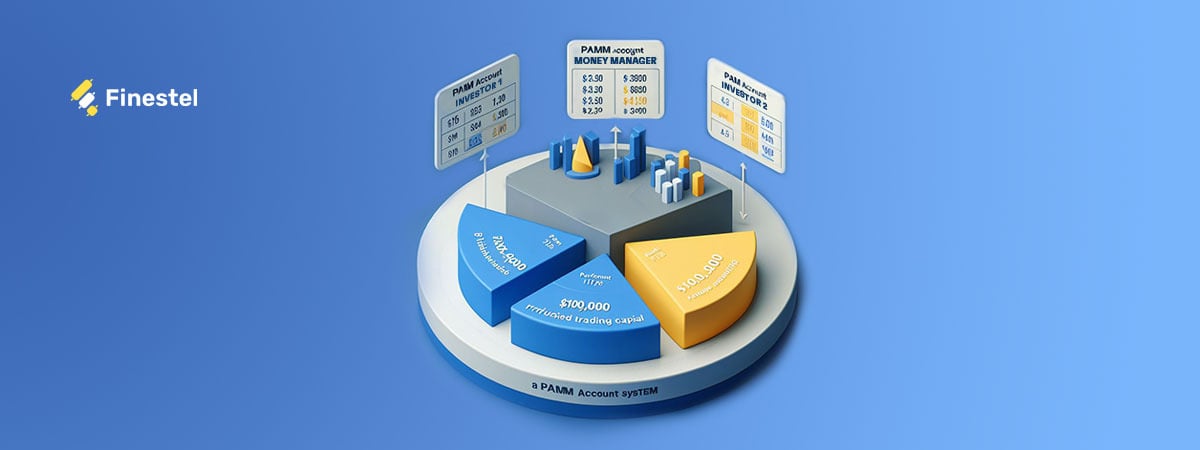
The PAMM account is yet another investment account solution that enables individuals to participate in the financial markets without having to trade themselves. Forex traders commonly use this investment solution, which stands for the Percentage Allocation Management Module. Taking a closer look, the percentage in PAMM refers to the manager’s share percentage, profit distribution percentage, or investor’s allocation percentage.

Going further, allocation in PAMM refers to the funds that investors assign or allocate to the PAMM account for trading purposes. Finally, the management module suggests that PAMM is an investment solution or a money management model that traders can choose to reap profit. Overall, PAMM accounts are a simple way for investor’s pick to benefit from profits with the slightest contribution.
How a PAMM Account Works: Step by Step
Three parties make a PAMM account function:
- The investor allocates capital and earns passive returns
- The PAMM manager trades the pooled funds and earns a performance fee
- The broker or platform connects both parties, calculates allocations, and distributes profits automatically
Here is the exact sequence of events when you invest through a PAMM account:
- A PAMM manager opens a master account on a broker (Forex) or software platform (crypto) and deposits their own capital, creating personal “skin in the game.”
- Investors review the manager’s track record and allocate funds to that master account.
- The manager trades the total pooled capital as a single account, making all buy and sell decisions.
- When positions are closed, the platform automatically calculates each investor’s share of the profit or loss based on their percentage of the pool.
- Performance fees are deducted from the investor’s profit share and credited to the manager.
- Investors can monitor results in real time and withdraw funds according to the agreed terms.
The platform handles all allocation math; you never need to manually calculate your share.
A Real Numerical Example
Suppose a PAMM account has three investors and one manager:
| Participant | Deposit | Pool Share |
| Investor A | $50,000 | 50% |
| Investor B | $30,000 | 30% |
| Investor C | $20,000 | 20% |
| Total Pool | $100,000 | 100% |
During the trading period, the manager generates a 10% gain → $10,000 in profit.
After deducting the 20% performance fee ($2,000):
Remaining profit to distribute = $8,000
| Investor | Share | Profit Received |
| Investor A | 50% | $4,000 |
| Investor B | 30% | $2,400 |
| Investor C | 20% | $1,600 |
If the account had lost 10% instead, the $10,000 loss would be split identically, A loses $5,000, B loses $3,000, C loses $2,000. The manager also absorbs losses on their own deposited capital, which is precisely why their interests stay aligned with yours.
PAMM Account Types
Not all PAMM accounts are structured the same way. Depending on the platform and your investment profile, you will typically encounter four main types:
Individual PAMM account: A one-to-one arrangement between a single investor and a specific fund manager. Best suited for investors who prefer a dedicated, personalised management relationship.
Pooled PAMM account: The standard model, where multiple investors combine their capital under one manager. This is the most widely available type on both Forex brokers and crypto platforms.
VIP PAMM account: Offered to high-net-worth investors, typically with lower fees, priority access to top-performing managers, and additional reporting tools.
Corporate PAMM account: Designed for institutional investors or corporate entities with regulatory and reporting requirements that differ from retail accounts.
Before committing, read the terms and conditions for the specific type you are opening — minimum deposits, lock-up periods, and withdrawal restrictions vary significantly.
AMM vs MAM vs LAMM: Key Differences
These three terms are often used interchangeably but they describe meaningfully different systems:
| Feature | PAMM | MAM | LAMM |
| Capital structure | Pooled | Separate sub-accounts | Separate sub-accounts |
| Profit allocation | % of pool | Per-account basis | Lot-based |
| Investor control | Low | Medium | Low |
| Risk customisation | No | Yes (per investor) | No |
| Best for | Passive investors | Investors wanting custom risk | Accounts of similar size to manager |
PAMM pools all funds and distributes results by percentage. The manager sees one large account, not dozens of individuals.
MAM (Multi-Account Manager) gives each investor their own sub-account. This means investors can agree on different risk levels, for example, one investor runs conservative lot sizes while another runs aggressive ones, while the manager still executes from a single interface.
LAMM (Lot Allocation Management Module) distributes trades by lot size rather than percentage. If the manager buys one standard lot, each investor’s account also receives one standard lot, regardless of how much capital they have. This makes LAMM impractical when investor account sizes differ significantly, which is why PAMM largely replaced it.
PAMM vs Copy Trading: Which Is Right for You?
This is one of the most common questions prospective PAMM investors ask, and the distinction matters.
In a PAMM account, your funds are transferred to the manager’s pooled account. The manager has full trading authority until you withdraw. You do not choose individual trades, you cannot exit a single trade early, and your performance is tied to the entire pool.
In copy trading, your capital stays in your own brokerage account at all times. You choose a signal provider, and every trade they execute is automatically mirrored in your account. You can pause copying, adjust your risk level, or stop following a trader instantly.
| Comparison point | PAMM account | Copy trading |
| Capital custody | Pooled with manager | Stays in your account |
| Control over trades | None | Partial (can stop anytime) |
| Execution precision | High (single pool) | May experience slippage |
| Transparency | Varies by platform | Usually higher |
| Ease of use | Very hands-off | Slightly more involvement |
| Best for | Long-term, trust-based investing | Flexible, diversified following |
Choose PAMM if you want a fully delegated, hands-off investment and you are comfortable entrusting funds to a vetted manager for a sustained period.
Choose copy trading if you want to retain account ownership, test multiple strategies simultaneously, or prefer to be able to exit at any moment without restriction.
Neither model guarantees profit, the quality of the trader you select is the single most important variable in both cases.

PAMM in Forex vs Crypto
The mechanics of a PAMM account are the same in both markets. What changes is the environment those mechanics operate in.
Forex PAMM accounts:
- Trading hours: 24 hours a day, 5 days a week (closed on weekends)
- Regulatory frameworks: well-established in most jurisdictions (FCA, CySEC, ASIC, etc.)
- Asset classes: primarily currency pairs, with some brokers adding commodities and indices
- Volatility: moderate and predictable for major pairs
- Origins: Alpari introduced the first Forex PAMM service in 2008
Crypto PAMM accounts:
- Trading hours: 24/7 with no market closure
- Regulatory frameworks: still developing in most regions; overnight regulatory changes can affect portfolios
- Asset classes: Bitcoin, Ethereum, altcoins, and DeFi tokens — far broader than Forex
- Volatility: significantly higher than Forex, with potential for rapid drawdowns and rapid recoveries
- Opportunity: more trading sessions and a larger asset universe create more potential entry points for skilled managers
If you are new to managed accounts, starting with a Forex PAMM account at a regulated broker typically offers a more predictable first experience. Crypto PAMM can offer higher potential returns, but requires a higher risk tolerance and careful vetting of both the platform and the manager.
PAMM Fee Structures Explained
Understanding the fee structure before you invest is essential, fees directly reduce your net return. The main revenue streams for a PAMM manager are:

Performance fee: The primary and most important fee. This is a percentage of the profit the manager generates, agreed upon before you allocate funds. A typical range is 15–30%. Because it is charged only on gains, the manager only earns well when you do.
Management fee: A flat periodic fee calculated as a percentage of total assets under management, regardless of performance. Not all PAMM accounts charge this, but some do, check carefully.
High-watermark principle: Many PAMM accounts include this investor-friendly clause. It means the manager can only charge a performance fee on new profits above the account’s previous peak. If the account loses 10% and then recovers that 10%, no performance fee is charged on the recovery, the manager must generate genuinely new profits first.
Volume commission: Some platforms pay managers a commission based on total trading volume, similar to an introducing broker arrangement.
IB (Introducing Broker) fees: Managers who refer new investors to a platform may receive a referral fee from the broker, separate from any investor-facing charges.
Always ask for a full fee schedule in writing before allocating capital.
How to Invest in a PAMM Account
Follow these steps to get started:
- Select a reputable platform. Look for a broker or software (such as Finestel for crypto PAMM) that is regulated, transparent about fee structures, and provides verifiable manager performance data.
- Evaluate PAMM managers carefully. Do not rely on short-term returns. Look for consistent performance across at least 6–12 months, a reasonable maximum drawdown (under 20–25% is a general benchmark), and a clear, documented trading strategy.
- Open and verify your account. Complete the platform’s KYC process and review the PAMM investment agreement, this document governs profit-sharing ratios, withdrawal terms, and fee structures.
- Fund your account and allocate capital. Decide what percentage of your investable capital to commit. It is advisable to start with a smaller allocation until you have observed the manager’s live performance.
- Monitor performance regularly. Use the platform’s reporting tools to track trade history, open positions, drawdown metrics, and net returns. Most platforms provide real-time dashboards.
- Withdraw and reinvest strategically. Once comfortable, you can test withdrawals and, if results meet your expectations, gradually increase your allocation or diversify across multiple managers.
How to Become a PAMM Manager
Managing a PAMM account is a serious undertaking that requires both trading skill and operational discipline. Here is what the process looks like:

Build a verifiable track record. Investors will examine your performance history before committing funds. Aim for at least 6–12 months of documented live trading results, not backtests. Platforms like Finestel offer automated reporting and real-time performance tracking that make this evidence easy to present.
Earn relevant credentials. Trading and investment management certifications signal credibility and regulatory awareness. They are not universally required but are increasingly expected by serious investors.
Choose the right platform. Your platform determines your tools, your reach, and how efficiently you can manage multiple investors. Finestel provides advanced analytics, automated investor notifications, built-in referral tools, and a large pool of investors actively seeking qualified managers.
Define and document your trading strategy. Investors need to understand your approach before they trust you with capital. Clearly articulate your market focus, risk management rules (maximum drawdown limits, stop-loss protocols), and the conditions under which you would close the account.
Market your services. A strong track record means nothing if investors cannot find you. Use the platform’s built-in promotional tools, share performance updates on social channels, and leverage referral systems to grow your investor base.
Maintain rigorous transparency. Send regular performance updates, communicate promptly if market conditions change your strategy, and never obscure drawdowns. Long-term trust, and therefore long-term capital, depends on it.
Why Finestel for PAMM Trading?
Choosing a PAMM platform is not just an administrative step, it directly affects how much visibility you have into your investment, how efficiently managers can operate, and ultimately how much trust exists between both sides. Here is where Finestel makes a concrete difference, and why it is worth examining specifically rather than treating it as interchangeable with any other option.
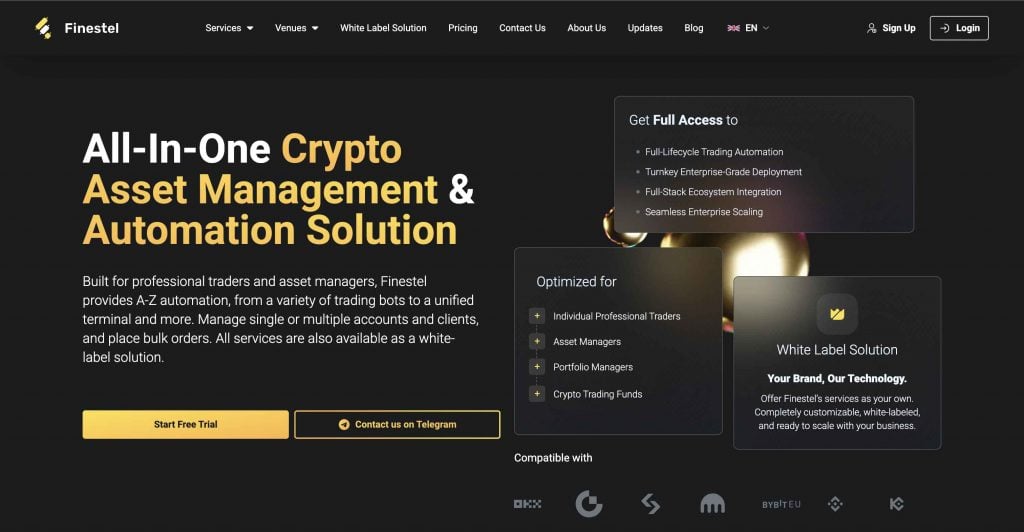
Screenshot
The problem most PAMM platforms have is that they were built as broker add-ons, not as dedicated asset management tools. That means reporting is basic, customisation is limited, and managers spend more time on administrative work than on trading. Finestel was built from the ground up for crypto asset management, which means PAMM functionality is the core product, not a feature tacked on.
For PAMM managers
Multi-investor management from one interface: Whether you are managing 5 investors or 500, Finestel handles allocation calculations, profit distribution, and fee deductions automatically and accurately. Scaling your investor base does not create proportionally more administrative overhead.
Automated investor reporting: One of the most time-consuming parts of running a PAMM account is keeping investors informed. Finestel automates this, This lets you focus entirely on trading.
Built-in marketing and referral tools: Finestel gives managers a shareable public profile page with live performance data, making it straightforward to attract new investors through social channels or the platform’s internal investor marketplace.
White label solution: This level of customisation is uncommon in PAMM platforms, but Finestel lets you to customize your platform and offer it to your clients under your own brand and name.
24/7 support: The crypto market never closes, and neither does Finestel’s support team. If a technical issue arises at 3am during a volatile session, there is someone to contact.

Allocation Methods: Equal Distribution vs Percentage Allocation
When an investor allocates capital across multiple managers or strategies, two frameworks apply:
Equal distribution splits capital evenly across all selected managers. For example, a $10,000 investment split equally across two managers means $5,000 to each. This is simple but inflexible, it gives no weight to your conviction in individual managers.
Percentage allocation lets you assign a custom proportion to each manager. With the same $10,000 you might allocate 10% to Strategy A, 40% to Strategy B, and 50% to Strategy C, reflecting different confidence levels or risk profiles. This approach requires more active decision-making but gives you precise control over your exposure.
Most experienced PAMM investors use percentage allocation to diversify across multiple managers with different styles (trend-following, range-trading, high-frequency), reducing the impact of any single manager’s drawdown on their overall portfolio.
Tax Considerations
Tax treatment of PAMM account income varies significantly by country. The following applies as general guidance, always consult a qualified tax professional in your jurisdiction before investing.
For investors: profits from PAMM accounts are most commonly treated as capital gains or passive investment income, often taxed at a lower rate than active employment income. Cross-border investments may trigger withholding tax obligations or foreign income reporting requirements.
For managers: management fees and performance fees are typically treated as business revenue or self-employment income. You may need to register as a business entity and file additional tax forms depending on your jurisdiction. Deductions for operating costs (software, professional services, data feeds) may be available.
For crypto PAMM participants: many countries treat cryptocurrency as property rather than currency. This means each trade within a PAMM account could technically be a taxable event. Accurate record-keeping of all transactions is essential.
Risks and How to Manage Them
PAMM accounts carry real risks that every investor should understand before allocating capital.
Manager risk: The manager may make poor decisions, overleverage, or simply face a sustained losing streak. Mitigation: diversify across multiple managers with different strategies, and set a maximum drawdown threshold at which you will withdraw.
Market risk: Even a skilled manager cannot fully protect against severe market dislocations, flash crashes, or liquidity crises. Mitigation: only invest capital you can afford to lose, and avoid concentrating your entire investable portfolio in a single PAMM account.
Liquidity risk: Some PAMM accounts impose withdrawal restrictions, lock-up periods, or notice requirements. Mitigation: read withdrawal terms carefully before investing, and ensure you maintain sufficient liquid savings outside the account.
Platform risk: Technological failures, cyber breaches, or insolvency of the broker or platform can put your funds at risk. Mitigation: use regulated brokers with established reputations and investor protection schemes.
Regulatory risk: Particularly relevant for crypto PAMM accounts, where sudden regulatory changes can affect fund access or platform operation. Mitigation: choose platforms in jurisdictions with clear and stable regulatory frameworks.
Allocation Methods: Equal Distribution vs Percentage Allocation
When an investor allocates capital across multiple managers or strategies, two frameworks apply:
Equal distribution splits capital evenly across all selected managers. For example, a $10,000 investment split equally across two managers means $5,000 to each. This is simple but inflexible, it gives no weight to your conviction in individual managers.
Percentage allocation lets you assign a custom proportion to each manager. With the same $10,000 you might allocate 10% to Strategy A, 40% to Strategy B, and 50% to Strategy C, reflecting different confidence levels or risk profiles. This approach requires more active decision-making but gives you precise control over your exposure.
Most experienced PAMM investors use percentage allocation to diversify across multiple managers with different styles (trend-following, range-trading, high-frequency), reducing the impact of any single manager’s drawdown on their overall portfolio.
Tax Considerations
Tax treatment of PAMM account income varies significantly by country. The following applies as general guidance, always consult a qualified tax professional in your jurisdiction before investing.
For investors: profits from PAMM accounts are most commonly treated as capital gains or passive investment income, often taxed at a lower rate than active employment income. Cross-border investments may trigger withholding tax obligations or foreign income reporting requirements.
For managers: management fees and performance fees are typically treated as business revenue or self-employment income. You may need to register as a business entity and file additional tax forms depending on your jurisdiction. Deductions for operating costs (software, professional services, data feeds) may be available.
For crypto PAMM participants: many countries treat cryptocurrency as property rather than currency. This means each trade within a PAMM account could technically be a taxable event. Accurate record-keeping of all transactions is essential.
An Overview Infographic: PAMM Accounts
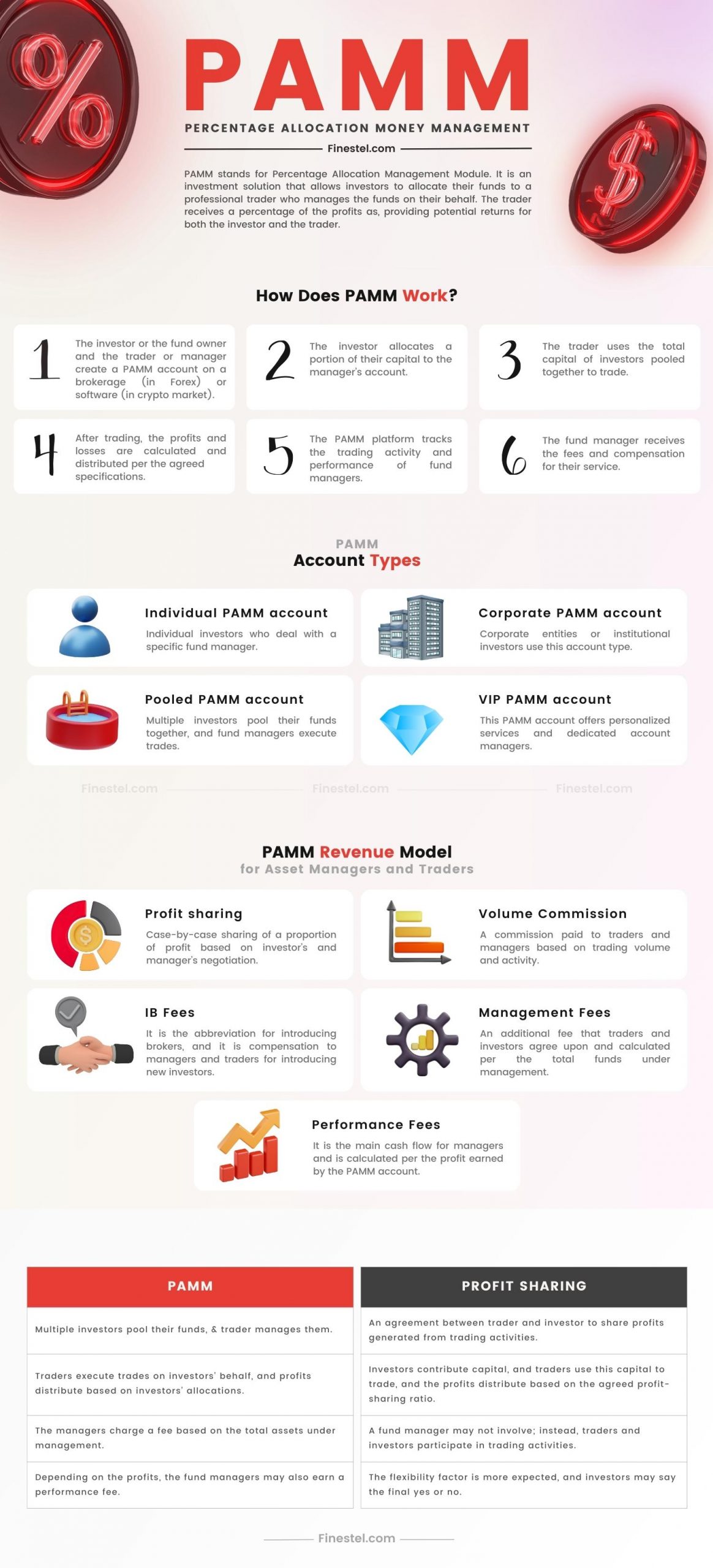
PAMM Overview Infographic
Frequently Asked Questions
What does PAMM stand for?
PAMM stands for Percentage Allocation Management Module. It refers to both the investment structure and the software system that automatically calculates and distributes profits and losses among participants.
How can I invest in a PAMM account?
Choose a regulated broker or software platform that offers PAMM services, open and verify your account, review manager performance data, and allocate your capital. Monitor performance regularly and withdraw if results no longer meet your criteria.
Are PAMM accounts legal?
In most jurisdictions, yes, provided the broker operating the PAMM service is properly licensed. Regulations differ by country; in the US, for example, PAMM accounts face stricter CFTC and NFA oversight. Always confirm the regulatory status of your broker before investing.
How do I monitor PAMM account performance?
Most platforms provide real-time dashboards showing trade history, open positions, drawdown statistics, and net returns. Account statements are typically generated automatically. You should also be able to communicate directly with your manager through the platform.
What fees are associated with PAMM accounts?
The primary fee is the performance fee, a percentage of profits charged by the manager. Some accounts also charge a management fee based on total assets. Always request a full, written fee schedule before investing.
Is a PAMM account profitable?
Profitability depends entirely on market conditions, the manager’s skill, and the risk management framework in place. Returns are not guaranteed. Investors who carefully vet managers, diversify across accounts, and maintain realistic expectations are best positioned for positive long-term results.
What is the difference between PAMM and copy trading?
In a PAMM account, your funds are pooled with other investors and managed collectively, you give up trade-by-trade control. In copy trading, your funds stay in your own account and trades are mirrored from a signal provider in real time, you retain the ability to stop copying at any moment.
Final Thoughts
PAMM accounts offer a genuinely compelling structure for investors who want exposure to professional trading without the time commitment of active trading. The proportional profit-sharing model, high-watermark fee principles, and automatic distribution mechanics make it one of the more investor-friendly managed account formats available.
That said, they require the same due diligence as any investment: vetting managers rigorously, understanding the fee structure fully, diversifying your exposure, and setting clear limits on acceptable drawdown.
For both investors and managers, having the right platform is critical. Finestel provides advanced performance tracking, automated reporting, customisable dashboards, and a secure environment built specifically for the demands of PAMM investing in both Forex and crypto markets.
Ready to explore PAMM investing? Join Finestel and start your journey today.



Leave a Reply