

A Hyperliquid vault allows users to pool their funds and receive a proportional share of the vault’s profits and losses. There are different types of vaults on Hyperliquid: HLP, the protocol’s official vault, is managed by Hyperliquid, while user vaults are operated by individual traders or automated strategies.
Many traders think of Hyperliquid vaults as a copy trading tool, where they only need to deposit crypto and gain passive exposure to a trading strategy. But it is important to note that Hyperliquid vaults are not without risks, and profits are not guaranteed. Before allocating capital, I recommend carefully assessing key risks, including lock-up periods, leverage, and potential drawdowns.
What Is a Hyperliquid Vault?
Put simply, a Hyperliquid vault pools users’ funds and uses them for different trading or liquidity strategies. When you deposit assets into a vault, you receive a share based on your contribution relative to its total equity. The vault then deploys this capital across Hyperliquid’s markets according to rules defined by its creator.
Unlike a vault, a Hyperliquid trading bot executes your own strategy while keeping funds in your personal account. It can automate signals, copy trades across multiple accounts, and give you more control over position sizing and exits, without a vault lock-up period.
Types of Hyperliquid Vaults
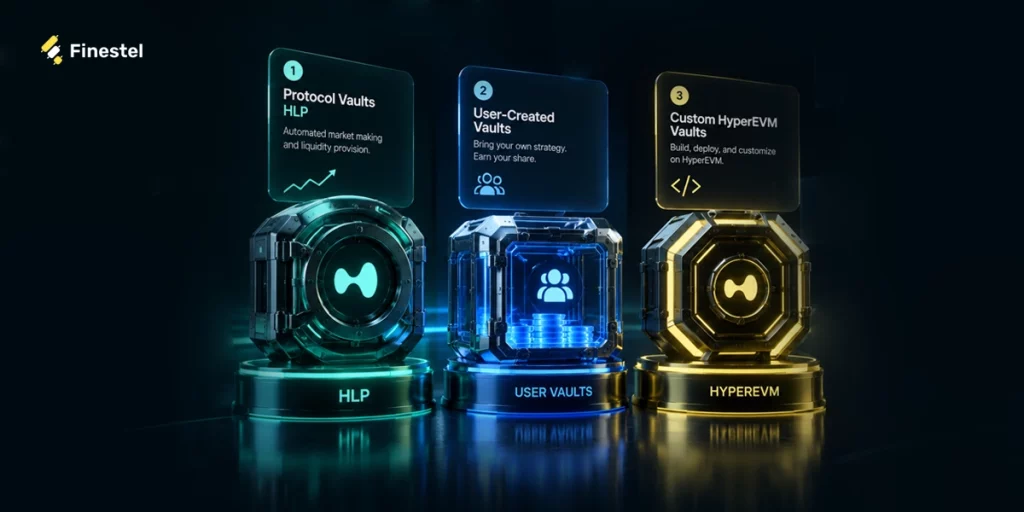
HyperCore includes protocol vaults such as HLP and user-created vaults. With the introduction of HyperEVM, builders can now create customizable vaults and define their own accounting, trading, and withdrawal rules.
1. Protocol Vaults: HLP
HLP, or Hyperliquidity Provider, is a community-owned protocol vault that allocates user capital across several market-making strategies, participates in liquidations, supplies a portion of its USDC to Hyperliquid Earn, and accrues a share of the platform’s trading fees.
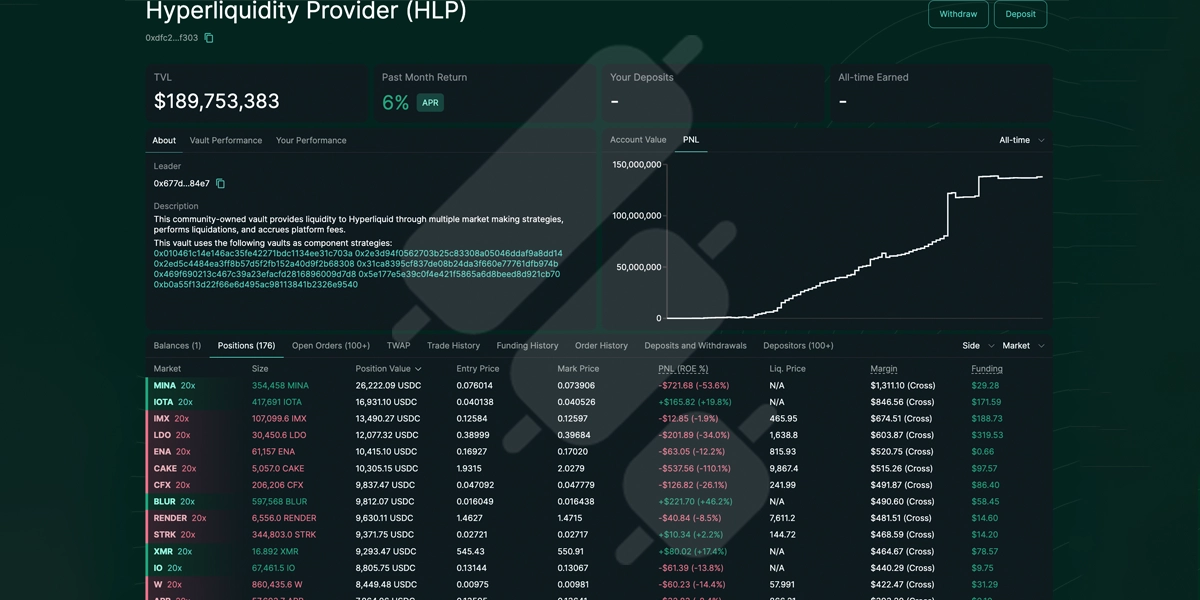
One of the key differences between HLP and user-created vaults is that it does not charge the 10% leader profit share. Instead, community members can provide liquidity to the vault and participate proportionally in its profits and losses.
2. User-Created Vaults
User-created vaults are managed by individual traders or automated trading systems. By depositing capital, you can gain exposure to the vault’s strategy and share proportionally in both its profits and losses. In return for managing the vault, the vault leader receives a 10% share of the profits generated for depositors.
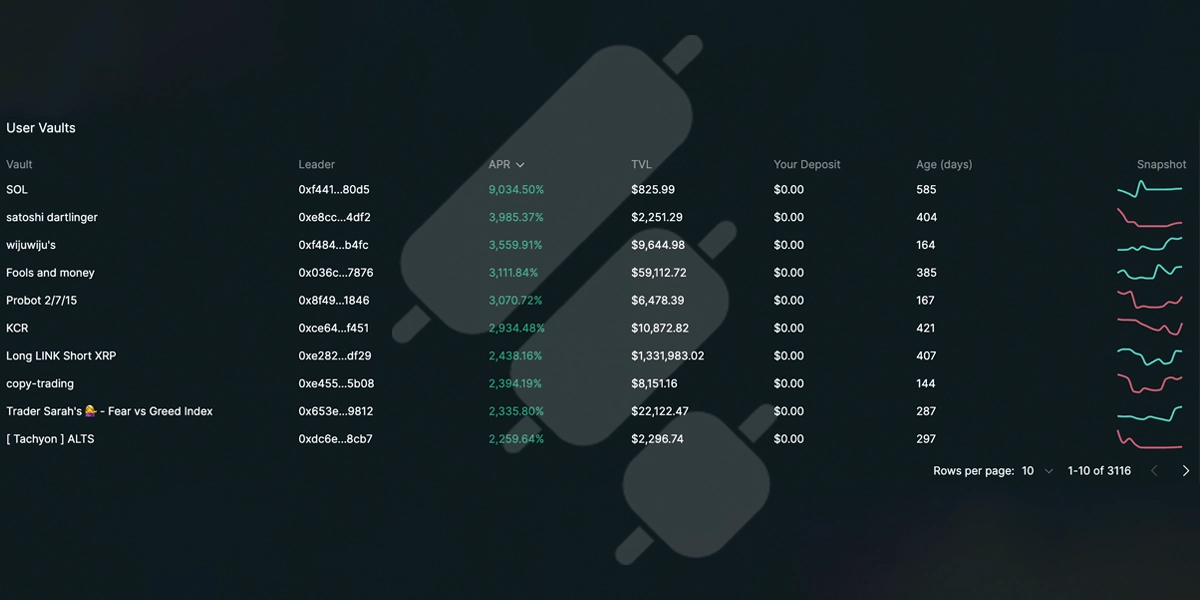
Legacy user-created vaults on HyperCore can only trade validator-operated perpetual markets. They cannot trade spot assets or HIP-3 perpetual markets.
3. Custom HyperEVM Vaults
Custom HyperEVM vaults can support a wide range of programmable strategies, including:
- How vault shares are issued and valued
- Deposit and withdrawal mechanics
- Fee structures
- Trading strategies
- Supported assets and markets
- Access permissions for bots and authorized agents
- Lock-up periods and settlement conditions
How Do Hyperliquid Vaults Work? Core Features and Workflow

At first glance, Hyperliquid vaults may resemble staking or liquidity pools in DeFi. But the key difference is that a vault is not limited to a predefined mechanism for placing trades or providing liquidity. It can execute a wide range of programmable strategies, including:
- Spot and perpetual trading
- Algorithmic trading strategies
- Market making on the order book
- Collateral and position management
- Delegating trade execution to bots or authorized agents
Workflow For Vault Leaders and Depositors
A legacy user-vault leader must deposit at least 100 USDC, pay a 100 USDC creation fee, and maintain at least 5% of the vault’s equity. As compensation, they receive 10% of the profits they generate for depositors, giving traders a way to share their strategies with a wider community.
This model is similar to the performance fee structure commonly used in copy trading, where the strategy provider is compensated only when the users following their strategy make a profit.

How Vault Shares Are Calculated
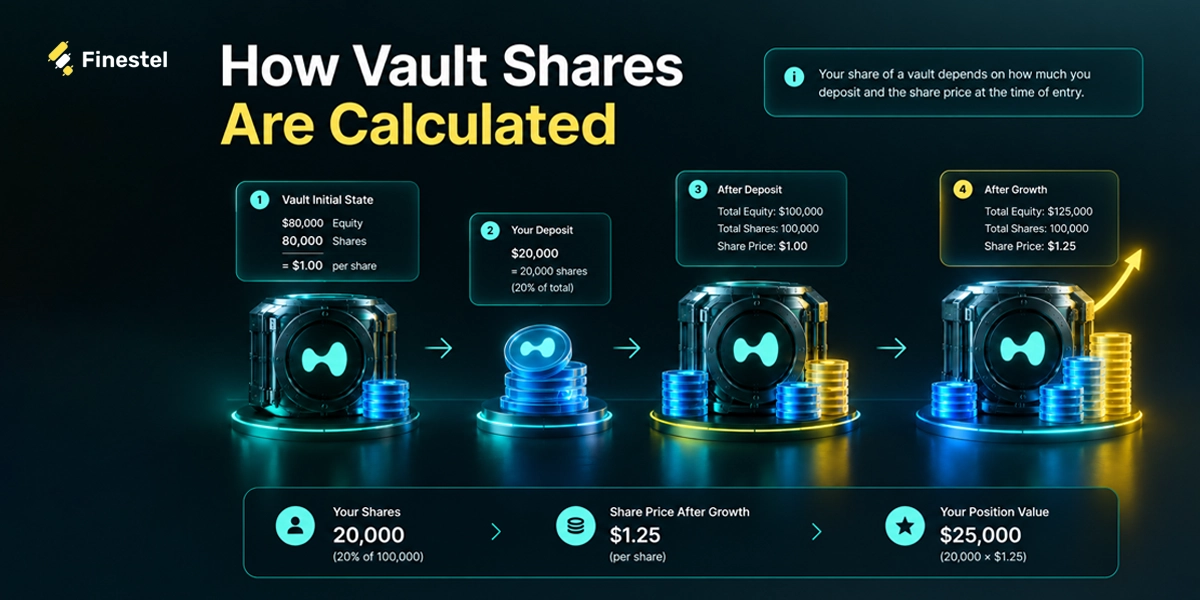
Your share of a vault depends on how much you deposit and the share price at the time of entry. For a simple example, suppose a vault has $80,000 in equity and 80,000 outstanding shares, making each share worth $1. If you deposit $20,000, you receive 20,000 shares and own 20% of the new $100,000 total.
If the vault’s equity later grows to $125,000, each share becomes worth $1.25, making your position worth $25,000.
How Profits and Losses Are Distributed
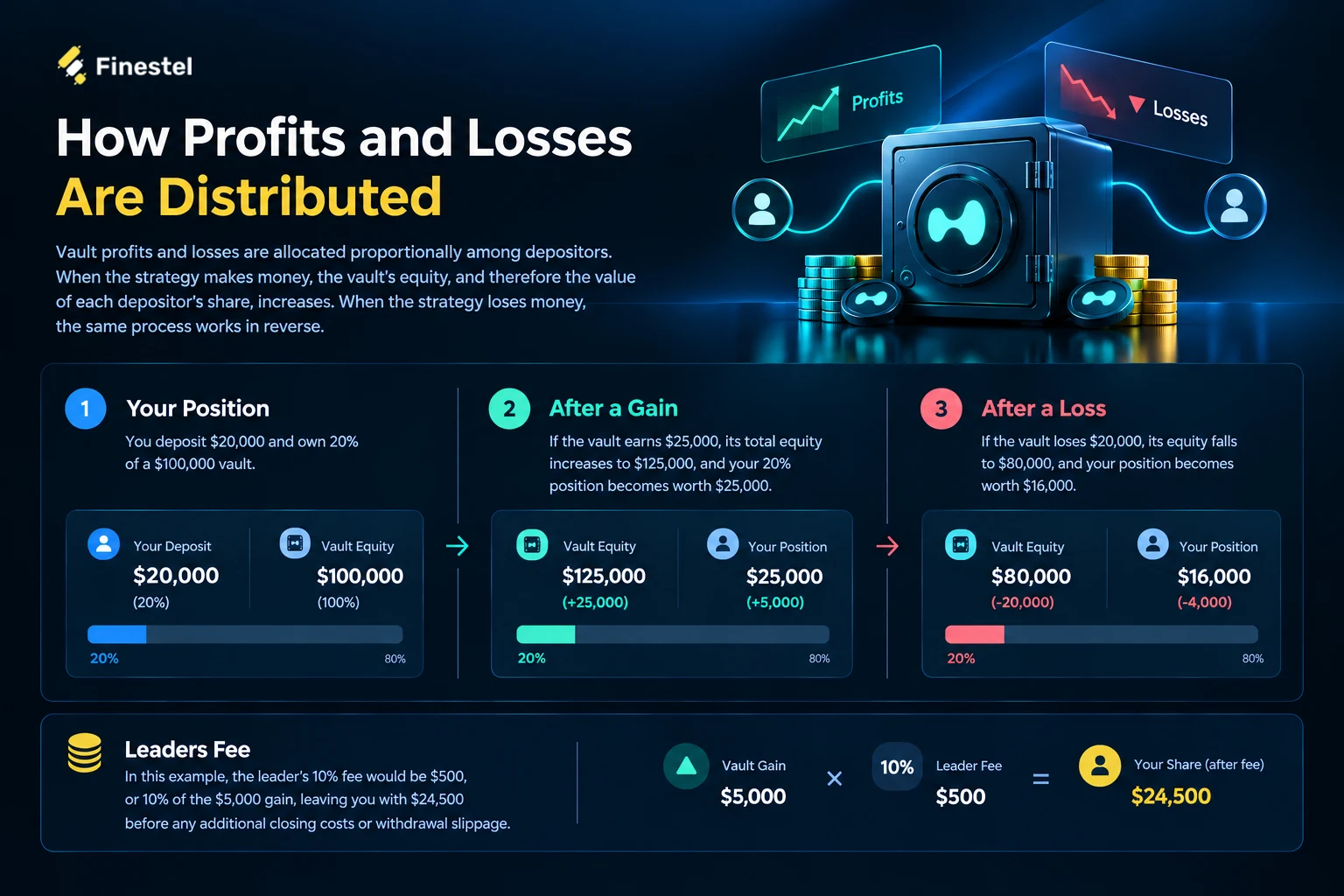
Vault profits and losses are allocated proportionally among depositors. When the strategy makes money, the vault’s equity, and therefore the value of each depositor’s share, increases. When the strategy loses money, the same process works in reverse.
Using the previous example, suppose you deposit $20,000 and own 20% of a $100,000 vault:
- If the vault earns $25,000, its total equity increases to $125,000, and your 20% position becomes worth $25,000.
- If the vault loses $20,000 instead, the vault’s equity falls to $80,000, and your position becomes worth $16,000.
In this example, the leader’s 10% fee would be $500, or 10% of the $5,000 gain, leaving you with $24,500 before any additional closing costs or withdrawal slippage.
Lock-Up and Withdrawal Mechanics
Before depositing crypto to a vault, you should consider its lock-up period for withdrawals. Here is how each model works:
- Hyperliquid HLP vaults apply a 4-day lockup for withdrawals, measured from your most recent deposit. For example, if your last deposit was on Monday at 10:00 a.m., the position becomes eligible for withdrawal on Friday at 10:00 a.m.
- User-created HyperCore vaults have a shorter 1-day lock-up. A deposit made at 3:00 p.m. on Tuesday would become eligible for withdrawal at 3:00 p.m. on Wednesday.
- For custom HyperEVM vaults, lock-up periods, withdrawal queues, fees, and settlement rules are programmable, so you should review the vault’s documentation before making any deposit.
Trading Fees, Funding, and Slippage
Each vault is treated as a separate trading account, meaning its fee tier is based on its own trading volume rather than the vault leader’s personal account. Frequent taker orders can increase trading costs, while maker orders may earn rebates.
Funding can also influence performance. Hyperliquid settles funding every hour, and a vault may either pay or receive it depending on its positions and the current funding rate.
Slippage becomes particularly important when a vault enters or exits large positions in a thin order book. It may also affect withdrawals if open positions must be partially closed to release enough capital.
Where Do Hyperliquid Vault Returns Come From?
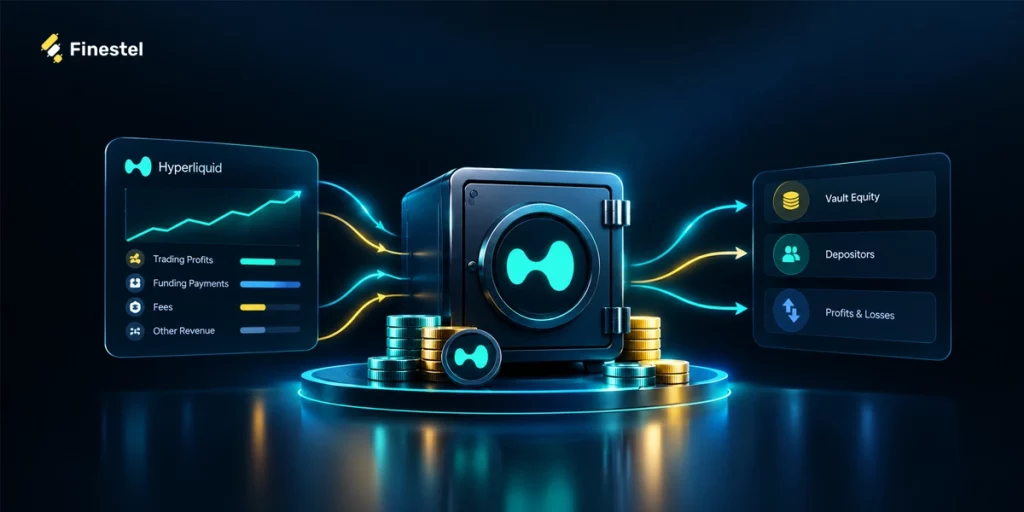
Hyperliquid vault returns do not come from a fixed interest rate. They are generated through active trading and can change depending on the vault’s strategy and market conditions. This means a vault can produce positive returns during one period and lose money during another.
In HLP
HLP generates PnL from several sources:
- Bid-ask spreads: HLP places buy and sell orders on the order book and may earn from the difference between the bid and ask prices.
- Liquidation PnL: HLP acts as a liquidation backstop for positions that cannot be fully liquidated through the order book. Taking over these positions can be profitable, but it may also expose the vault to losses during volatile or manipulated markets.
- Trading fee allocation: A portion of Hyperliquid’s trading fees is allocated to HLP.
- Funding payments: The perpetual positions held by HLP may pay or receive hourly funding.
- USDC Earn: HLP may allocate part of its USDC to Hyperliquid Earn and make use of unused capital to generate additional returns.
In User-Created Vaults
User-created vaults generate returns through the strategy their leaders use. Depending on the trader, this could include:
- Long or short positions
- Relative-value and market-neutral trades
- Market making
- Short-term algorithmic trading
The vault’s performance mainly depends on the leader’s execution, leverage, position sizing, and risk management. Trading fees, funding costs, slippage, and the leader’s 10% profit share can further reduce the amount ultimately received by depositors.
If you want to run a spot-perpetual strategy in your own accounts, read our guide to Hyperliquid funding rate arbitrage.
How to Evaluate Hyperliquid Vaults’ Performance and Profitability
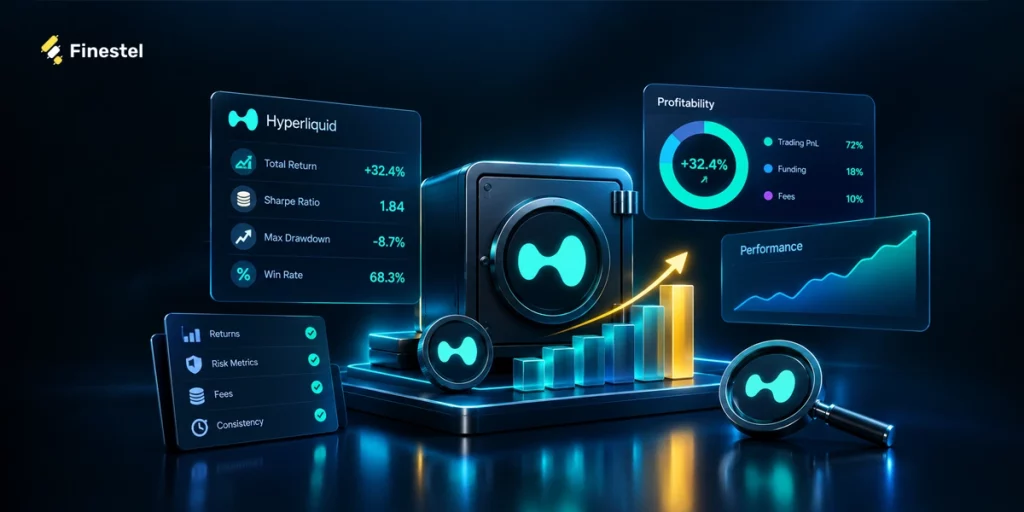
One serious mistake I see some traders make is choosing a vault by looking only at its APR. Instead, you should evaluate whether its returns are sustainable by checking these:
- Track record: Prefer consistent performance across different market conditions over short-term profit spikes.
- Risk-adjusted return: Compare net returns with maximum drawdown, volatility, and recovery time.
- Position risk: Review leverage, liquidation exposure, and concentration in individual assets.
- Strategy capacity: Check whether the strategy can maintain its performance as AUM grows.
- Leader alignment: Look at how much of their own capital the leader has invested and how they behave during market stress.
User Vaults Performance Comparison: KCR vs. SIM Funds
Hyperliquid allows users to sort vaults by leader, APR, TVL, deposit, and age. To put these metrics into practice, I sorted the list by APR and reviewed KCR and SIM Funds using data collected on September 3, 2026. These figures represent a point-in-time snapshot and may change. Displayed APRs are annualized figures based on recent performance, not guaranteed returns.
KCR:
KCR describes itself as an automated BTC trend-following strategy targeting a 3x annual return. It has been active since February 19, 2026, and had approximately 2,000 historical trades at the time of our review.
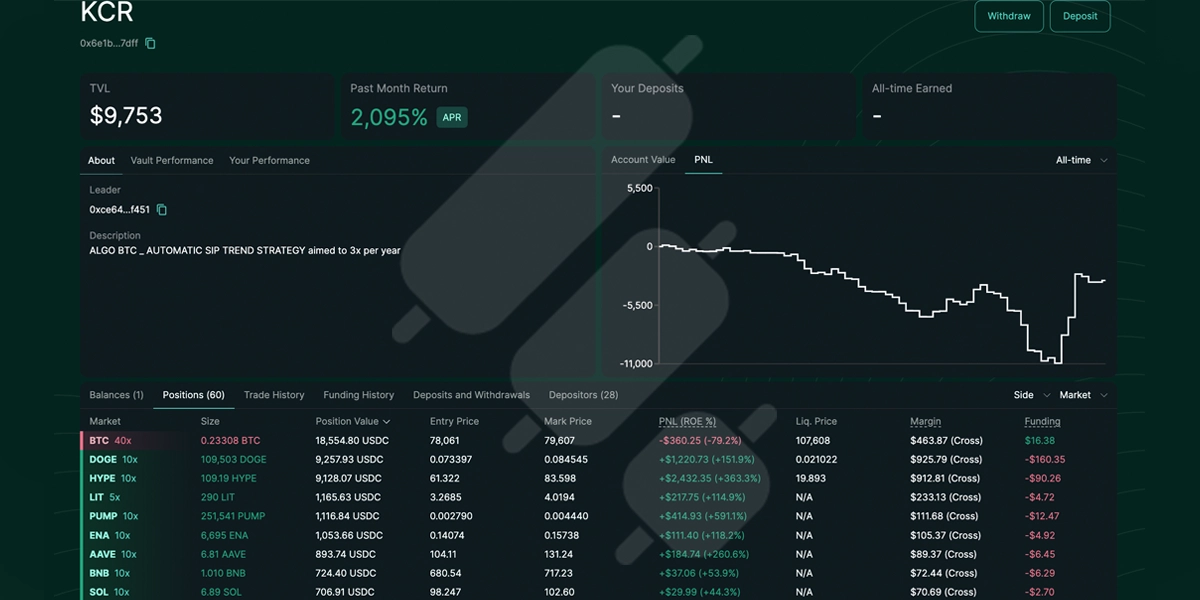
At the time of writing, KCR displayed:
- $9,753 in TVL.
- A 2,095% annualized APR based on the previous month
- 60 open positions
- 28 depositors
- Cross-margin positions with leverage settings reaching 40x
- -$1,944.12 PnL
- 2,271.68% Max Drawdown
Despite its high recent APR, KCR still had negative cumulative PnL. Its PnL curve fell to roughly -$11,000 around August 17 before partially recovering. Its current portfolio also extends beyond BTC, with large visible positions in DOGE, HYPE, and several other altcoins.
This matters because the headline APR reflects a recent period of performance, while the longer PnL history reveals the depth of losses the strategy experienced along the way.
Note that Hyperliquid’s displayed Max Drawdown uses changes in PnL relative to the account value at the beginning of each measured period. Therefore, KCR’s reported 2,271.68% figure does not mean depositors lost 2,271.68% of their original capital.
SIM Funds:
SIM Funds describes itself as a Bitcoin-based model for investors, institutions, and capital allocators. It has been active since December 10, 2025, with approximately 1,000 historical trades.
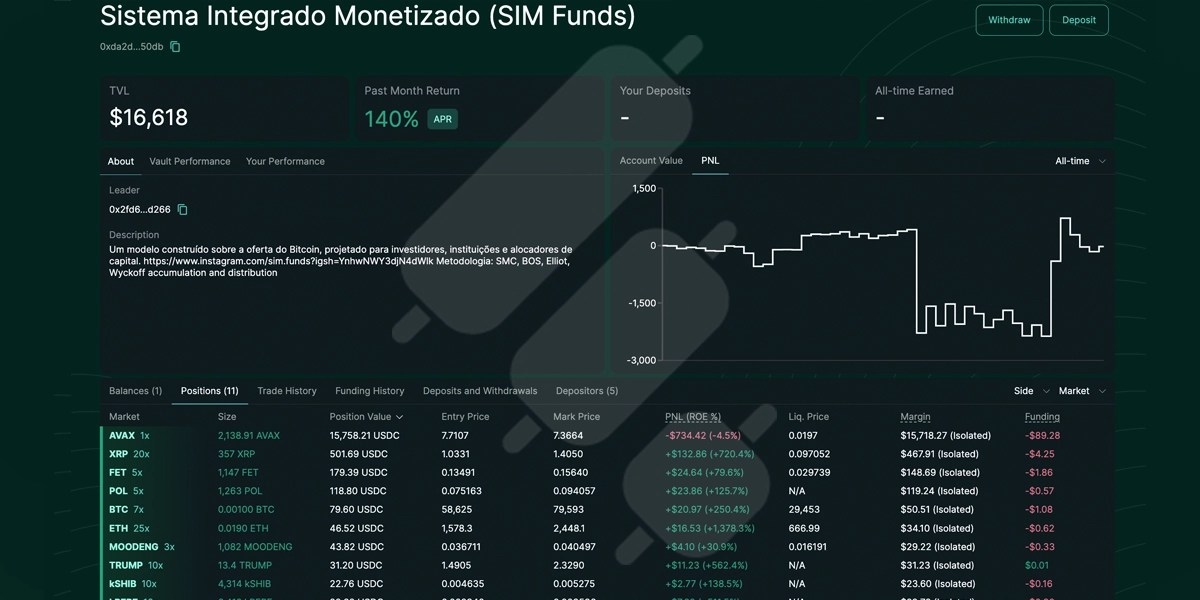
At the time of review, SIM Funds displayed:
- $16,618 in TVL
- A 140% annualized APR based on the previous month
- 11 open positions
- 5 depositors
- Isolated positions with leverage settings of up to 25x
- $352.95 PnL
- 22.63% Max Drawdown
SIM Funds had positive cumulative PnL at the time of review, but its portfolio was highly concentrated. Its $15,758 AVAX position was equal to almost 95% of its TVL, while the remaining exposure came from smaller leveraged positions. Its PnL curve also fell to around -$2,500 before recovering into positive territory.
What This Comparison Shows
KCR shows a much higher recent APR, but it also has negative cumulative PnL, cross-margin exposure, and a volatile performance history. SIM Funds shows positive PnL and a lower reported drawdown, but most of its capital is concentrated in one AVAX position.
This comparison shows why APR alone is not enough. PnL, portfolio concentration, leverage, margin mode, track-record length, and the platform’s calculation method should all be reviewed before depositing.
HLP Vault Performance
To apply the same framework to a protocol vault, I reviewed HLP using data collected on September 3, 2026.
At the time of review, HLP displayed:
- $189.75 million in TVL
- A 6% APR based on its past-month performance
- 176 open positions
- More than 100 open orders and depositors
- $137,906,320.00 PnL
- 5.68% Max Drawdown
The 6% figure is an annualized rate based on the previous month. It does not mean HLP earned 6% during that month, and it should not be compared directly with the much higher APRs shown by KCR or SIM Funds. These vaults use very different strategies and carry different risks.
HLP’s PnL chart also shows that its returns have not grown at a steady rate. Much of the chart rises gradually, while several large jumps appear within short periods. This fits HLP’s role as a market maker and liquidation backstop, where profits may be concentrated during periods of high trading activity or large liquidation events.
Vault Performance
The Vault Performance tab provides more context behind HLP’s 6% APR. On September 3, 2026, HLP reported $137.91 million in cumulative PnL and a maximum drawdown of 5.68%.
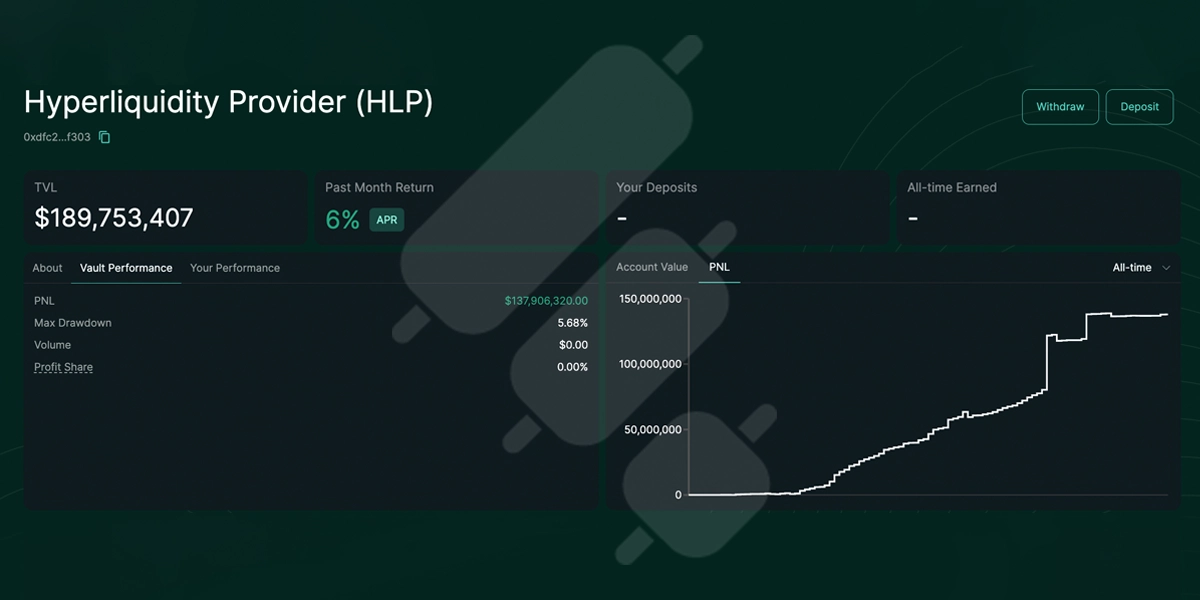
The PnL figure represents the vault’s lifetime trading result, while HLP reported a 5.68% front-end max drawdown. This metric uses changes in PnL relative to the account value at the beginning of each period, rather than the standard peak-to-trough equity formula.
So, when deciding whether to deposit, consider these metrics alongside the vault’s current positions, leverage, four-day lock-up, and liquidation exposure, instead of relying on the headline APR alone.
Risks of Hyperliquid Vaults
Hyperliquid vaults are not risk-free. Their value depends on trading performance, so you might lose part or all of your capital. Here are some of the possible risks that you should pay attention to:
- Leverage and liquidation: High leverage can turn a small market move into a large loss or liquidation.
- Leader and strategy risk: A user vault is only as reliable as its leader and strategy. Strong past results do not guarantee future profits.
- Smart-contract and protocol risk: Bugs, exploits, or technical failures may put deposited funds at risk.
- Withdrawal slippage: Closing positions to process a withdrawal may reduce the final amount received.
- Oracle and manipulation risk: Incorrect price data or market manipulation can lead to losses or unexpected liquidations.
- Regulatory risk: Vault access and legal protections may vary by country, and depositors may not receive the protections available in regulated investment products.
Hyperliquid Vaults vs. Copy Trading: Which One Fits You?

The comparison depends on whether you want to follow someone else’s strategy or run your own strategy across multiple accounts.
From a Trade Copier Perspective
On many crypto exchanges, copy trading lets you browse traders, review their results, and choose one to follow. Their trades are then copied using the funds you allocate. Depending on the platform, you may be able to set limits, stop copying, or close positions yourself.
A Hyperliquid vault offers another way to gain exposure to a strategy. Instead of copying trades into your account, you deposit into a shared vault and receive a proportional share of its profits and losses. You cannot change individual positions, and withdrawals follow the vault’s lock-up and withdrawal rules.
The choice comes down to how much control you need. Exchange copy trading may offer more individual settings, while a vault lets you participate in a pooled strategy. In either case, review the strategy’s trading history, costs, and risks before committing funds.
From a Manager’s Perspective
If you are a professional trader or an asset manager managing different client accounts, already have a strategy, and want to copy it across multiple Hyperliquid accounts, a user-created Hyperliquid vault and Finestel’s Hyperliquid trade copier offer two different setups:
- In a user-created Hyperliquid vault, you can trade different pairs and get 10% of the profits earned by depositors to your vault.
- Add a master account and connect the copier accounts that should follow it. Finestel’s trade copier places each trade on all of those accounts at the same time, sized to each account’s capital. The copier accounts can be on Hyperliquid or on any of 10+ CEXs, such as Binance, Bybit, or OKX, so one strategy can run across both. Copier funds stay in their own accounts at all times; Finestel never has custody of anyone’s assets.
-
Finestel also offers a White Label version (optional on the Scale plan). Brokers, exchanges, asset managers and traders can run the same copy trading engine fully under their own brand, name, logo, and domain, with no mention of Finestel visible to their end users. It’s a way to launch a copy trading product under your own name without having to build and maintain that infrastructure yourselves. You can also customize the performance fee you want to take from the copier accounts.
A user-created vault may fit your business if you just need users to share one portfolio and the same strategy-level settings. Finestel fits better if you need to run your own strategy across separate client accounts with different sizing or risk settings. Your choice depends on how you want to organize client capital and manage execution.
How to Use a Hyperliquid Vault: From Deposit to Withdrawal
To deposit into or withdraw from a Hyperliquid vault and track your account, follow these steps.
Deposit
- Open the Vaults page and click Connect to link your wallet.
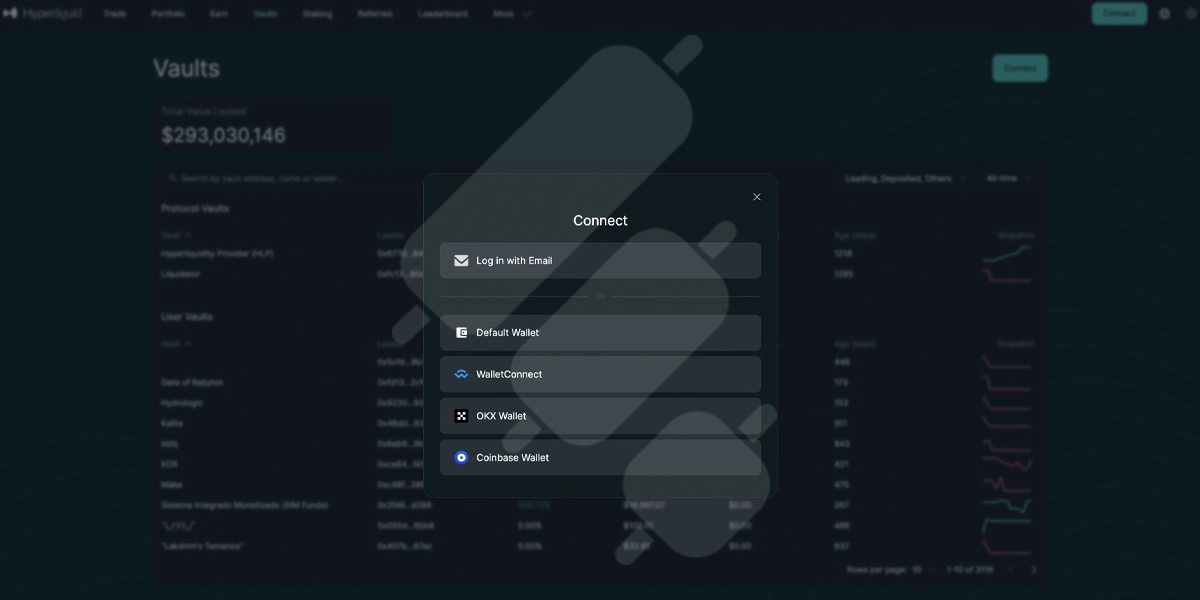
- Funding your Hyperliquid account is separate from depositing into a vault. Before continuing, make sure you have enough USDC available in your Hyperliquid perpetuals account.
Now, suppose you want to deposit into HLP. Open the HLP page, click Deposit, and enter your desired amount. Before confirming, check the lock-up period and read the warning shown in the deposit window.
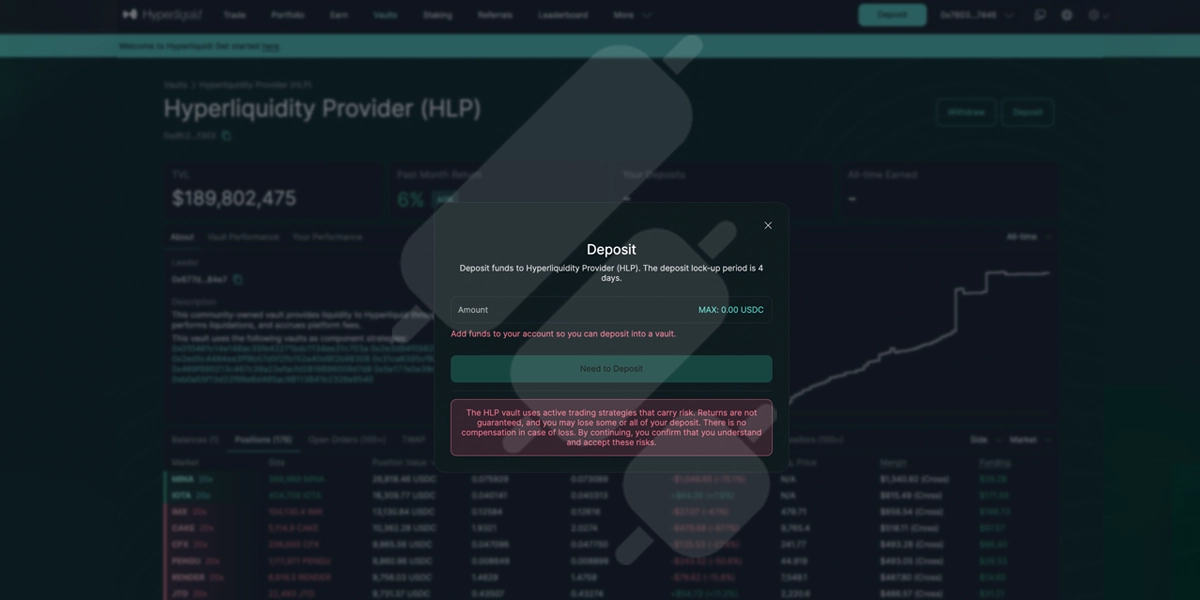
After completing the deposit, you can see your deposited balance under “Your Deposit” at the top of the vault page.
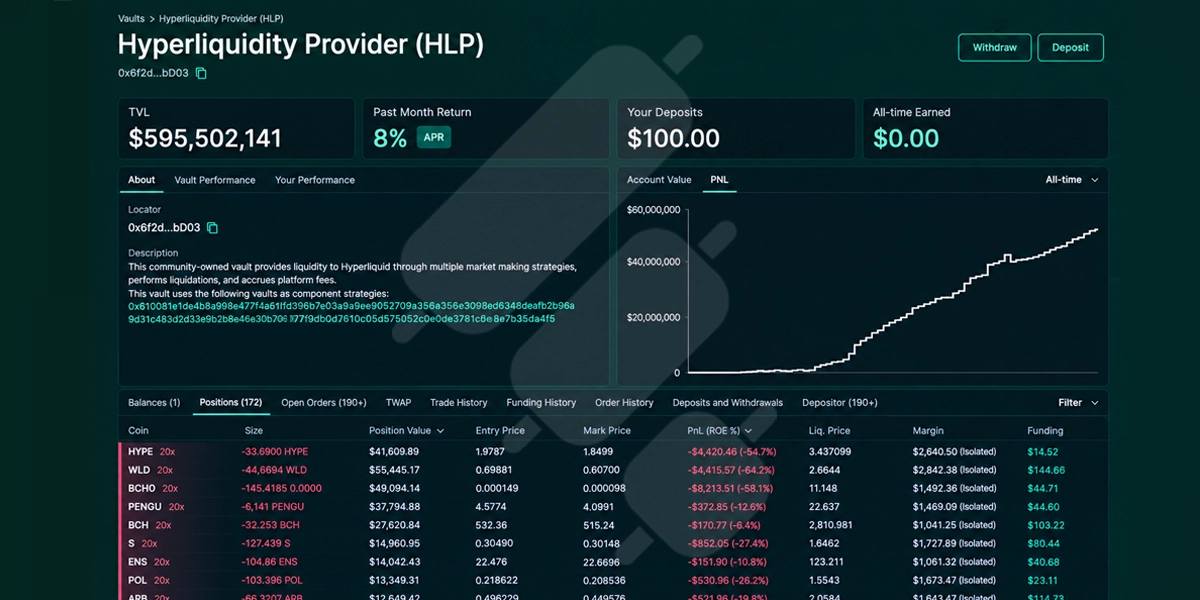
Withdraw
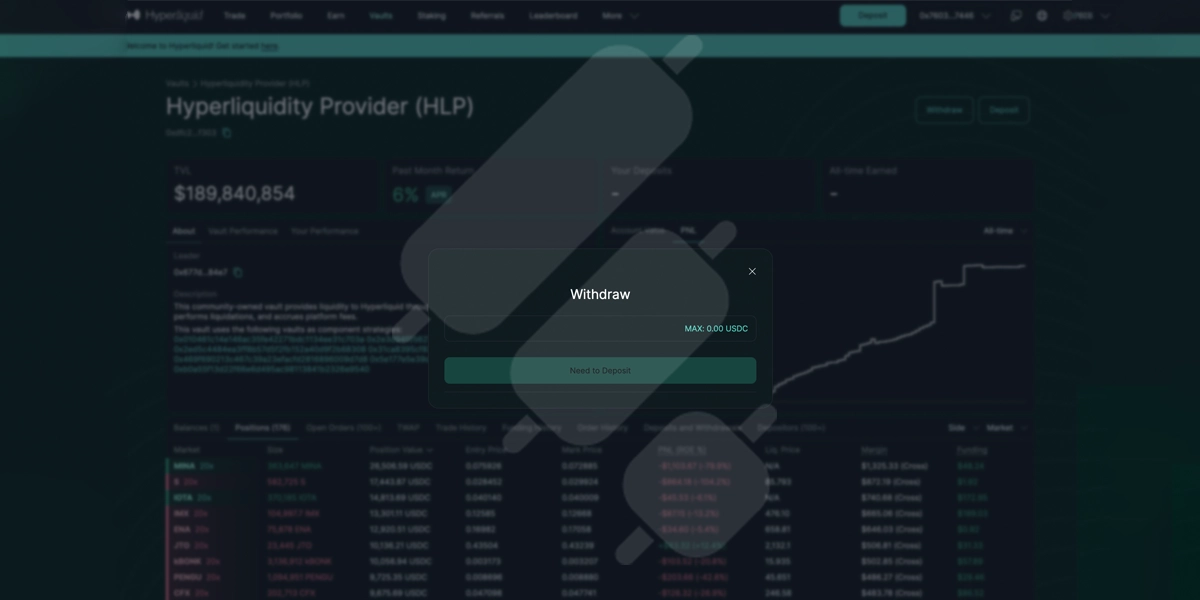
You must wait until the vault’s lock-up period ends before withdrawing. The lock-up is four days for HLP and one day for legacy user vaults. Once the period has ended, open the vault page, click Withdraw, and enter the amount you want to withdraw.
Final Thoughts: Are Hyperliquid Vaults Worth It?
Hyperliquid vaults make it easier to gain exposure to HLP or trader-managed strategies without placing every trade yourself. However, their returns come from real trading activity, so APR can change and losses are always possible. Before depositing, look beyond the headline return and review the vault’s PnL history, drawdown, leverage, open positions, lock-up period, and withdrawal conditions.
FAQs
Are Hyperliquid vaults safe?
Hyperliquid vaults are transparent and operate on-chain, but they are not risk-free. Their safety depends on the strategy, leverage, vault leader, and protocol security.
Can you lose money in a Hyperliquid vault?
Yes. Vaults share both profits and losses with depositors, so poor trades, liquidations, or market volatility can reduce your capital.
How does HLP generate returns?
HLP earns from market making, liquidations, platform fees, funding payments, and USDC allocated to Hyperliquid Earn. These activities can generate profits but may also create losses.
Are Hyperliquid vault returns guaranteed?
No. Displayed APRs are based on past performance and can change quickly. A vault may produce positive or negative returns in the future.




Leave a Reply