

Crypto options have always been a different beast. For a long time, the tools just weren’t there to match traditional options trading. In this SignalPlus review, I’ll discuss why it is one of the platforms that’s been changing that. Interestingly, the more I looked into it, the more I understood why names like Goldman Sachs and Cumberland DRW have been using it. So I decided to do a proper deep dive.
I’ll walk you through what the platform actually offers, which includes the trading dashboard, the volatility analytics, the automation tools, and the institutional side of things. I’ll also cover who it’s realistically built for, and where it falls short. By the end of this SignalPlus review, you’ll be able to decide if it fits what you’re trying to do or not.
What Is SignalPlus?
SignalPlus is a crypto options trading platform that was founded in 2021 and is based in Hong Kong. The company was built by Chris Yu (SignalPlus CEO) and James Shan (COO). Both of them come from institutional backgrounds at places like Goldman Sachs, Alibaba, and ByteDance. So this isn’t a team that stumbled into options trading and decided to build a product for it. They essentially came from that world.
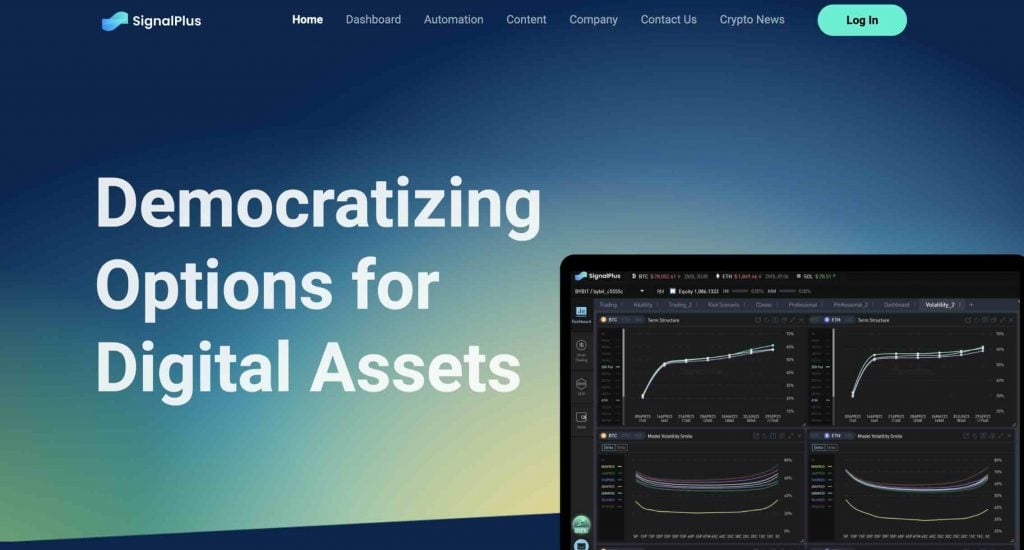
One of the main things I want you to take away from this SignalPlus review is that SignalPlus is not an exchange. It’s a software layer that sits on top of exchanges like Deribit, Binance, Bybit, OKX, and Coincall. It gives you professional-grade analytics and execution tools that those venues simply don’t offer natively. The platform has raised $23M in total funding and is backed by OKX Ventures, AppWorks, and HashKey. The names would pretty much tell you the caliber of the people behind it.
SignalPlus Dashboard
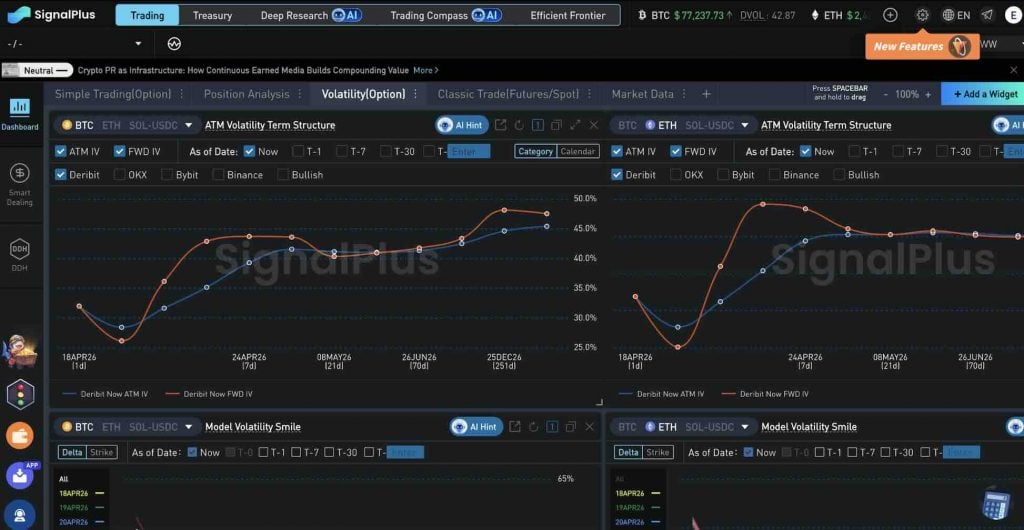
The dashboard is the primary part of the SignalPlus experience, and it’s free. This was very surprising for me when I saw what’s actually inside. For this SignalPlus review, I want to walk through each module properly, because a lot is going on in it.
Risk & PnL Tracking
This is your real-time command center. I mean, you get a live view of your full inventory, intraday Greeks exposure broken down across expiries and strikes, and a detailed P&L breakdown. The breakdown actually tells you why your book moved, not just that it did.
The P&L attribution tools, strike analysis, and theta analysis are also the kind of things you’d expect from a proper trading desk setup. So, it’s fair to say SignalPlus is not another generic free web dashboard that is found everywhere these days. It’s actually very useful.
Volatility Lab
The SignalPlus Volatility Lab is a part of the product I genuinely found interesting. It gives you a fully visualized volatility profile. I mean, there’s term structure, model vol smile, model vol surface, and 7-day realized volatility momentum.
I think if you’ve spent any time in TradFi options, you’ll recognize this immediately. For crypto, having this level of volatility analytics in one place is still pretty rare in 2026.
Smart Dealing
Smart Dealing is the module that handles execution. You can build and execute multi-legged orders using its embedded algorithms. These algos are there to minimize slippage, which is critical in this environment.
The platform also auto-calculates gamma- and vega-neutral offsets with a few clicks. So instead of manually legging into complex structures, the system itself handles the balancing act for you.
Dynamic Delta Hedging (DDH)
The SignalPlus Dynamic Delta Hedging is another standout feature for me. The DDH robot runs 24/7 and automatically manages your delta exposure across all market conditions based on your own parameters.
It’s also highly customizable, and every trade it executes sends you a real-time notification via Telegram. For people who run a serious options book, having automated delta hedging that works around the clock without you babysitting it is a real operational advantage.
Risk Scenario & Trading Compass
Finally, the Risk Scenario tools let you stress-test your P&L and exposures under different scenarios. It essentially runs simulation scenarios so you can see how your book holds up under different market conditions. This is something that almost all quantitative and high-frequency trading teams and funds do for all of their strategies.
Alongside that, the AI-powered Trading Compass aggregates live crypto news, labels it by relevance, and runs sentiment analysis in real time. This is also a very advanced and sophisticated part of the dashboard that I found very interesting.
SignalPlus Automation
Now, the free dashboard we’ve discussed above in this SignalPlus review is impressive on its own. But SignalPlus also has a second layer that’s built for a completely different type of user.
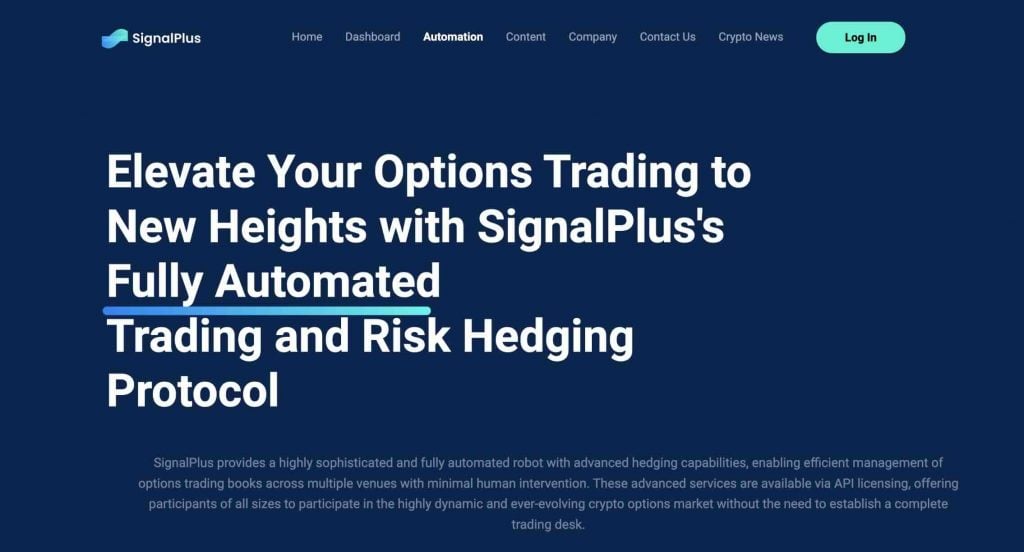
The Core+ automation suite is an API-licensed product. This means that it’s designed for an even higher grade of customers. These can be market makers, structured product issuers, and institutional trading desks that need to run options books at scale, across multiple venues, and with minimal human oversight.
We’re talking 200+ user-defined parameters to tune your own risk management logic. There is 24/7 automated market making across all supported exchanges and a structured product pricer, which they describe as Wall Street-grade. The hedging logic is also fully transparent with auditable execution trails.
The downside is that pricing isn’t listed publicly. But that’s usually the case for institutional-grade products. If you want to get a quote, you need to reach out to their BD team directly to get into the specifics.
User Feedback and Online Presence
Another disappointing fact is that formal public SignalPlus reviews are sparse. But this is pretty much what you’d expect from a platform built for institutional desks rather than retail traders.
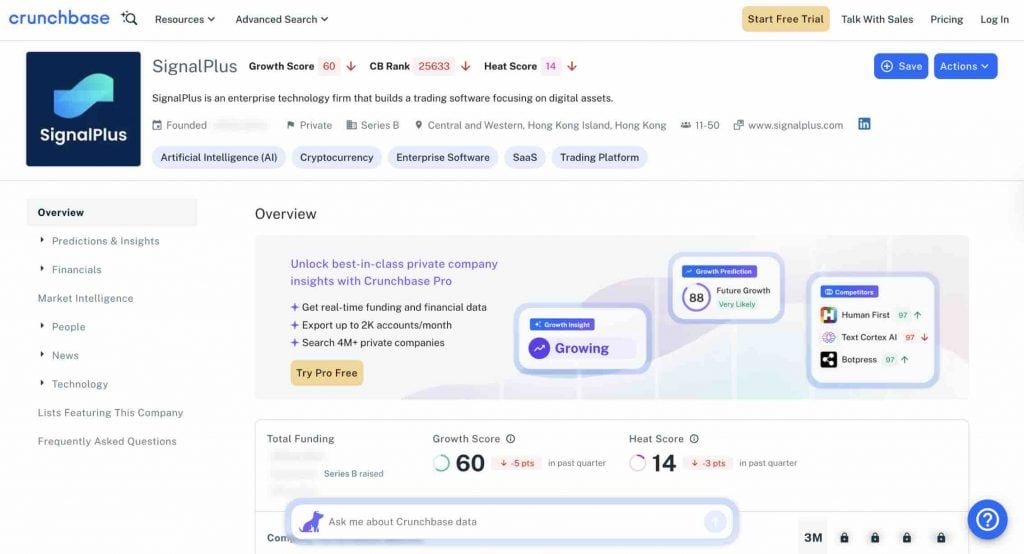
On the SignalPlus Crunchbase page, the platform is listed as a private Series B company with $23M raised across two rounds, backed by credible institutional names like OKX Ventures, AppWorks, and HashKey.
Moreover, the SignalPlus LinkedIn company page is not very active. But the content they post is mostly market-focused and technically sharp. So, if you want to keep up with what they’re building or publishing, the LinkedIn page and the SignalPlus Medium publications are the main places to follow along.
Who Is SignalPlus For?
It should be clear by now that SignalPlus is a specialized tool. So, it’s worth being direct about who actually benefits from it.
If you’re a professional options trader, a crypto market maker, or part of an institutional desk running a structured product book, this platform was pretty much built for you.
The depth of analytics, the DDH automation, and the multi-venue execution tools all make sense in that context. You’ll get a lot out of it from day one.
However, if you’re newer to trading or you don’t actively trade options, a lot of what SignalPlus offers will either feel overwhelming or simply not relevant to you. The same goes if what you’re really looking for is copy trading, signal-following, asset management, or algo bots for spot and futures.
SignalPlus doesn’t go there at all. It’s laser-focused on options, and everything outside of that is essentially out of scope. I like this specialized niche they’re focusing on, but that also means that most of you who are reading this SignalPlus review will never use it. But, we’ve got you covered (more on this later).
SignalPlus Alternatives
Now, a key part of this SignalPlus review is introducing its primary competitors. While the platform is genuinely strong for what it does, it’s narrowly focused on options analytics and execution. So, if you’re looking for something different, here are the platforms that actually compete in the same space.
| Feature | SignalPlus | Laevitas | Deribit Metrics |
| Options analytics | Yes | Yes | Yes (basic) |
| Multi-exchange connectivity | Yes | Yes (data only) | No (Deribit only) |
| Trade execution | Yes | No | Yes (on Deribit) |
| Multi-leg execution / Smart Dealing | Yes | No | No |
| Dynamic Delta Hedging (DDH) | Yes | No | No |
| Automation / Market Making Robot | Yes (Core+) | No | No |
| Mobile app | Yes | No | Yes |
| Free tier | Yes | Yes (limited) | Yes |
| Pricing (paid tier) | Contact BD | From $50/mo | Free |
Laevitas is the closest thing to a true analytics peer. It covers options, perpetual futures, dated futures, and order books across major exchanges. There’s institutional-grade data, including full option chains, implied volatility, Greeks, and deep historical data. The difference is that Laevitas is purely a data and analytics layer. So, there’s no mobile app, trade execution, or automation tools. To learn more about it, read our ‘Laevitas review‘ article.
Deribit Metrics is the second SignalPlus alternative, which is Deribit’s own built-in analytics dashboard. You get open interest, put/call ratios, volatility surfaces, skew charts, and order book depth, all for free, natively on Deribit. And the catch is obviously the fact that it only covers Deribit. So, if you’re trading across multiple venues like me, it immediately falls short. There’s also no execution tooling and DDH bot.
Finestel: SignalPlus Alternative for Asset Managers
As I mentioned above, SignalPlus is specifically used for options trading. But if your goal is to run a copy trading operation, manage client portfolios, or automate strategies across multiple exchanges, you’re looking at the wrong tool. That’s where Finestel comes in.
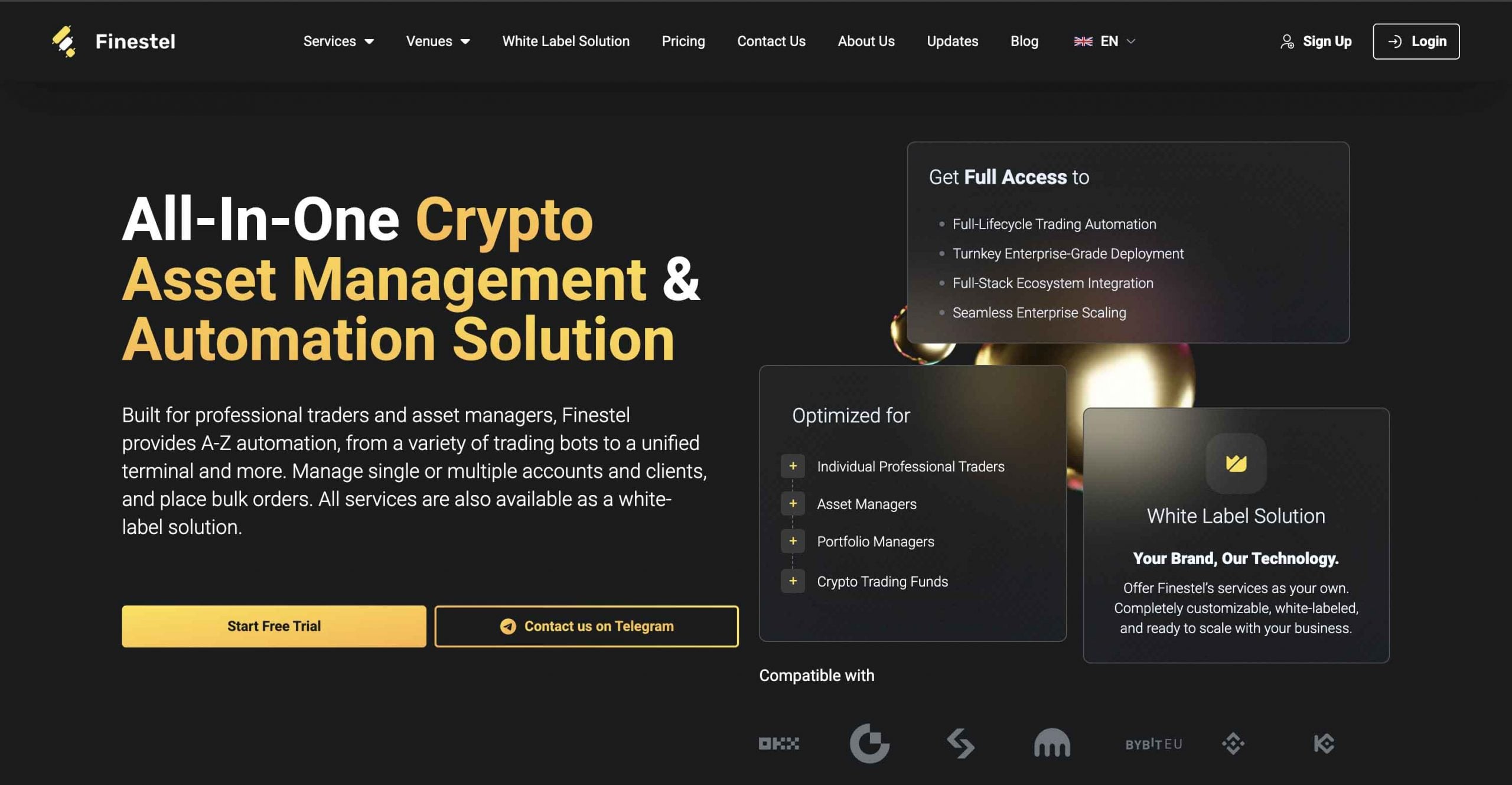
Finestel is an all-in-one crypto asset management platform. We’ve designed it for crypto trading teams and crypto asset managers. The core product is copy trading software and infrastructure. It automatically replicates your trades across client accounts (or your accounts) in real time. As of now, there are 7 supported exchanges, including Binance, Bybit, OKX, KuCoin, Bitget, Gate, and Kraken (latest addition).
And, beyond copy trading, our cutting-edge crypto trading terminal is worth paying attention to. The terminal includes:
- Multi-exchange, multi-account trading from a single dashboard
- Bulk order execution, which fires trades across unlimited accounts in one click
- Bulk action execution, which means adjusting leverage, margin type, and position mode across accounts simultaneously
- TradingView charting with 100+ indicators built right into the interface
And if you want to take things further, Finestel’s white-label solution lets you deploy the entire platform under your own brand and domain, plus several other marketing, CRM, analytics, and billing tools. TradingView bots and signal bots are also there for those of you seeking automation.
So the honest framing here is that SignalPlus and Finestel aren’t competing for the same user. SignalPlus is for the options trader. Finestel is for the crypto asset manager running a book of clients.
Conclusion
To wrap this SignalPlus review up, the platform is one of the more impressive free tools I’ve come across in the crypto space (and I’ve tested numerous platforms). The dashboard alone is the kind of setup you’d normally expect to pay serious money for. And for professional options traders or institutional desks, the Core+ automation layer takes it even further.
That said, it’s a specialized tool for a specific type of trader. If you’re running client portfolios, automating strategies across exchanges, or building a copy trading operation, SignalPlus simply isn’t built for that. I’d recommend checking out Finestel instead. It covers that entire side of the picture and then some.


Leave a Reply