

Automated crypto trading has matured significantly since the early days of simple buy/sell scripts. In 2026, the market is crowded with cloud-based bots promising plug-and-play profits, which makes automated trading tools and bots’ deliberate choice to stay self-hosted, privacy-first, and deeply customizable stand out more than ever. This review by Finestel cuts through the noise with an objective look at what Gunbot actually offers, who it’s right for, and where it falls short.
What is Gunbot? An Overview
Gunbot is a self-hosted automated crypto trading bot, first released in 2016 by Gunthar de Niro S.L.R. Unlike subscription-based cloud platforms, it runs as downloadable software on hardware you control, whether that’s a desktop machine, a home server, or a VPS. Your API keys, your strategies, and your trading data never leave your device.

This architectural choice defines the Gunbot experience. It trades convenience for control, and monthly fees for a one-time lifetime license. For traders who prioritize data sovereignty and long-term cost efficiency, that’s a compelling trade-off. For those who want a quick setup and mobile-first workflow, the learning curve will feel steep.
As of 2026, Gunbot supports over 100 exchanges through API integration, including major centralized platforms like Binance, Kraken, Coinbase, Bybit, and Bitget, as well as decentralized exchanges (DEXs), including dYdX, HyperLiquid, and PancakeSwap on the top-tier plan. A notable recent expansion added support for stock and ETF trading via Alpaca, signaling ambitions beyond crypto.
Key Features
Gunbot delivers self-hosted automation for spot, futures, and DeFi trading across 20+ exchanges like Binance, Bybit, and Kraken. It runs locally on Windows, Linux, or VPS setups, keeping API keys offline to limit remote hack risks, though this shifts server maintenance duties to users.
Strategy Options
Over 20 pre-configured strategies handle common scenarios, including StepGridScalp for volatility capture, dollar-cost averaging to average down on dips, and limit grid bots that automate buys/sells at set price intervals. These support unlimited trading pairs per exchange slot, with tunable parameters like trailing stops and partial take-profits.
Customization Tools
Users code bespoke logic in JavaScript or generate it via AI from plain-language descriptions, such as “enter longs on RSI oversold with EMA confirmation.” Built-in indicators span RSI, ADX, MACD, and multi-timeframe analysis, while AutoConfig dynamically tweaks settings based on recent performance.
Testing and Monitoring
Backtesting simulates strategies against historical data, paired with optimization to refine configs before live runs. TradingView webhook integration pulls external signals, and Telegram bots push trade alerts, balance updates, or error logs in real time.
Custom JavaScript Strategies
For advanced users, Gunbot exposes a full JavaScript API. You can write entirely custom logic from scratch, accessing market data, indicators, and trade execution functions through an gb object. This turns Gunbot into a proper trading development framework, not just a configurable tool. This feature is available on higher-tier licenses.
Backtesting and Forward Testing
Gunbot allows strategy validation against historical market data before risking live capital. The DeFi/Ultimate tier includes forward-testing on real market data without executing trades, useful for validating new strategies in live conditions safely.
Pros and Cons
After deploying Gunbot on my VPS for two weeks, cycling through StepGridScalp on BTC futures via Bybit, custom DCA on SOL dips, limit grids across altcoin pairs, and even a GTRENDFUTURES setup for trend reversals, I pinpointed strengths that reward patient users, plus weaknesses that tested my limits.

What Worked Well
Self-hosting locked down my API keys offline, eliminating cloud hack fears I had with other bots, no data leaks, just pure control. StepGridScalp crushed volatility plays, auto-scaling buys on 5% dips while trailing stops locked in 12% gains on SOL without me hovering. Limit grids hummed 24/7 across unlimited pairs, sniping 3-5% swings on sideways alts like LINK, far smoother than manual order placement.
Backtesting sped up iterations: running six months of MEXC data revealed optimal RSI/EMA combos in under 10 minutes, dodging live losses from untested configs. TradingView webhooks pulled clean signals for my custom JS strategy (“short on ADX spike + bearish MACD”), executing flawlessly with Telegram alerts that included P&L snapshots, no app-switching needed. Community forum downloads slotted in seamlessly, boosting my edge on day four.
Pain Points Exposed
JSON config tweaks turned tedious fast, one misplaced comma in the multi-timeframe ADX settings crashed the bot during a BTC pump, costing two hours of missed grid fills and a restart. The ramp-up devoured my first weekend; AI-generated code from prompts like “hedge longs on volume fade” spat buggy JS needing line-by-line fixes without dev experience.
VPS dependency bit me hard, a firmware update killed uptime overnight, halting all strategies until reboot, unlike always-on competitors. No native signal marketplace forced endless forum scrolling for fresh ideas, and while v28’s dark-mode GUI handles pair notes and MetaMask DeFi logins decently, it glosses over the file-editing grind for anything advanced. Gains hit 15% overall, but only after wrestling errors that could frustrate beginners into quitting.
Pricing Structure
Lifetime licenses dominate, with aggressive 2026 spring discounts slashing entry barriers, no recurring fees, just one-time buys with free lifetime updates.
GO deeper into Automated Trading: Explore Fairdesk review, Coinrule review, Coscoin review, Quotex review, and More.
User Reviews
Gunbot garners solid feedback across Trustpilot and Reddit, with users split between praising its depth for dedicated traders and critiquing setup hurdles for casual ones. Trustpilot holds a steady 4.4-4.5/5 rating from 170+ reviews as of early 2026, reflecting consistent satisfaction among those who stick with it.
Trustpilot Highlights
Reviewers frequently call out responsive support, often naming “Uri” for fixing config snags in hours, and the active community that shares battle-tested strategies. Long-term users note reliable uptime and profitability once dialed in, like one who reported smooth 24/7 operation on lifetime licenses with free updates. A common thread: the offline privacy and customization power it unlocks, earning five stars from pros who value control over simplicity.
That said, gripes surface around non-refundable licenses and compatibility issues, such as Raspberry Pi failures leaving buyers out $500 with no recourse. Beginners lament the steep learning curve, with some calling initial setup “long and anguishing” despite helpful docs.
Reddit Sentiment
On Reddit’s r/gunbot and trading subs, experiences span 2017 holdouts touting years of profits via self-hosted security and exchange flexibility, to frustrated newbies ditching over “bs excuses” from resellers and unreliable buy/sell triggers. Positive posts highlight its edge in sideways markets; users share configs turning small bags into steady base currency gains, but warn it’s no AI magic; you must craft rules yourself.
Mixed threads question value versus easier bots, with some stuck holding bags in crashes due to loss-averse defaults. Overall, Reddit leans pragmatic: rewarding for tinkerers patient with trial-and-error, but a pass for set-it-and-forget-it seekers.

Gunbot vs. the Alternatives: A Head-to-Head Comparison (2026)
Choosing between crypto trading bots is rarely about which one is “best” in the abstract. Each platform involves real trade-offs between control and convenience, cost and features, flexibility and simplicity. The comparisons below try to surface those trade-offs honestly, so you can match a tool to your actual situation rather than to its marketing copy.
Gunbot vs. 3Commas
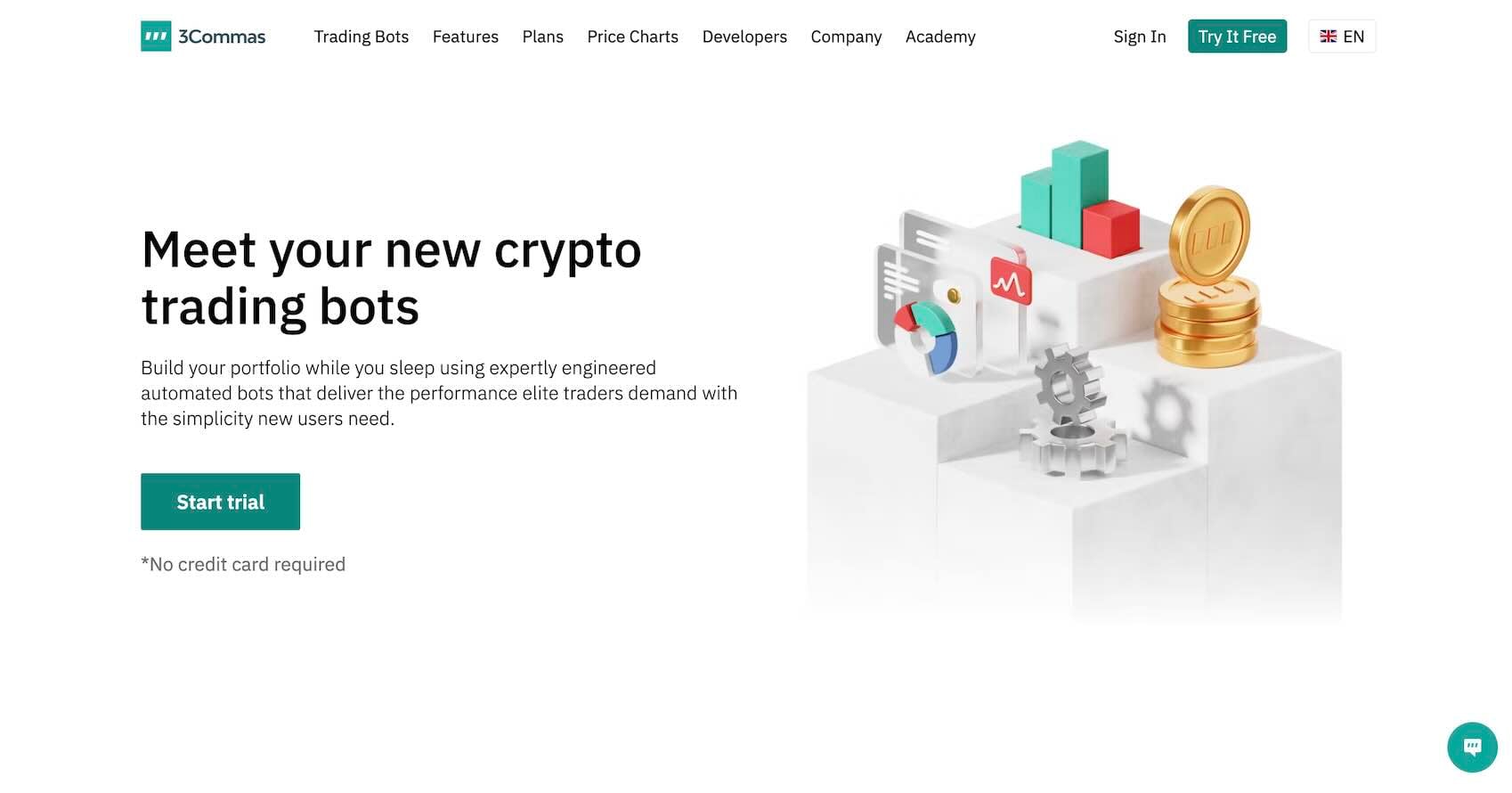
3Commas at a glance: Cloud-based bot platform launched in 2017, supporting 15+ exchanges. Subscription-based pricing from $15/month (Starter) to $110/month (Expert). Offers DCA bots, grid bots, signal bots, SmartTrade terminal, TradingView integration, and a copy trading marketplace. Generally considered the best all-around platform for intermediate traders who don’t want to self-host.
Where Gunbot has the edge:
- No ongoing subscription cost. At $199–$499 one-time, Gunbot becomes cheaper than 3Commas within 1–3 years, depending on the tier you’d use.
- Self-hosted privacy. 3Commas is a cloud platform, meaning your API keys live on their servers. Notably, 3Commas suffered a significant API key leak in 2022 that affected a large number of users, a concrete reminder that cloud custody carries real security risk.
- DEX support. 3Commas does not support decentralized exchange trading.
- Custom JavaScript strategy development. 3Commas has no equivalent to Gunbot’s programmable strategy layer.
- Exchange breadth. Gunbot supports 100+ exchanges vs. 3Commas’ 15+.
Where 3Commas has the edge:
- Substantially easier to set up and use. 3Commas has a modern cloud interface accessible from any browser or mobile device, with no installation, VPS, or server configuration required.
- A proven copy trading marketplace with hundreds of strategies from real traders with verified performance records. Gunbot’s copy trading feature is newer and less developed in this regard.
- Better for beginners. The strategy builder and dashboard are intuitive enough that traders without technical backgrounds can be running bots within an hour.
- Demo trading is included, allowing new users to test strategies without risking capital before going live.
- Regular UI updates and mobile access. Gunbot’s interface has been consistently described as dated.
The uncomfortable reality for 3Commas: The 2022 API key incident is difficult to dismiss. Over 150,000 user keys were exposed, and users reported unauthorized trades on their accounts. The platform attributed it to phishing but independent security researchers raised questions about that explanation. If API key security is a priority for you, this incident is relevant context, and it’s precisely the risk that Gunbot’s self-hosted architecture is designed to avoid.
Verdict: For most intermediate traders who want automation without technical overhead, 3Commas is the more practical choice. For traders who prioritize privacy, want to avoid recurring fees, or need DEX support, Gunbot is the stronger fit.
Gunbot vs. Cryptohopper
Cryptohopper at a glance: Cloud-based bot platform operating since 2017. Supports roughly 10–12 exchanges. Subscription pricing: free Pioneer tier (manual only), Explorer at $24.16/month, Adventurer at $57.50/month, Hero at $107.50/month. Known for its strategy marketplace, AI Strategy Designer (added in late 2025), paper trading, backtesting, and copy trading with a social element.

Where Gunbot has the edge:
- Self-hosted privacy and control. Same argument as with 3Commas: API keys stay on your hardware.
- Broader exchange support. Cryptohopper’s 10–12 exchanges are considerably narrower than Gunbot’s 100+.
- DEX trading. Cryptohopper is CEX-only.
- Long-term cost. Cryptohopper’s Hero tier runs $107.50/month; Gunbot’s entire DeFi license costs less than five months of that.
- Custom strategy code. Gunbot’s JavaScript layer offers more programmable control than Cryptohopper’s visual strategy builder.
Where Cryptohopper has the edge:
- The marketplace. Cryptohopper has an established marketplace where traders can buy, sell, and follow strategies and signal providers with track records. This is a meaningful differentiator for traders who want to access external strategy logic without building it themselves.
- The AI Strategy Designer. It suggests bot parameters based on your risk tolerance and market conditions, a feature Gunbot doesn’t currently offer.
- Beginner accessibility. No installation, no server, and a visual interface that guides users through bot setup.
- Paper trading from the free tier. You can test strategies on real market data before risking any money, without a paid subscription.
- Copy trading bots with a social dimension. Cryptohopper has a more developed social trading ecosystem than Gunbot.
Verdict: Cryptohopper is more accessible and comes with a richer social and marketplace layer. Gunbot offers more raw control, better privacy, and lower long-term cost for experienced traders who know what strategies they want to run. For beginners, Cryptohopper is the clearer starting point.
Gunbot vs. Finestel
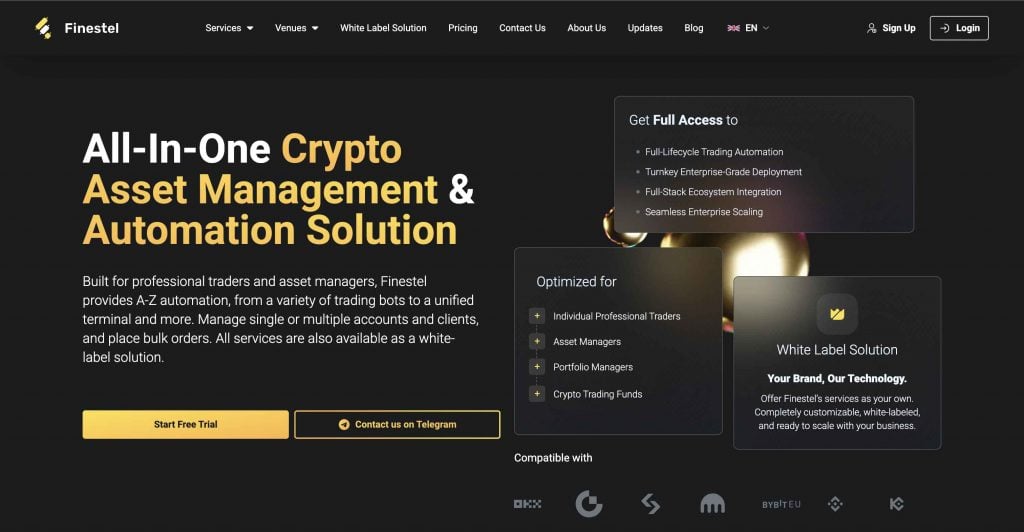
What Finestel actually is: Finestel is an All-In-One crypto asset management & automation solution. Its two main products are an automation suite containing a copy trading bot, signal bot, TradingView bot, advanced trading terminal, advanced trade executions including TWAP and DCA bot, and the white-label solution (for businesses wanting to launch their own branded automated trading platform). It integrates with Binance, Bybit, KuCoin, OKX, Kraken, Gate, Bitget, HyperLiquid crypto bot, etc.
Screenshot
Where Gunbot has the edge:
- Self-hosted and private. No third-party server ever sees your API keys or trade data.
- One-time cost. Gunbot’s $199–$499 lifetime license competes well over time against Finestel’s recurring subscription model for comparable use cases.
Where Finestel has the edge:
- Multi-account copy execution at scale. Managing unlimited client accounts simultaneously and replicating trades proportionally across them. Gunbot has a copy trading feature, but it isn’t Finestel’s level of depth for this use case.
- White-label infrastructure. Finestel lets asset managers and businesses launch a fully branded copy trading platform, with automated billing, client dashboards, and performance reporting, without building anything from scratch. Gunbot has no equivalent offering.
- Client management tools. Finestel bundles billing systems, performance analytics, and client-facing dashboards. These are irrelevant for solo traders, but essential for anyone managing outside capital.
- TradingView bots, signal bots, a Telegram bot, and an advanced trading terminal are all integrated natively, creating a workflow layer that Gunbot doesn’t replicate at the same business-management level.
Honest limitations of each: Finestel’s exchange coverage is narrower than Gunbot’s. Gunbot, on the other hand, requires real technical commitment. If you don’t want to manage a server, configure parameters from documentation, and actively monitor performance, you’ll get less value from it than from a cloud-based alternative.
Gunbot vs. Bitsgap
Bitsgap at a glance: Cloud-based bot platform focused on grid and DCA automation. Supports 17+ exchanges. Pricing starts at $23/month (Basic) with higher tiers up to approximately $110/month. Notable for its Combo Bot (combining grid and DCA logic for futures trading), visual bot configuration, 365-day backtesting on higher tiers, and an arbitrage scanner across connected exchanges.

Where Gunbot has the edge:
- Self-hosted privacy, same as above.
- Far wider exchange coverage. Bitsgap’s 17+ is functional but Gunbot’s 100+ leaves it behind.
- DEX support. Bitsgap does not trade on decentralized exchanges.
- Programmable custom strategies. Bitsgap is primarily a configuration-based platform, you adjust parameters within a defined framework. Gunbot lets you write your own logic from scratch.
- Long-term cost. Again, a one-time license vs. ongoing monthly fees.
Where Bitsgap has the edge:
- Interface quality. Multiple reviewers cite Bitsgap’s dashboard as one of the cleanest and most intuitive in the market, while Gunbot’s UI is consistently described as dated.
- The Combo Bot. Bitsgap’s futures-specific bot combining grid and DCA is a polished, purpose-built tool that many traders find more refined than Gunbot’s equivalent setup.
- Setup speed. Bitsgap can be configured and running in under an hour with no technical background required.
- Demo mode. A paper trading environment is available to test bots before going live.
- Arbitrage scanning. Bitsgap actively monitors price discrepancies across all 17+ connected exchanges in real time — a specific feature Gunbot doesn’t replicate cleanly.
Verdict: Bitsgap is the better choice for traders who want grid and futures automation in a polished cloud environment with minimal setup. Gunbot wins on cost over time, privacy, and the depth of customization available to technical users.
Gunbot vs. Pionex
Pionex at a glance: Pionex is not a third-party bot platform, it’s an exchange with 16 built-in trading bots included at no extra cost. Users pay only Pionex’s 0.05% spot trading fee. The built-in bots cover grid trading, DCA, infinity grid, arbitrage, leveraged grid, rebalancing, and more. Because the bots are exchange-native, there’s no API configuration required.

Where Gunbot has the edge:
- You’re not locked into one exchange. Gunbot connects to 100+ exchanges; Pionex only works within Pionex’s own platform.
- DEX support. Pionex is entirely CEX-based.
- Strategy depth. Gunbot’s customization options, indicators, parameters, custom code, and TradingView integration, are orders of magnitude deeper than Pionex’s fixed bot templates.
- You hold your assets where you choose. Depositing on Pionex means your funds are held by Pionex. If the exchange has liquidity issues, you’re exposed.
Where Pionex has the edge:
- Cost. The 0.05% trading fee with no subscription fee is the most cost-efficient structure available for simple bot strategies. Gunbot’s $199–$499 upfront cost, plus the cost of a VPS to run it, requires meaningful volume before it becomes efficient.
- Zero friction. No API keys, no installation, no server. You open an account and pick a bot. This is as simple as bot trading gets.
- Beginner suitability. Pionex is the most accessible entry point in the automated crypto trading space for new users.
- Mobile access. The Pionex mobile app provides full bot management from a phone.
The real concern with Pionex is that its model requires you to hold your assets on the Pionex exchange; it doesn’t connect to external accounts. This introduces exchange custody risk that simply doesn’t exist when using Gunbot on Binance or Kraken directly. For small amounts and simple strategies, this may be acceptable. For larger portfolios, it’s a meaningful structural difference.
Verdict: Pionex is the right starting point for new traders who want to experience grid or DCA automation with minimal cost and zero technical setup. It is not a substitute for Gunbot for traders who need cross-exchange capability, deeper strategy control, or the ability to keep funds on their own exchange accounts.
Conclusion
Gunbot is a legitimate, mature, and capable platform for a specific type of user. It isn’t a good fit for most crypto traders in 2026, the cloud alternatives are simply faster to set up, easier to use, and don’t require server management. But for the trader who values control, privacy, and long-term cost efficiency over convenience, and who has the technical background to use it properly, Gunbot remains the strongest self-hosted option on the market.



Leave a Reply