

API trading connects trading software to a broker or exchange so it can retrieve market data, submit orders, and monitor account activity. You can use it to build automated strategies, connect ready-made trading tools, and coordinate activity across accounts.
API trading is used across cryptocurrency, stock, and forex markets. However, platforms serve different purposes: some provide direct brokerage APIs for developers, while others offer software that connects to existing exchange accounts.
In this guide, I will explain how API trading works, its benefits and limitations, and how Finestel, Alpaca, OANDA, Saxo Bank, and FXCM differ as top platforms.
Understanding the Basics of API Trading
API, or Application Programming Interface, is a set of protocols, tools, and standards that enable different software applications to communicate with each other. In the context of cryptocurrency trading, an API acts as a bridge between a trader’s automated trading system and the exchange’s trading engine, allowing for seamless data exchange and trade execution.
Through API trading, traders can access a wide range of functionalities, including retrieving real-time market data, placing orders, checking account balances, managing portfolios, and monitoring trade execution.
The API provides the connection. A trader, algorithm, or connected application determines what to trade and when. API trading can therefore support both fully automated strategies and tools that execute instructions entered manually.
How Does API Trading Work?
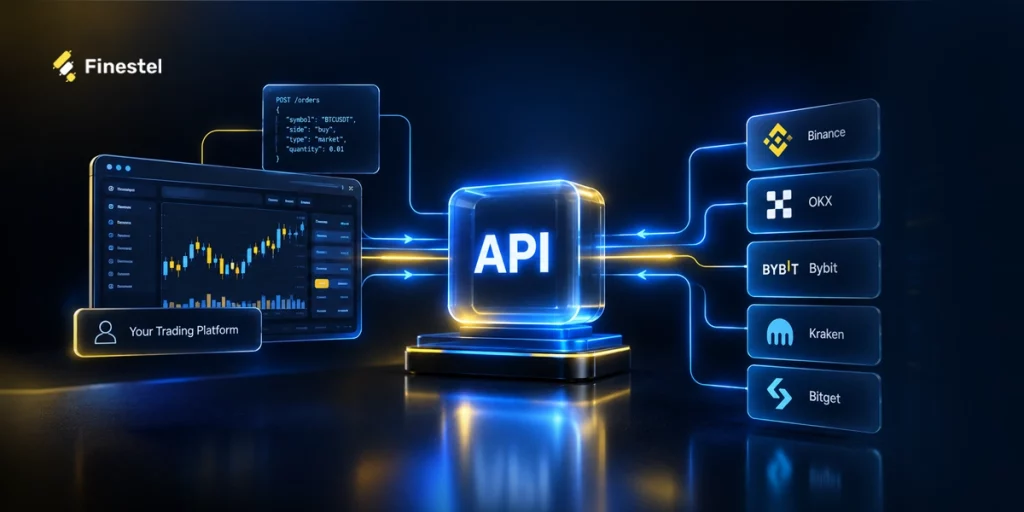
A typical API trading workflow has five stages:
- Connect and authenticate: The application uses the trade’s supported authentication method, such as API credentials or an access token.
- Retrieve information: It receives prices, balances, positions, or order updates.
- Apply trading rules: A strategy or user instruction determines the action, subject to position and risk limits.
- Submit an order: The application sends the order to the broker or exchange.
- Monitor the outcome: It checks whether the order was rejected, remains open, or was partially or fully filled.
Many providers use REST APIs for individual requests and streaming connections for ongoing updates. Available interfaces vary by platform.
These technologies are related, but they are not interchangeable. A trading API is the broader connection through which software accesses trading functions; REST is one method for sending individual requests, webhooks push event-driven updates or signals, and MCP provides a standardized way for AI agents to interact with external tools and data. Read our detailed comparison of MCP, webhooks, trading APIs, REST, and WebSockets to understand which one fits each trading workflow.
For example, a crypto trading application could monitor a moving-average crossover, check the permitted position size, and submit an order. It must then verify the order’s status; submitting a request does not guarantee a completed trade.
The Benefits of API Trading in Crypto
- Faster responses: Automation can reduce manual delays. Actual execution depends on connectivity, platform limits, liquidity, and market conditions.
- Less repetitive work: Software can automate data collection, order submission, and account monitoring.
- Reduced errors: Automated trading systems powered by APIs are less prone to human errors, such as typos or delayed order placement, which can have significant consequences in the volatile cryptocurrency market.
- Support for strategy testing: Historical data can support backtesting when combined with suitable testing software and realistic assumptions.
- Scalability: API trading platforms can handle a large number of trades and market data, making them suitable for both individual traders and institutional investors.
- Customization: API trading provides a high degree of customization, allowing traders to integrate their own trading algorithms, indicators, and risk management strategies into their automated trading systems.
Best API Trading Strategies, Indicators, and Evaluation Methods

APIs can support many trading approaches, but the connection itself does not make a strategy profitable. Here, I will introduce you to common examples of strategies, indicators, and evaluation methods that can be used with API trading.
Common Strategies
- Copy Trading: Copy trading platforms assist traders looking to automate their trading strategies and replicate the trades of successful traders. By following best practices and integrating APIs into their trading strategies, traders can harness the full potential of this strategy while minimizing risks and ensuring a safer trading environment.
- Arbitrage: This strategy takes advantage of price disparities across two or more markets for the same asset. It involves buying an asset in one market and selling it in another market at a higher price to make a profit.
- Market Making: This strategy involves buying and selling assets at different prices to profit from the spread between the buy and sell prices. It requires a deep understanding of the market dynamics and the ability to execute trades quickly and efficiently.
- High-Frequency Trading: HFT trading uses advanced technologies like machine learning and AI to execute trades at hyperkinetic speeds. It requires a high-speed internet connection and the ability to process large amounts of data quickly.
- Portfolio rebalancing: This strategy involves managing a portfolio of assets to maximize returns and minimize risks. It requires a deep understanding of the market dynamics and the ability to develop and implement complex algorithms. Read more about the best crypto portfolio trackers.
- Trend-following strategies: This strategy uses rules such as moving-average crossovers to identify potential entries and exits.
- Mean-reversion strategies: With this strategy, you can trade on the expectation that a price deviation may reverse. Indicators such as RSI can form part of the rules.
These strategies can be implemented using automated trading bots that use APIs to communicate with the cryptocurrency exchanges. The bots can analyze market data, execute trades, and manage portfolios automatically, allowing traders to focus on other aspects of their business.
Common Indicators and Inputs
Indicators such as RSI, MACD, and Fibonacci retracement levels are inputs to a strategy. Each approach still needs entry and exit rules, position sizing, and execution controls:
- Moving Average Trading: This strategy uses the Simple Moving Average (SMA) or the Exponential Moving Average (EMA) to analyze the price data and generate trading signals. It is a popular strategy that can be customized to suit long-term and short-term investors.
- Relative Strength Index (RSI): This momentum indicator determines the speed and magnitude of an asset’s recent price changes. It also reveals the bearish and bullish price momentum of the specific asset, which can be used to make informed trading decisions.
- MACD Trading: The Moving Average Convergence Divergence (MACD) is a trend-following momentum indicator that shows the relationship between two moving averages of a security’s price. It can be used to identify potential buy and sell signals.
- Fibonacci Retracement Strategy: This strategy uses the Fibonacci retracement levels to identify potential support and resistance levels. It can be used to make informed trading decisions based on the price movements of the asset.
Common Evaluation Methods
- Backtesting: Backtesting involves testing a trading strategy on historical data to evaluate its performance. It requires a deep understanding of the market dynamics and the ability to develop and implement complex algorithms.
- Paper Trading: Paper trading tests a strategy’s operation using simulated trades.
Best API Trading Platforms Compared
This section provides an overview and detailed analysis of the top five API trading platforms, including Finestel, Alpaca Trading, Oanda, Saxo Bank, and FXCM.
Before proceeding, I should mention that these five providers serve different trading needs. This comparison focuses on their capabilities and intended workflows, rather than ranking execution performance.
The table below shows a quick comparison between these 5 platforms:
| Platform | Main Features | Connection or interface | Best for | API trading costs / Pricing |
| Finestel | Crypto trade copying software.
Signal automation through its Signal Bot and TradingView bot. Manual trading with its Trading Terminal. Manual trading across multiple exchanges and accounts with its Trading Terminal. White-label solution for asset managers seeking to offer their own brand to their clients. Advanced execution strategies including DCA, TWAP, Grid, and Scale across all products. Portfolio management and reporting for personal and clients’ accounts. Multi-asset, multi-account, multi-exchange trading and order management. |
API connections to 8+ crypto exchanges | Solo Professional traders
Asset managers Portfolio Trackers Trading desks and teams |
Starter free plan with multiple Hyperliquid accounts + 1 CEX account, signal bot, TradingView bot, trading terminal & Portfolio tracker
Subscription plans: No additional API trading costs. |
| Alpaca | Programmatic trading in US stocks, ETFs, options, and crypto, subject to eligibility.
Real-time and historical market data. Order, position, and account management. Paper trading for testing strategies with simulated funds. |
Trading API and market data services through REST and WebSocket connections | Algorithmic traders
Developers building custom trading applications Traders testing automated strategies |
Free paper trading.
Market data plans: Commission-free eligible securities trades; crypto trading fees and other applicable charges are separate. |
| OANDA | Automated order placement, modification, and cancellation.
Live pricing and historical market data. Account, position, and transaction monitoring. Demo accounts for testing integrations. Requires an eligible OANDA v20 account. |
v20 REST API with pricing and transaction streams | Forex algorithmic traders
Developers building custom trading systems Traders automating eligible OANDA accounts |
Free demo account.
Live trading costs depend on the regional entity and account pricing model: spread-only or core spreads plus commission where available. Financing and other applicable account charges may apply. |
| Saxo Bank | Multi-asset trading and order management.
Streaming quotes and account updates. Portfolio monitoring, including balances, positions, and open orders. Historical chart and instrument data. Simulation environment for application testing. |
OpenAPI with REST and WebSocket streaming | Multi-asset traders
Developers building custom trading interfaces Portfolio managers building account monitoring tools |
Trading commissions and spreads vary by instrument, account tier, and region.
Some market data requires paid subscriptions or separate licensing. Additional account and financing charges may apply. |
| FXCM | Automated forex and CFD trading, subject to regional availability.
Streaming prices and historical market data. Order execution and position management. Account reports through ForexConnect. Multiple interfaces for custom trading integrations. |
FIX, Java, and ForexConnect | Forex and CFD algorithmic traders
Developers building custom execution systems Trading teams requiring FIX connectivity |
Free API access.
Trading spreads, applicable commissions, and financing charges are separate. FIX requires a minimum Trading Station account balance: $5,000 for FXCM Markets or €5,000 for FXCM EU. |
Finestel
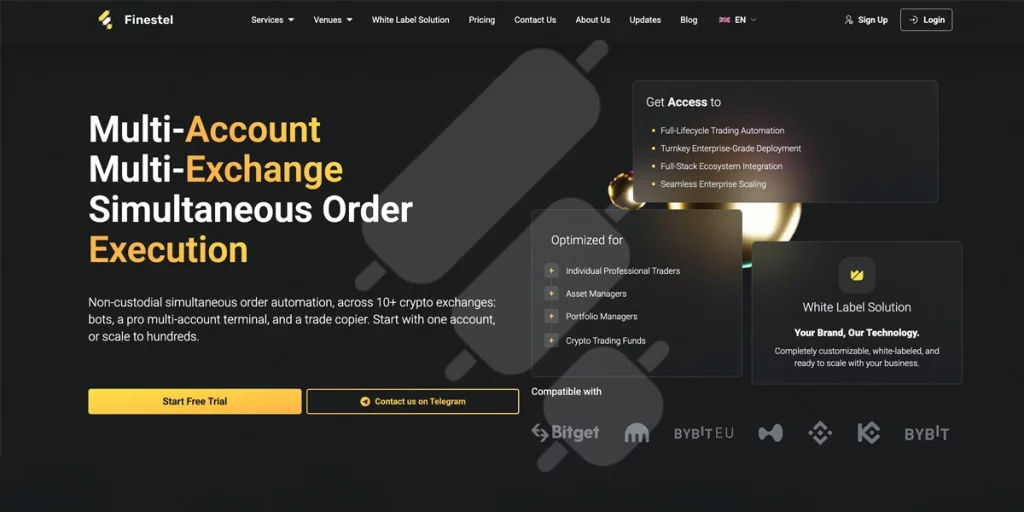
Finestel is a leading API trading platform for multi-account, multi-exchange simultaneous order execution. It offers a cutting-edge trade copier solution that lets solo professional traders and asset managers replicate trades across their personal and clients’ accounts.

The White-Label solution has also allowed me to offer my services under my own brand and website, with a fully customizable interface and features.
The additional services like portfolio trackers, signal bot, TradingView bot, trading terminal, and performance analytics have also been helpful in managing my clients’ investments.
Alpaca
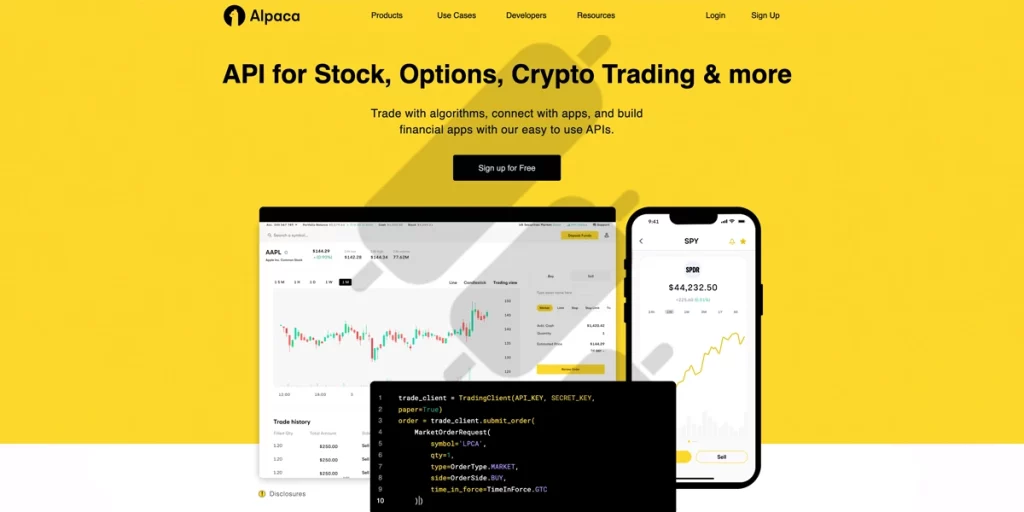
Alpaca is a top-rated API trading platform that supports programmatic trading in stocks, ETFs, options, and crypto, subject to eligibility and product permissions. Its paper trading environment lets developers test applications using simulated funds. The platform is also known for its user-friendly interface and strong security measures.
Commission-free trading applies to qualifying securities trading arrangements; crypto trading carries fees, and other charges may apply. Market data coverage also depends on the subscription: the Basic plan has more limited real-time coverage than paid access.
As a user of Alpaca Trading, I have found the platform to be a game-changer for my trading strategy. The API is easy to use and provides real-time market data, which has helped me make more informed trading decisions. The platform’s security measures also give me peace of mind, knowing that my account and personal information are safe.
Oanda

Oanda is a leading API trading platform that offers access to Forex, crypto CFDs, shares, and commodities markets. OANDA’s v20 REST API supports pricing data, historical data, order management, and account information for compatible v20 trading accounts. The platform is also known for its low spreads, fast execution speeds, and strong security measures.
As a user of Oanda, I have been impressed with the platform’s ability to provide real-time market data and execute trades quickly. The API is easy to use and has helped me automate my trading strategy, saving me time and effort. The platform’s low spreads and strong security measures also give me confidence in my trades.
Saxo Bank

Saxo Bank is a top-tier API trading platform that offers access to a wide range of financial markets, including Forex, stocks, ETFs, mutual funds, Bonds, Options, CFDs, and Futures.
Saxo Bank’s OpenAPI supports trading and portfolio applications through REST requests and WebSocket streaming. Developers can work with account information, orders, positions, and available market data.
Saxo provides separate simulation and live environments. Moving to live trading requires the appropriate application access, and market data restrictions apply.
As a user of Saxo Bank, I have been impressed with the platform’s ability to provide real-time market data and execute trades quickly. The API is powerful and has helped me automate my trading strategy, giving me an edge in the market. The platform’s strong security measures and high-quality customer service also give me peace of mind and confidence in my trades.
FXCM
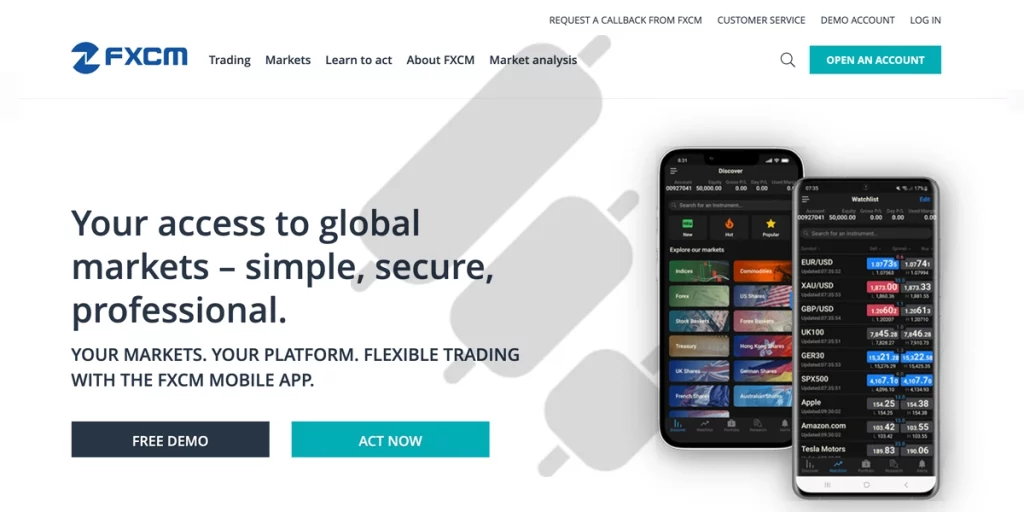
FXCM is a well-established API trading platform that offers access to Forex, stock CFDs, indices, raw materials, and Cryptocurrencies. FXCM’s current API offering includes FIX, Java, and ForexConnect. These interfaces support different development requirements, so traders should select an API based on their application and account eligibility.
ForexConnect provides functions such as order management, streaming prices, and historical data. FIX has separate access requirements; the FXCM Markets page currently specifies a Trading Station account with a minimum balance of $5,000.
As a user of FXCM, I have been impressed with the platform’s ability to provide real-time market data and execute trades quickly. The API is easy to use and has helped me automate my trading strategy, saving me time and effort. The platform’s low spreads and strong security measures also give me confidence in my trades.
How to Choose an API Trading Platform
Start with your intended market and workflow. Determine whether you need a direct broker API for custom development or ready-made software that connects to existing accounts.
Then compare supported instruments, regional eligibility, documentation, testing environments, data coverage, order types, request limits, and total costs. Include trading fees, spreads, data subscriptions, and software charges where applicable.
Read our full guide on KuCoin API key.
API Trading Risks and Security
API trading introduces both account-access risks and operational risks. To safeguard against unwanted risks, I recommend taking these actions:
- To avoid any important information leakage, grant an application only the permissions it needs. A portfolio tracker may require read-only access, while a trading application needs appropriate trading permissions. A trading bot should not need withdrawal access. Where supported, restrict credentials to trusted IP addresses, store secrets securely, and revoke credentials that may have been exposed.
- Operational problems also require safeguards. Connections can fail, prices can become stale, and orders may be rejected or partially filled. If a request times out, verify its status before resubmitting it; an uncertain response does not necessarily mean the original order failed.
- Use order-size limits, position limits, alerts, and a way to stop new orders when the system behaves unexpectedly.
Read more about how to safeguard your Bybit API key in our blog.
How to Get Started With API Trading

- Define the workflow: Decide whether you need market data, automated execution, copy trading, or portfolio monitoring.
- Check compatibility: Confirm regional eligibility, supported instruments, API access, and total costs.
- Choose the implementation: Build an application or use compatible ready-made software.
- Configure access: Apply the minimum required permissions and protect the credentials.
- Test the strategy and integration: Use historical testing and a paper, demo, or test environment where available. Test rejected orders, disconnections, and position limits as well as normal operation.
- Introduce live trading cautiously: Use limited exposure and compare actual orders, fills, and balances with the application’s records.
If you want to get started with Binance, we have prepared a guide to Binance API key in our blog.
Final Thoughts
API trading connects trading decisions and software tools to brokerage or exchange accounts. It can reduce repetitive work and support more consistent execution, but successful operation still depends on sound rules, reliable integration, and ongoing monitoring.
Choose a platform according to the market you trade, the accounts you use, and the workflow you want to automate. Compare access requirements, testing tools, data coverage, and total costs before moving to live trading.
FAQs
Does stopping a trading bot cancel its open orders?
Not necessarily. Stopping a bot does not automatically cancel orders already accepted by the broker or exchange, or close existing positions. The outcome depends on the platform’s shutdown settings and each order’s expiration rules. Check open orders and positions directly after stopping automation.
Can I trade manually while an API bot is running?
Usually, yes, but manual trades can change the balances and positions the bot relies on. Depending on its design, the bot may offset your changes or continue trading with outdated assumptions. Check how it handles manual activity, or use a separate account or subaccount where supported.
Can I use the same trading bot on different exchanges?
Only if the bot supports each exchange’s API. Exchanges can use different authentication methods, symbol formats, order types, and minimum trade sizes. Even with a compatible bot, you need to configure and test each connection separately.



Leave a Reply